






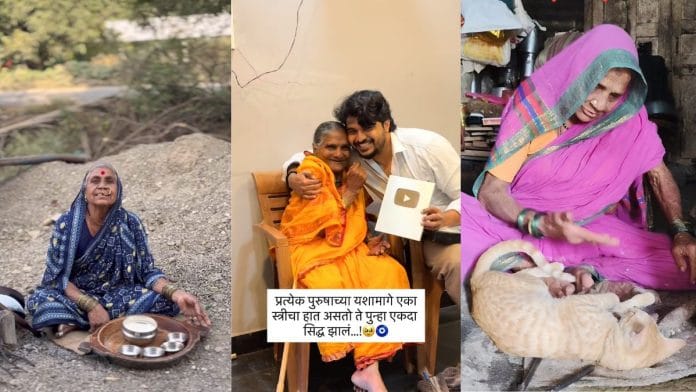



My Instagram feed likes to give me a break from brainrot and sea lions from time to time. And it has found the perfect genre of videos: Marathi grandmothers. They’re all nine-yard saris, huge nose rings, and gummy smiles. Sometimes they say something semi-feminist, and you’re pleasantly surprised. You don’t see that very often, you say to yourself, hitting the like button.
In this week’s viral spiral, we’re looking at the social media microverse that is Marathi grandmothers. And unlike other niches, this one’s not a monolith. Every grandma has her own brand. One can be found cooking anything from gulab jamun to wheat biscuits on a chulha in the middle of a farm. Another has a puppy called Shital and a cat called Ravanrao, whom she loves with all her heart. A third one specialises in roasting her husband.
Now, if you’re a six-yard-sari-wearing, educated urban grandmother, you’ll find viewers, of course, but it’ll be limited to the population of Pune’s Koregaon Park. The majority wants their grandmothers to be rustic. And they must play the sweet, smiling, “bholi ajji (innocent grandma)”. Where else will a connection-starved generation get its daily fix of roots?
Also read: How the BMC elections killed AI Hulk
The new market
It’s tempting to think that these laddu-making, proverb-saying grandmas are a breath of authenticity in a platform riddled with trend-hopping influencers. No such luck, though. Open a random grandma page, and more often than not, you’ll find that the creator started with beauty or cooking videos.
Akshay Mane’s very first grandma video in November 2025 took off unlike any other post on his profile, and he hasn’t looked back since. The handle @bindass_aaji used to be @crippling_beauty until 28 December. I don’t blame these creators, either. Who knows, the desire for clicks probably makes for fewer lonely grandparents.
A new channel, ‘Majhi Khatyal Ajji’ (my mischievous grandma), posted its first reel on Wednesday. Clearly, the market remains lucrative.
And the comments are always gushing with love. Most call the creators fortunate for having a grandmother. Many miss their own. “The last generation with such love in their hearts,” is the familiar refrain.
But there’s more to it. “The last generation to wear kashta (nine-yard sari)” or “The last generation that preserves culture” pop up from time to time. By the time it gets to “This generation won’t come back again,” (duh) I’m forced to ask: Is it that deep, though?
The padar or pallu has a special place in these videos. “All that work and still she didn’t let her padar fall from her head,” the commenters write in awe. “The last generation to cover their head with a padar,” some buffoon will write.
And where is the grandfather in this ecosystem? If he appears at all, it’s as an accessory to grandma. We can’t give him a spotlight and spoil the fun, after all. It’s soft patriarchy vibes only.
Views are personal.
(Edited by Theres Sudeep)