









It always begins quietly. A file moves. A permission is reviewed. An “administrative” decision is taken. But behind some decisions lies a deeper question that should unsettle us all: when institutions meant to heal, teach, and uplift are dragged into identity battles, what remains sacred? If hospitals become communal, will the emergency ward form ask for the patient’s and doctor’s religion? Will merit need a surname? Will survival require a certificate of belonging?
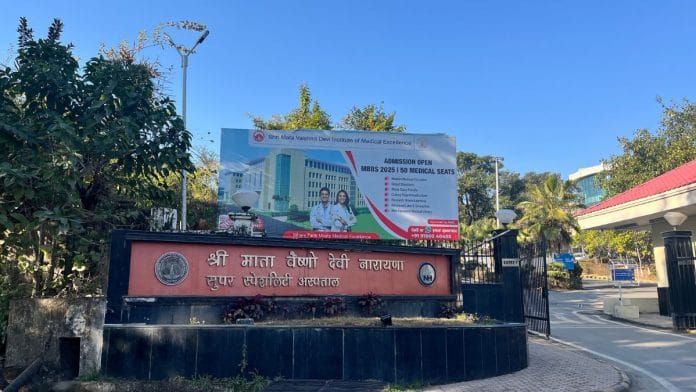
The suspension of the MBBS course at the Shri Mata Vaishno Devi Institute of Medical Sciences is not a routine regulation. It is a warning signal. A functioning medical college in Jammu has been destabilised, students pushed into uncertainty, and a region weakened not by lack of infrastructure or faculty, but by sustained political pressure. When education becomes expendable, the future becomes negotiable.
The decision by the National Medical Commission to revoke the course followed prolonged agitation created by the Bharatiya Janata Party (BJP), which repeatedly objected to Muslim students studying at the institute. This was never about compliance or capacity. It was about identity. Merit was placed on trial. Equality was treated with suspicion. An institution was punished not for failure, but for reflecting constitutional inclusion. Since when did diversity become a disqualification?
For the people of Jammu, this episode exposes an uncomfortable truth. BJP has long projected itself as the guardian of the region. In 2015, when the All India Institute of Medical Sciences (AIIMS) was announced only for Kashmir, Jammu protested, demanding parity. That movement was rooted in fairness, not exclusion. BJP amplified that anger and converted it into political capital. A decade later, the same party has actively contributed to Jammu losing a working medical college. What kind of guardians preside over loss? What kind of leadership celebrates deprivation?
Forty-two Muslim students earned admission at the Shri Mata Vaishno Devi Institute of Medical Sciences purely on merit. No rule was bent. No process compromised. Their success should have strengthened faith in the system. Instead, it was weaponised. Rather than defending merit, belonging was questioned. Rather than protecting the institution, it was destabilised. This is how communal politics operates when it seeks legitimacy: it does not openly oppose education; it makes education fragile. And fragility is easier to exploit than excellence.
The fallout spares no one. Hindu, Muslim, and Sikh students all now face uncertainty. Families that invested savings are left anxious. Jammu already struggles with limited professional avenues and relentless youth migration. A medical college is not just a campus; it is healthcare access, employment, research, and regional dignity. Removing it pushes Jammu further away from opportunity and closer to dependency. Is this empowerment, or quiet sabotage?
Also read: Why Jammu’s Vaishno Devi medical college is state-of-the-art but empty today
Students aren’t collateral
The constitutional implications are grave. Article 14 guarantees equality before the law. Article 15 forbids discrimination. Article 21A recognises education as a right. When political mobilisation targets an institution because of the religious identity of its students, these guarantees are reduced to decorative text. A Constitution survives not only in courtrooms but in classrooms.
Karl Marx warned that power preserves itself by shaping material conditions. Education produces consciousness, and conscious youth resist manipulation. By weakening institutions and shrinking opportunities, insecurity is manufactured and fear becomes a tool. What is happening in Jammu is not an administrative failure; it is a political strategy. An educated society asks questions. A deprived one is told what to fear.
In this manufactured crisis, responsibility came from the elected government. The Jammu & Kashmir National Conference responded with restraint. Chief Minister Omar Abdullah assured that affected students would be adjusted elsewhere. That response affirmed a basic principle: students are not collateral in political contests.
Jammu deserves institutions and opportunities, not agitation. A party that claims to speak for Jammu while weakening its educational foundations cannot claim to represent its youth. Because an educated Jammu would question this injustice. And that is precisely why its institutions are being weakened, so questions never rise, only slogans do.
Adv Shriya Handoo is a research head and additional spokesperson for Jammu & Kashmir National Conference (JKNC). She tweets @iamshriyahandoo. Views are personal.
(Edited by Ratan Priya)
This National Conference spokesperson serves up a politically seasoned curry of constitutional melodrama, where 42 students become “pawns” in a rhetorical chess game.
Marx would be amused – not by the revolution, but by how smoothly political narratives can transform educational institutions into ideological battlegrounds.
When Shaheen Bagh blocked streets and economic arteries, it was ‘democratic protest’.
When Hindu concerns emerge about an institution funded by their donations, suddenly it’s ‘communal politics’. The irony is so thick, you could spread it on toast – constitutional rights for me, but not for thee. Jammu loses a medical college, and we get a lecture on equality wrapped in partisan packaging. Because nothing says ‘social justice’ quite like an empty campus and migrating youth. Bravo!