






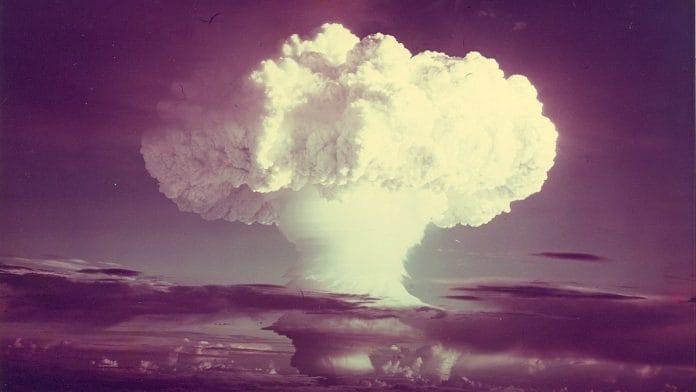



On 5 February, the US-Russia nuclear pact known as New START expired. There are now no treaties requiring the two countries to pursue further reductions in their nuclear arsenals.
This comes just months after US President Donald Trump announced that America would resume nuclear testing after 33 years, a move that could provoke other major nuclear-armed countries to follow suit and accelerate a new arms race.
In this backdrop, it is worth recalling how the nuclear order evolved and how that framework has since eroded.
The nuclear fission theory that an atomic nucleus could split into smaller parts and release massive energy led to the world’s first nuclear weapons explosion on 16 July 1945 in Los Alamos, New Mexico, as part of the Manhattan Project.
Just three weeks after this test, atomic bombs were dropped on Hiroshima on 6 August and on Nagasaki on 9 August, killing about 200,000 people. Japan surrendered and accepted the terms of the Potsdam Ultimatum. The Second World War ended, but the destruction revealed the astounding power of a new class of weapons and signalled the beginning of a nuclear arms race.
The Cold War that followed witnessed the most alarming nuclear arms race between the United States and the Soviet Union. Over the decades, the two sides signed various arms control agreements to manage their rivalry and limit the risk of nuclear war.
However, deep fissures have re-emerged in the US-Russia relationship in recent years, leading to the expiration of the last bilateral nuclear arms control treaty, and raising once again the spectre of a nuclear arms race.
Also Read: Don’t celebrate India-US deal yet. It’s a work in progress & Trump can back out any time
The long road to regulating nuclear tests
After the use of nuclear weapons in Hiroshima and Nagasaki, there was general concern across the world, especially in developed countries, on issues related to harnessing nuclear power in a more controlled manner for electricity generation and other peaceful purposes.
But opinion on the use of nuclear devices was divided, especially among scientists working on developing Peaceful Nuclear Explosions (PNE) programmes. Both the US and (then) USSR conducted several tests under PNE programmes.
Considering the expertise the US had developed, the USSR even approached it for technology exchanges. This led to negotiations on the Threshold Test Ban Treaty (TTBT), signed in July 1974, which set limits on underground nuclear tests.
Meanwhile, in May 1974, India successfully conducted its first PNE test in Pokhran, codenamed “Smiling Buddha”.
Two years on, in accordance with the TTBT, the US and the USSR signed the PNE Treaty on 28 May 1976, limiting the parameters of such tests. The treaty entered into effect on 11 December 1990 after prolonged ratification delays, and was initially valid for five years. Since then, neither party has conducted a PNE.
Peaceful nuclear explosions were also addressed under Nuclear Non-Proliferation Treaty (NPT), to which most countries signed on — though India chose not to. Article V of the NPT allows for PNEs. However, at the 2000 NPT Review Conference, member countries agreed that Article V was to be interpreted in light of the Comprehensive Nuclear Test Ban Treaty (CTBT), once it enters into force. Although the CTBT was signed in 1996, it has not yet entered into force.
START and stop?
One of the earliest efforts to harness nuclear explosions for peaceful purposes was the US Plowshare Programme, set up in mid-1957 by the former US Atomic Energy Commission (AEC). Later that year, the AEC carried out the first underground nuclear explosion at the Nevada Test Site — the Rainier event — of 1.7 kiloton. The results validated theoretical concepts and gave impetus to Plowshare. In total, 27 PNE tests, consisting of 35 separate blasts, were conducted between December 1961 and May 1973 in the US as part of the programme.
A plowshare (or ploughshare), a sharp sword-like tool used to plough fields, was invoked in this context to symbolise creative tools that benefit humankind, as opposed to destructive tools of war. The Biblical reference states: “And he shall judge among the nations, and shall rebuke many people: and they shall beat their swords into plowshares, and their spears into pruning hooks: nation shall not lift up sword against nation, neither shall they learn war any more” (Isaiah 2:4).
The USSR, too, had its own parallel programme, ‘Nuclear Explosions for the National Economy’, in this era, where it conducted its own series of tests.
During the Cold War, the US and the Soviet Union, worried about the consequences of Mutually Assured Destruction (MAD) in the event of a direct conflict, agreed to negotiate even as deterrence underpinned their vertical proliferation of nuclear weapons.
The spectre of MAD compelled them to conclude a series of treaties and agreements such as the Strategic Arms Limitation Treaty (SALT I and II), the Anti-Ballistic Missile (ABM) Treaty, the Intermediate-Range Nuclear Forces (INF) Treaty, the Strategic Arms Reduction Treaty (START I), the Strategic Offensive Reductions Treaty (SORT), the Cooperative Threat Reduction (CTR) Programme (Nunn-Lugar Programme), and the New START Treaty—which just expired and left a major vacuum. While Moscow has signalled it will continue to observe New START limits if Washington does the same, there is no binding framework in place.
According to a report last year by the Stockholm International Peace Research Institute, Russia had 5,459 nuclear warheads, and the US about 5,177. China came as a distant third with at least 600.
Also Read: A secret nuclear test by China? It’s a Hollywood-style conspiracy, Chinese say
The doomsday clock is ticking
Last October, Trump made a startling announcement aboard Air Force One: “We’ve halted [testing] many years ago, but with others doing testing I think it’s appropriate to do so.”
Since 1945, there have been 2,056 nuclear test explosions worldwide, 1,030 of them conducted by the United States. Former US President Bill Clinton halted US testing in 1992 at the end of the Cold War. The Soviet Union conducted its last test in 1990 and China in 1996.
Just this week, China rejected US claims that it conducted a nuclear test in 2020, calling the accusation “an excuse” to justify a potential American return to testing.
“The United States has persistently distorted and smeared China’s nuclear policy,” foreign ministry spokesperson Lin Jian said. Denials apart, there has been speculation among analysts that China could be conducting “de-coupled” tests to advance warhead development for delivery systems such as hypersonic missiles, possibly to counter US missile defences, especially around Taiwan.
Amid ongoing conflicts, especially involving nuclear-armed states, the global security environment is becoming more unstable. Unfortunately, the UN can’t do much — its inability to prevent the outbreak of a nuclear war is mainly due to the veto power of the Nuclear Five, the P5, as well as its limited authority and enforcement power.
As of 27 January 2026, the Bulletin of the Atomic Scientists has set the Doomsday Clock, a symbolic timepiece maintained since 1947, to 85 seconds to midnight — the closest it has ever been to global catastrophe. This record-setting move reflects heightened nuclear tensions, artificial intelligence risks, and inadequate climate action. The Bulletin’s Science and Security Board, which sets the clock, called for urgent action to limit nuclear arsenals, create international guidelines on the use of AI, and pursue multilateral agreements to address global biological threats.
The world, shaken and stirred, needs a new START.
Seshadri Chari is the former editor of ‘Organiser’. He tweets @seshadrichari. Views are personal.
(Edited by Asavari Singh)