






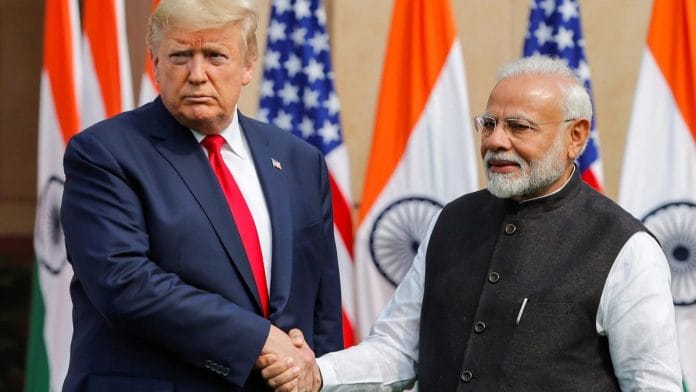



The joint US-India statement on trade has now been formally unveiled, and deserves to be read for what it is: an interim agreement. It’s a preparatory step toward a much more comprehensive Bilateral Trade Agreement. Such arrangements are not unusual in large, politically sensitive negotiations. They allow both sides to bank early gains, signal intent to markets and partners, and create momentum without confronting every contentious detail at the outset.
Yet, as with all such frameworks, the true story does not lie only in the list of concessions but in the language chosen to describe them. It is at the level of terminology that the agreement becomes potentially controversial.
Trade agreements are drafted in a global, technical, and deliberately sanitised vocabulary. They rarely speak the language of domestic politics or everyday commerce. Broad, internationally accepted terms reduce friction at the negotiating table, but they also compress a wide range of products into deceptively neutral phrases. What sounds modest in a joint statement can translate into substantial market access once schedules and annexes are finalised.
For India, where agriculture, food, and consumer products are deeply political, this gap between trade lexicon and popular understanding can become a flashpoint.
Tree nuts and sorghum
Take the term ‘tree nuts’ prominently mentioned in the framework. In Indian usage, there is no equivalent expression in common economic or political debate. We speak of almonds, walnuts, pistachios, cashews—often collectively as dry fruits. But ‘tree nuts’ is a classic trade-category umbrella. It efficiently covers all these items and potentially more without naming any one.
For instance, almonds—one of the most politically sensitive imports in India—sit comfortably within this category. So do walnuts and pistachios. By using a single, clinical term, the agreement avoids drawing attention to individual products that have previously attracted lobbying and protest. The language is accurate, but it is also strategic.
The framework also refers to ‘red sorghum for animal feed’. Here, the challenge is not concealment but translation—between global agricultural science and Indian farming discourse. In Indian parlance, sorghum is jowar. Bajra, often mentioned alongside jowar in political debates, is pearl millet and is botanically distinct. Trade texts are precise on such distinctions; public debates rarely are.
To an Indian farmer, the fear may rest on the future trajectory: if jowar is opened up under a feed-grain category today, will other millets face pressure tomorrow? The concern may not always be scientifically sound, but it is a political reality. Once again, the neutral language of trade risks colliding with the emotional language of livelihood.
Also read: ‘WaPo bloodbath’ lets journalists introspect—Why does the world think of them so poorly?
DDGs, fruits, oils
Perhaps the most opaque term in the statement is ‘dried distillers’ grains’ (DDGs). Outside specialised feed and ethanol circles, the expression is virtually unknown in India. DDGs are by-products of grain-based ethanol production, widely used as animal feed. In the American context, they are most commonly derived from corn.
The framework does not announce corn or maize imports in bold letters. Yet DDGs can, in practice, function as a channel through which grain-linked trade flows expand without explicitly naming the primary crop. The terminology does not mislead; it simply operates at a level of abstraction far removed from public debate.
Similarly expansive are phrases such as ‘fresh and processed fruit’ and references to products such as soybean oil. These are not minor categories. ‘Processed fruit’ alone can cover dried fruit, canned fruit, frozen pulp, juices, and concentrates. Each sub-category carries different implications for domestic growers, processors, and retailers.
But in an interim framework, such breadth is convenient. It allows negotiators to signal openness while deferring the politically fraught exercise of item-by-item scrutiny.
Spirits and dairy
Where the agreement is less subtle is in its reference to ‘wine and spirits’. In trade law, ‘spirits’ simply means distilled alcoholic beverages. In Indian politics, however, it collapses into the charged word ‘liquor’, sitting at the intersection of morality, revenue, and state autonomy. Any perception of expanded imports can provoke resistance—not just from producers but also state governments that jealously guard their excise domains.
By using internationally standard terms, the framework keeps the discussion technical. But once implementation begins, this is an area where political pushback is almost guaranteed.
Notably, the excerpted framework does not explicitly mention milk or dairy products such as cheese, whey, and milk powders. This absence will reassure some and worry others.
Seasoned trade watchers know that the real commitments often sit in annexes rather than headlines. Absence from a summary does not necessarily mean exclusion from the final agreement. It simply means the issue has been parked for later—or embedded elsewhere.
Also read: Who are the real winners in the cloud services tax holiday
Managing adjustment pressures
Given the layers of meaning, some backlash from farmer organisations and sectoral lobbies is understandable. Trade language can feel like sleight of hand to those who live with its consequences. But it would be a serious mistake to allow ill-informed agitations to dominate the response.
India is no more a fragile economy tentatively peeking outward. It is a large market seeking integration, technology, energy security and resilient supply chains. Engagement with global trade, especially with the US, is not an ideological indulgence; it is a strategic choice.
If specific sectors face adjustment pressures, the responsibility to manage them lies squarely with the government. And this must be achieved through phased implementation, safeguards, tariff-rate quotas, standards enforcement and, where necessary, direct compensation. That is how modern states reconcile openness with social stability.
What will not serve either farmers or the broader economy is a cycle of reactionary protests driven by misreading trade terminology. Policy must be debated on the basis of full schedules, quantified impacts, and transparent negotiation—not on anticipatory anxiety.
The interim agreement is exactly that. The real negotiations are yet to come. The task for Indians is not to fear the lexicon of trade, but to decode it carefully, negotiate it firmly, and implement it responsibly.
KBS Sidhu is a former IAS officer who retired as Special Chief Secretary, Punjab. He tweets @kbssidhu1961. Views are personal.
(Edited by Prasanna Bachchhav)