






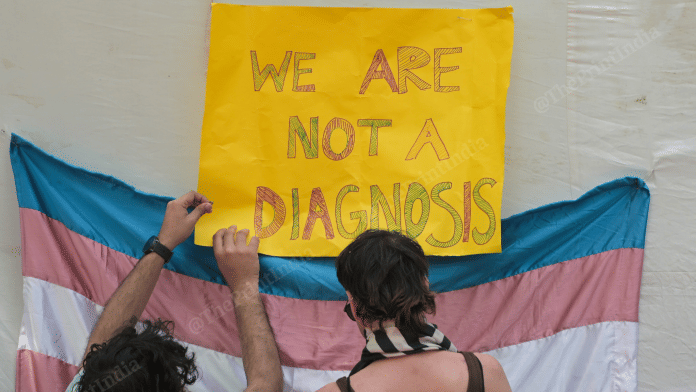



Trans people don’t reproduce their own. They make togetherness by giving shelter to others who have also strayed from the sexed order of the world. If sex is an instrument of control and reproduction in a society ordered by caste and patriarchy, transgenders have refused this control. They have dared to leave behind the names and fates in which they would otherwise be caged by birth.
Such leaving is often marked by violence from families. Anytime a trans person moves against the world’s norms of sex, they are policed and often forced to erase themselves in service of the heterosexual family.
The departures of trans people bring together all kinds of messy otherness under the same umbrella. Hijras, kinnars, jogatis, transmen, NBs, Shivshaktis, kothis, GNCs, Aravanis, Thirunangais, Nupamanbas, intersex (and I could go on) are various sociocultural communities or loose formations of trans people that gather, make friendships, and survive in a hostile world otherwise made only for families. They are kinships forged by a desire to survive in the face of marginalisation.
Whether it is hijra gharanas who go to weddings for badhai, trans men who become bodybuilders, kothis who dance in jhankis, Nupa Maanbas who started a football team, or even transpeople who make street Reels, they collectively perform their fantasies of gender that match and defy the heterosexual world at once. Many don’t take up these professions but still stay with others they call their own, banded by both love and need, with nowhere else to go. In these ways, transgender people forge alternate ways of being, beside and against the mandates of heterosexual families. While they belong to these many different names, the one thing that keeps the relentless beauty of trans people alive is their kinships and the radical offer to be otherwise.
In the Transgender Persons (Protection of Rights) Amendment Bill, 2026, lawmakers read this kinship as ‘deception’, ‘allurement’, and ‘undue influence’, making it a criminal offence punishable with up to 10 years of rigorous imprisonment. In the imagination of the Bill, making someone trans—whatever that may mean—is a punishable act, a sin.
A farman against trans collectivities
Unlike the initial sections of the Bill, which narrowly prescribe who a transgender person should be, the section on offences and penalties pursues a more expansive definition to criminalise. The legally recognised transgender people are only “kinner, hijra, aravani, or jogta, and a person with variations at birth”, embodiments that invite criminalisation of kin are broad enough to include even those who “conduct themselves outwardly as a transgender person”. Sarees, chest binders, hormones, lipstick, surgery, everything is a giveaway—for the government, all people who visibly stray away from their mandated sex are dangerous, and their safe havens must be pulverised and exterminated.
Despite all the confusion between categories, the Bill is a cannon aimed against all collectivities of transpeople—at the birth of new trans folks outside of reproduction. It claims to help ‘genuinely’ oppressed trans populations but in reality it is a farman for the extinction of their kind.
These are clear echoes of the Criminal Tribes Act of 1871, imposed by the British rulers with the clear mandate to “reduce the number of eunuchs” and “gradually lead to their extinction”. Criminal Tribes Act created a register of eunuchs, and anchored the definition of ‘eunuch’ in medical inspection. The similarity cannot be ignored.
The last standing place where trans people find shelter and take new births are the first ones in the line of attack. The charge under which the Bill wishes to criminalise trans families or gharanas is that they are violent places where coercion happens, and yet there are no protections in the Bill for trans people who are utterly alone. They must be in a gharana, do ritual begging, to be recognised. The Bill offers no reservations, education, medical assistance, or housing. Researcher Vaivab Das wrote in 2024 how, after more than a decade of the NALSA judgment, the needle of social equality hadn’t moved to the delivery of rights for transgender persons in India. The empty promise of benefits is raised in the amendment Bill only to put more trans people in surveillance registers.
Also read: The RPwD Act has aged well. What are the gaps to be filled after a decade of progress
The violent unit they call family
Clearly, leaving the institution of family is being made impermissible. Family functions as the smallest unit of state control. This is evident in how civil servant Yogita Swaroop responded to members of the National Council for Transpersons (NCPT) when they were abruptly called by the Ministry of Social Justice for dialogue—after the Bill was already introduced in Parliament.
When Kalki Subramaniam, an NCTP member, raised the concern that many trans people are harassed and even killed by their families, Swaroop said that trans people should stay with their parents regardless. The officials “will never punish the parents”, Swaroop said, erasing and even authorising the violations of home.
The statement issued by the Dalit Bahujan Adivasi Trans Queer (DBATQ) Panthers National Network adds to this question. It places the State’s need for affiliation to the caste-family in line with other recent laws that punish interfaith and inter-caste relationships. The added burden of structural inequalities, and the double whammy of family-centric laws makes Dalit and Muslim trans and queer couples more precarious in their attempts to survive and make community.
Trans people don’t reproduce their own. But in the most patriarchal families, from under the iron fist of tyrannical fathers, new rebellions forever rear their heads. There will always be those who refuse the rules foisted on them, those who imagine themselves more, those who leave. There will always be transgenders, everywhere you look.
Aditya Vikram is a writer, translator, and scholar. They teach a course on critical thinking at Ashoka University. Their X handle is @AdityaVShri. Views are personal.
(Edited by Prasanna Bachchhav)