






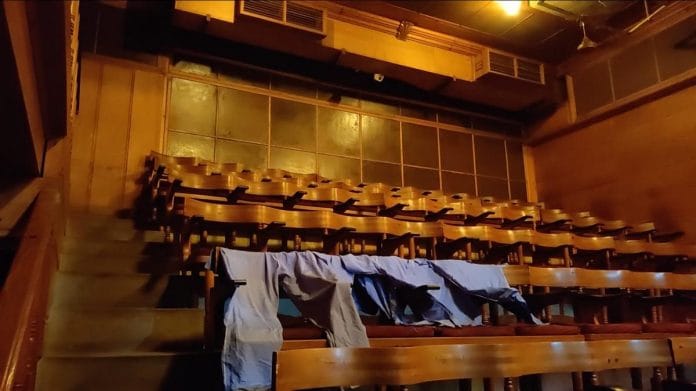



As a former theatre kid, I’ve watched the live stage hollow out in slow motion. Auditoriums are emptier, runs are shorter, and there’s a nagging sense that ambition no longer lives in theatre. The talent hasn’t disappeared, but everything around it is eroding
Delhi should have been the undisputed theatre capital. It has a long and proud legacy, including institutions such as the National School of Drama that produced generations of formidable actors and directors— from Naseeruddin Shah, Pankaj Tripathi, Ratna Pathak Shah, and Neena Gupta to MK Raina, Satish Kaushik, and Santanu Bose. And yet, somewhere along the way, the pipeline broke.
The city has the bones of a theatre culture, but not the system to sustain it.
Ironically, Mumbai, the city of cinema, arguably does theatre better than Delhi. Aspiring actors who don’t break into Bollywood often turn to theatre, keeping the scene alive through sheer persistence and as a fallback. But here too, there’s stagnation.
Also Read: Nehru, Mughals, Dhurandhar, Narcos & Kargil. A Delhi show on the great Indian blame game
Talent without an anchor
There’ve been some razzle-dazzle investments of late in Mumbai, but they also reveal the gap. The Nita Mukesh Ambani Cultural Centre (NMACC) — a 2,000-seat venue opened in 2023 — is a welcome addition. But let’s be honest, it leans heavily on importing large-scale Western productions like Wicked and Matilda. While that raises the bar for production value, it doesn’t build a homegrown ecosystem.
Theatre is losing ground in its own spaces. Indie films are now being screened in venues that once hosted plays. Even alternative storytelling formats are moving toward the screen. Everyone wants to be a part of cinema, whether mainstream or indie, because that’s where visibility, money, and momentum are.
In that rush, slower art forms like theatre are being left behind.
The tragedy is that the talent pool in Indian theatre remains extraordinary. Across cities, there are actors, writers, and directors doing original, rigorous work. In fact, just in the coming week, Delhi’s stages will host a range of exciting productions: Rebel Ranis, a dance-theatre musical by the Keelaka Dance Company at Kamani Auditorium; BIG B, a Hindi-English comedy directed by Dr M Sayeed Alam and Niti Phool, known for their historically rooted yet humorous plays, at the Shri Ram Centre for Performing Arts; Massage, a demanding two-hour monologue performed by Rakesh Bedi at Kamani.
Yet such productions are no longer part of the cultural mainstream. Their audiences are shrinking, their visibility is fading, and they are sustained by passion rather than a functional industry.
And that’s the real problem: India never built a system for theatre to thrive.
Also Read: Three women over 60 are redefining Delhi theatre. ‘People think we’re mad’
Toward an Indian Broadway
America’s Broadway works because of infrastructure, not just talent. It relies on investor confidence, marketing machines, and a culture that treats theatre as a destination rather than a stepping stone to film.
India has never offered that.
We don’t need to clone Broadway, but we do need the pillars it’s built on. The foundations could be laid in Delhi, where productions can run long enough to find audiences, where investment meets creativity, and where theatre is treated as a serious cultural economy.
Right now, theatre is being overshadowed by cinema entirely. If we continue on this path, it will only continue to survive as a niche, an occasional indulgence rather than a living, breathing cultural force.
And that would be a loss far greater than we realise.
Because theatre is where stories are tested, and audiences engage without a screen between them. It is raw, immediate, deeply human, and new every time.
India can have its own Broadway, only if people care enough.
Mrinalini Manda is an intern who graduated from Batch 5 of ThePrint School of Journalism. Views are personal.
(Edited by Asavari Singh)