









The rather clumsily executed war, sorry, combat operation, in Iran has resulted in an exponential increase in the number of doomsayers talking endlessly about the “decline” of the West. It appears that the situation has resulted not only in lots of missiles, bombs and drones being launched, but also assorted intellectual or pseudo-intellectual objects being hurled in the air on television and YouTube.
Perhaps it is time to take a deep breath and attempt to clear the sullied air a bit.
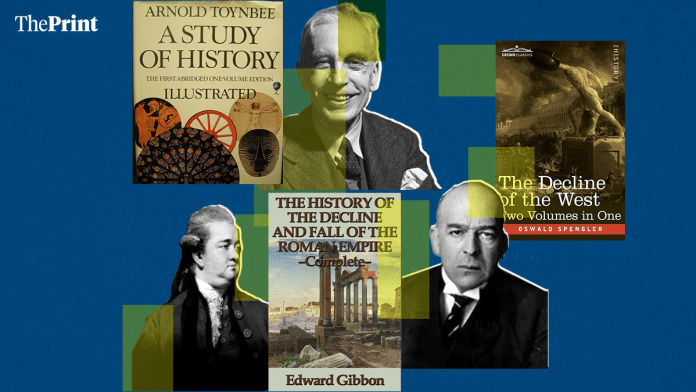
The origin of the expression “Decline of the West” goes back to the German historian Oswald Spengler, who published the first volume of his eponymous book in 1918 and the second volume in 1922. Spengler can be seen as an intellectual descendant of the German Romantic Movement. He was a great admirer of Johann Wolfgang von Goethe. Among other things, Spengler believed that our Indic civilisation was “ahistorical”. That, in his opinion, was not a bad thing. It might actually be a sign of civilisational health—or so he seems to have thought!
Spengler viewed civilisations as akin to natural organisms subject to the impact of seasons. Civilisations, according to him, went through four stages or seasons—spring, summer, autumn and winter. His principal obsession was with the “decline/downfall” of Western civilisation, which he thought was heading into its winter in the 1920s. Spengler was fashionable for a time, especially in Germany, where the pessimism of the soul has always had its spokespersons. As Marxists and post-modernists took over Western academia, Spengler disappeared from the reading list.
Even those not of the Marxist persuasion made the case that instead of declining, the West was booming and blossoming, especially after 1945 and even more so after 1991. This was when the Francis Fukuyama thesis became popular. Not only was the West thriving, but all other civilisations had no choice but to become like the West. Bill Clinton, possibly a Fukuyama acolyte, predicted that China would inevitably become like the West.
Economic crisis
Just three decades later, things look very different. 9/11 represented the first invasion into the very heartland of the empire. It provided a warning sign. 2008 may have been when the West as we know it, peaked. The fall was pretty rough as Western economies imploded.
The economic crisis was exacerbated by two never-ending wars in which the West got involved in the Middle East. Meanwhile, Russia, which had been dismissed as a “petrol station” pretending to be a country, managed to improve its economy even as it boldly embraced “non-western” Russian orthodoxy. China proved Clinton wrong by getting richer and more powerful while diligently refusing to imitate the West.
Clinton turned out to be not a prophet, but a stand-up comedian. Even an also-ran country/civilisation like India quietly charted its own path. And Türkiye actually turned its back on westernisation. And of course, Iran continued to maintain that Western civilisation was “satanic” and needed to be avoided at all costs.
No wonder, three decades after 1990, Herr Spengler is back in fashion. There are dozens of YouTube experts who are telling us that the West is in a state of terminal decline. The current “Supreme Leader” of the West actually promised to reverse matters and re-energise the region. But his predecessor’s dubious gift of a war with Russia and his own erratic behaviour have only emboldened critics. The West appears to many not only to be declining, but to be flailing around like “an ineffectual angel beating its wings in the void”.
Can we conclude that Spengler was correct? After all, his timing was off just by a century, which, when all things are considered, is a mere blip in the long duree of seasons that govern civilisations. There is certainly a case for re-reading Spengler. But before we let Spengler monopolise our attention, it might be worth paying attention to two historians who have in recent times been “cancelled” by the leftist sultans who control Western universities.
They are Edward Gibbon and Arnold Toynbee. There might be some learnings not only for us, ahistorical non-Western types, but even for the leaders of the West who presumably are trying to stem its decline and make sure that there is nothing inexorable about that decline.
Gibbon felt that Christianity, with its attacks on the civic religions of the Roman world and with its intolerance, hastened the decline of the Roman Empire. In today’s world, a case can be made that the modern religion of “wokeism/extreme climatism” is analogous to early Christianity. And just like Gibbon’s argument that Christianity weakened the Roman world, this new religion may have weakened the West of today.
Also read: War in West Asia shows India must rethink tech sovereignty
The larger theme
Germany is an interesting example. The country has shut down all nuclear power plants and has stopped buying economically priced Russian gas. The resulting high energy costs are among the main causes for German de-industrialisation. Britain, too, with the pursuit of “net-zero” carbon emissions, has achieved the highest prices for energy in the world.
It is hard to see how this does not come with severe economic costs. Gibbon felt that Christianity hurt Roman military recruitment and martial abilities. It is hard to see any of today’s woke leftists joining the military, let alone fighting with enthusiasm. The Joe Biden administration was well on its way to imitating Germany and Britain. Is the reversal of policies by the present dispensation in the US too little too late? Time will tell as to whether the decline of the West is too far gone or can be saved from modern religions.
Hadrian was one of the “noble” emperors who was admired by Gibbon. Hadrian is known for consciously stopping imperial expansionism. He built a wall in northern England and deliberately chose not to attempt to conquer the “difficult” Scots and the Picts who lived further north. One wonders if today’s Rome could have stopped with Iraq and not tried to go after the “difficult” Iranians. Hadrian might have advocated that, and it should not be forgotten that the Roman Empire continued to flourish for a few centuries after Hadrian.
One of the most interesting Roman Emperors was Julian. In Gore Vidal’s brilliant work of historical fiction, Julian comes across as a heroic figure who tried hard to ensure that Christianity’s intolerant suppression of other religions was not supported by the Roman state. Vidal’s Julian wanted all sacral traditions to exist side by side in an empire that was not committed to a monochromatic ideology.
After Julian’s death, the Roman Empire went back to embracing an aggressive Christianity. The early Christian fathers made sure that to this day, history books refer to him as Julian the Apostate. This would suggest that the woke/climate religion could easily have a comeback after today’s “apostasy” is overthrown. In many Western countries, young people respond to questions in polls in a manner that suggests that they feel that a climate apocalypse is inevitable. And who can forget Bertrand Russell’s cheeky comment that St Paul thought that the world was going to end in his lifetime.
Gibbon’s larger theme is about how imperial Rome suffered from success. Success made Rome flabby, comfortable and pleasure-loving. This ensured that the earlier qualities of civic sobriety were discarded. Looking at the hedonistic consumption patterns of western societies where pleasure is demanded without the need on the part of the populace to put in effort, one can dimly visualise some parallels with Rome.
One can think of Tik-Tok as a “stately pleasure dome” from Kubla Khan’s country. The fact is that even the apostate leader who wants to recover the traits of old Rome seems unable to deprive his people of the pleasure dome that they are hooked on. That should tell us something about the pursuit of pleasure in preference to the pursuit of civic discipline.
Also read: India-Europe ties can stabilise the chaotic international order
Decline is not inevitable
As one moves from Gibbon to Toynbee, one cannot help but think about how postmodernist leftism has actually destroyed genuine Western intellectual traditions. In history departments in Europe and North America (and for that matter, in India), Toynbee is completely absent from explorations or discussions. That itself may be an indicator of Spenglerian decline. But let us leave that thought for now.
Toynbee felt that civilisations are faced with challenges. These challenges may be natural ones, like climatic disturbances or human ones, like invasions. Toynbee suggests that civilisations have collective agency in how they respond to these challenges. He provides numerous examples of responses which are successful, partly successful or completely unsuccessful.
One important takeaway from this is agency. In other words, decline is not inevitable in the Splengerian sense of a movement from autumn to winter that cannot be stopped. Civilisations make choices. For instance, the West could today attempt to re-colonise different parts of the world. This option seems to be what Marco Rubio had in mind when he spoke in Munich. Or it could think of creative responses like Rome passing on its mantle to a second Rome (Constantinople), which then inspired a third Rome (Moscow). Of course, one can argue that this was not a creative response at all, but an admission of defeat. What then is the creative response?
Toynbee spoke about internal and external proletariats, which destabilised universal imperial states. It would be curious today to ask the question as to whether internal and external proletariats exist in the contemporary West. If so, who or what are these destabilising forces? Understanding this may be the key to an intelligent “response” to the day’s “challenge”.
If today’s leaders of the West are willing to concede that the rise of the West is some five centuries old, as articulated recently by Marco Rubio, that the apogee of Western achievement took place between 1800 and 2008, are they willing to notice incipient signs of decline which have now been building up for some decades? Do they acknowledge that they have agency and that they can do something about it?
In some ways, the current endless chatter on YouTube may do the West a favour and lead to intelligent responses like the ones put in place by Hadrian and Antoninus Pius. If they want to do so, as a first step, they should buy the out-of-print volumes of Gibbon and Toynbee and start reading energetically. As the latter says, nothing is inevitable. The decline of the West into a Spenglerian winter is not a given. The key question is about what kind of response a civilisation makes to the challenges it faces.
I can assure the leaders of the West that we members of Spengler’s ahistorical Indic civilisation are watching them with interest. For does their response not result in challenges that we have to face and, in turn, respond to?
Jaithirth ‘Jerry’ Rao is a retired entrepreneur who lives in Lonavala. He has published three books: ‘Notes from an Indian Conservative’, ‘The Indian Conservative’, and ‘Economist Gandhi’.
Views are personal.
(Edited by Saptak Datta)
Interesting academic essay! Some would call it intellectual mastu..tion!