






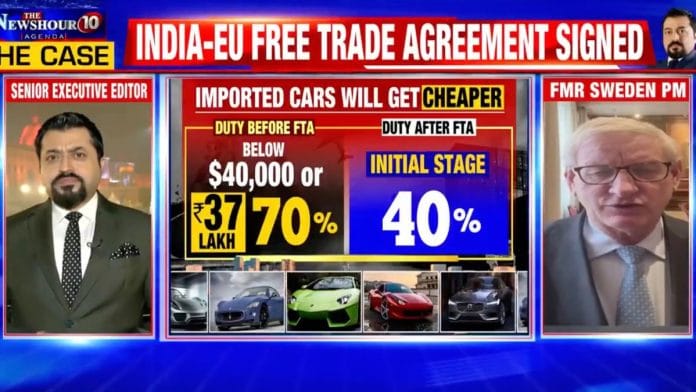



You’ve seldom seen so many happy faces on India’s news channels. The television screen was filled with big grins. Even the faces of news anchors, usually as glum as the grey clouds over North India, had a sunny look about them.
Why?
“Cars cheaper, wine smoother,” explained Times Now on Tuesday. This was after Prime Minister Narendra Modi, European Commission President Ursula von der Leyen, and European Council President Antonio Costa held hands and raised them in salute to the Free Trade Agreement between India and the European Union, signed in New Delhi on 27 January.
“[The] excitement is equal in all three of them,” said a Times Now reporter.
“It’s a win-win,” said anchors across English news channels.
Why? Well, The Times of India, like its sister news channel, was clear about why Indians stood to gain. “Luxe cars, spirits to cost less under ‘mother of all deals’,” it stated in its page-one lead headline.
Hey, and that’s not all. The tariff on ‘olive oil’ has been scrapped, and EU beer will be cheaper by 50 per cent, according to India Today. So the next time you reach for the Heineken, glug away.
All hail the tipplers of India and the BMW and Mercedes Benz lovers – you have received a bonanza. Well, not just yet.
There’s the small matter of 27 European nations signing off on the deal—something TV news mentioned only in passing. But, hopefully by 2027, you will be driving along in your luxurious automobile and sipping chilled Riesling.
“In Europe, the cost of wine is often the same as [that of] mineral water,” revealed one expert on Times Now.
Other channels were equally pleased by the news.
Someone ought to study the sociological significance of news outlets headlining the “mother of all deals” and the world’s “largest FTA” (India Today) for the 1.4 billion people of India and with reduced tariffs on alcohol and luxury vehicles.
Is that really what they believed would appeal to their audiences?
Also read: How Noida techie’s death finally angered TV news channels & put the lens on the ‘system’
Answering the ‘daddy of all questions’
Well, perhaps they chose to highlight wine and cars because these were tangible benefits. Other advantages of the India-EU FTA were often lost in too many details. News channels did take the trouble to explain those details, but honestly?
We got a little lost. Better, then, to stick to platitudes.
On Tuesday, TV news anchors across channels turned to their reporters or guest experts—usually retired diplomats or market watchers—with one question: “Why is this the ‘mother of all deals’?”
The reporter or expert would then launch into a speech about the “historic” agreement. On Bharat 24, market expert Aakash Jindal said the “great deal” would increase India’s GDP by one per cent and income levels by 2 per cent—presumably for those linked to sectors covered by the FTA. How this would happen, he did not explain.
On NDTV 24×7, a reporter explained that 90 per cent of Indian exports would move to zero tariffs, benefiting sectors such as textiles, gems and jewellery. Up to 97 per cent of EU goods, the channel said, would see tariffs reduced to zero.
The deal would also make travel to Europe and working there easier for Indians, Bharat 24 added.
This agreement, the channel said, “was a significant message to the global community—that deals could be struck even in times of such ‘turbulence’.”
“Indian products will be VVIP,” declared News18 India with pomp. This “mega deal” would be beneficial to both sides, it said—a manufacturing “power play”. “India will prosper.”
CNN News18 devoted extensive airtime to the FTA and gave us another set of facts to deal with: one-third of international trade was between India and the EU. The deal, it said, would reduce dependence on the US and China and boost India’s growth.
For example, India Today told us that China is currently the largest source of EU imports.
For once, the news wasn’t about Donald Trump. Or perhaps it was. There were several sly digs at the American president. “EU opens as Trump closes doors,” said Bharat 24. “US fumes,” said Republic TV.
“Europe and India have a different vision from Trump,” said Pratik Dattani of think tank Bridge India Ltd on NDTV 24×7. “The EU is standing up to show what it’s about.”
Also read: AQI and Aravalli showed a glimpse of what TV news could do. Then Bangladesh lynching happened
Doubt another day
In this emphasis on the sunny side of the India-EU FTA deal, question marks over its implementation were kept to a minimum.
Except on News Nine, where they were discussed at length, especially the EU’s Carbon Border Adjustment Mechanism, which taxes goods such as steel and aluminium based on their carbon emissions.
Several experts across English news channels also raised concerns about the quality of Indian products—would they meet Europe’s high and stringent standards?
As The Times of India wrote, the ratification of the deal by all 27 European countries was its “big ‘if’.”
But that is for another date, time and place. On Tuesday, we watched “excited” leaders—Modi, von der Leyen and Costa—radiating graciousness and charm.
Truly, it was a big deal.
Prying eyes on Pawar
The death of Maharashtra Deputy Chief Minister Ajit Pawar in an aircraft crash Wednesday was covered throughout the day by television news channels.
While the channels were respectful to his memory, they were less so toward his family. All afternoon, footage of family members meeting and mourning him was repeatedly aired. Could they not be given a little privacy in their grief?
Even more troubling was the broadcast of charred remains of some bodies before they were masked. Surely a channel like Republic TV could have reviewed the footage before airing it?
The author tweets @shailajabajpai. Views are personal.
(Edited by Prashant Dixit)