






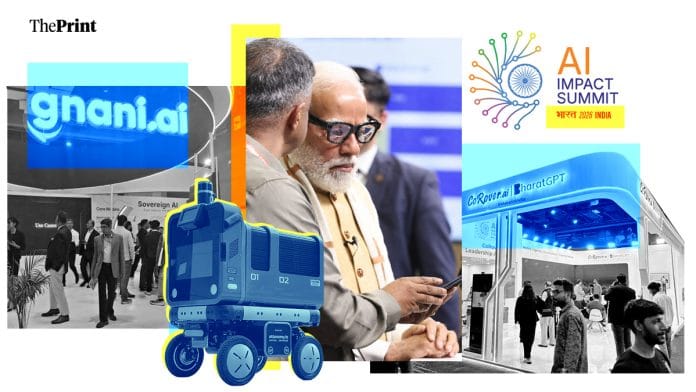



Can India be an economic and technology powerhouse by 2047, as promised by Prime Minister Narendra Modi? Maybe. Maybe not. But it’s trying.
Recent news reports, opinion pieces, and even a short documentary in the international news media on India’s economy, energy, and the AI Impact Summit are mostly encouraging. They’re a recognition of India’s potential, but—there’s always a ‘but’, isn’t there—it comes with a word of caution. You’re punching a little above your weight, big fella.
Take the AI Impact Summit held in New Delhi last week. The jury (leading foreign news outlets) gave an ambiguous verdict.
This is what they said, in a nutshell: Yes, you have the educated workforce; yes, you have the largest consumer market; yes, you’re taking strides in the right direction; and yes, you are the world’s fastest growing major economy—but you still have a long way to go.
All true. However, many of the headlines of the articles and opinion pieces would strike Indian readers as somewhat patronising.
“India Can’t Spectacle Its Way to AI Power,” said an opinion piece in Bloomberg, the financial news agency.
Financial Times felt “India’s AI ambitions hit limits at global summit”, while The Economist minced few words in its judgement: “Artificially Inflated,” it wrote in its print edition.
It was left to The New York Times to be less harsh: “At A.I. Summit, India Tries to Find a Way Between the U.S. and China”.
Also read: India must build its own AI stack. It is now a strategic necessity
Hype and VIP culture
The Economist also took a dim view of the AI Summit’s organisation in this piece, titled “India’s VIP culture is out of control”.
Most of us would have to agree with its view of ‘VIP culture’—especially those of us who live in Delhi and regularly face delays in movement or access due to VIPs.
The AI summit caused traffic snarls, and there were problems with entry during the first few days. The Economist was biting in its assessment: “What tens of thousands of attendees saw…was a fulsome display of India’s retrograde ‘VIP culture’…The country’s leaders claim to be servants but act like masters,” it wrote
Bloomberg’s Cathy Thorbecke in New Delhi, also noted the summit’s “dysfunction” and found giant posters of PM Modi in Delhi disconcerting, “…it’s almost like he is always watching,” she said.
On the summit itself, publications played a balancing act. Here’s how NYT did that: It wrote that the race in AI power is between the United States and China, “(but) India has a pitch for those left behind.”
It added, India “has neither America’s homegrown AI giants… nor China’s know-how and stores of the rare earth elements…Instead, India is using technology as a tool of foreign policy, casting itself as a moral voice for the smaller, developing countries of the Global South.”
This is from Financial Times: “The world’s most populous country wants to make sure that AI decision-making is not restricted to the US and China…(But) experts warned that India did not yet have the large-scale computing infrastructure needed to become a big player in AI.”
Bloomberg wasn’t sure about India’s AI dreams. “How does it go from being an enthusiastic AI consumer to being a serious producer?” Thorbecke asked.
She added that the problems for India included infrastructure, “land, water and electricity [which] are already stretched thin here, straining the nation’s power grid and water supply”.
The Economist is known to cover India extensively for its financial and business potential, but on AI, it had its doubts. Its conclusion was that India is using the (AI) event to hype itself as an emerging AI superpower, alongside America and China.
“In many ways, that is fanciful. India has little aptitude in advanced manufacturing and cannot produce the chips on which AI depends,” it wrote. And then it sweetened the pill by adding that “India does have attributes that will give it an important role in shaping AI adoption,” which includes 900 million internet users, “an unignorable market for AI companies looking to hoover up data on which to train models.”
The magazine also praised what it called “the data centre boom”.
Also read: AI Summit is a snapshot of today’s India — intelligence, competence in short supply
Coal and milk
Other India-specific reports and videos in the foreign press over the past few weeks indicated that their interest in India lies in its economic and tech assets—and where the country succeeds or falls short.
Bloomberg’s Thorbecke spoke about India’s power grid, and the Financial Times produced a 20-minute film on “India and the true cost of coal”.
Its reporter, Andres Schipani, explores India’s dependence on coal for its power generation despite its environmental and health hazards. He visits the Gevra mine in Chhattisgarh, the second-largest coal mine in the world.
He says India is facing “a conundrum”. It wants to become “a manufacturing hub”, but that comes at a cost: Widespread pollution and environmental degradation.
This is an in-depth analysis of India’s coal dependence—20 million livelihoods—power and environmental concerns, and the future of renewable energy. Prognosis? Coal will be phased out by 2070, said one expert.
“If you ask me if there is a way out for India from coal, I don’t think there is one,” Schipani says.
Milk adulteration caught the eye of the French newspaper Le Monde in Gujarat’s Sabarkantha. The newspaper pointedly began with a reference to the piety of the cow in India: “In India, a country where cows are sacred, the dairy market is awash with adulterated products”. The issue—real and consequential as this Andhra Pradesh incident shows—was reported in some Indian news media but wasn’t highlighted.
The chemical adulterants used included detergent—not exactly mother’s milk, right?
There are heartwarming stories, too. This one is not in India but about Indians abroad: The revival of an Indian community, its social and cultural life in Japan’s capital, Tokyo. Nishikasai, in eastern Edogawa Ward, is a small corner of India in the country—approximately 10 per cent of Indians in Japan reside there.
The story reinforces the adage that you can take an Indian out of India, but you can’t take India out of Indians.
The author tweets @shailajabajpai. Views are personal.
(Edited by Theres Sudeep)
Our expertise is limited to third-class infrastructure, pollution, and corruption. Artificial intelligence is beyond our capability.