






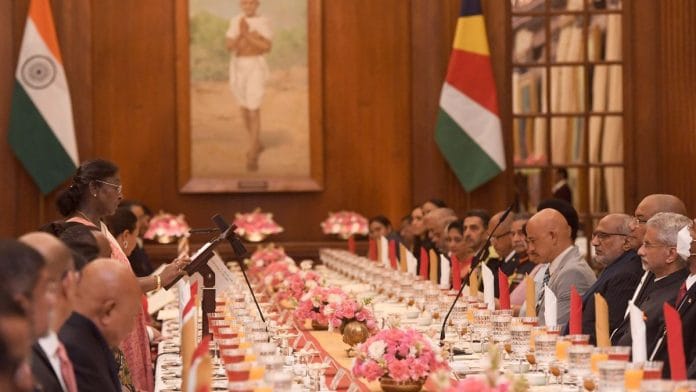



Would you be interested — or rather, intrigued — to have for dinner ‘Koshambari with charred pineapple on yoghurt foam’ or ‘jackfruit and banana blossom skewer’? Or for dessert a nice bowl of ‘shrikhand crème brûlée’?
These were among the dishes served at the recent state banquet hosted by Droupadi Murmu for Seychelles President Patrick Herminie at Rashtrapati Bhavan.
A picture of the menu went viral online. Social media was filled with incredulity, satire, and a certain culinary unease. The discomfort was not just about the ingredients, but also about the idiom. The dishes felt familiar and estranged at once. The commentary grew sharper when journalist Suhasini Haidar remarked that it is an “open secret in Delhi’s diplomatic circles” that visiting dignitaries often return from such banquets and order Indian food from room service. Mahua Moitra amplified the point, claiming that Emmanuel Macron had once requested bread, cheese, and cold cuts after a G20 dinner because he could not eat what had been served. Whether the claim is true or exaggerated, the question becomes: is India truly impressing its guests and serving them food that delights, or offering something awkward and outlandish instead?
For a nation that calls itself Vishwaguru, the optics are embarrassing. Even allowing for exaggeration, the idea that visiting dignitaries might leave a state banquet unsatisfied is unsettling. Because India does not suffer from a crisis of culinary legitimacy. Our food has travelled the world without molecular theatrics or ornamental vocabulary.
Food diplomacy
From London to Leicester, from Birmingham to Bradford, restaurants branded “Indian” — many run by Pakistani and Bangladeshi entrepreneurs — serve butter chicken, palak paneer, and naan to full houses. The global affection for Indian cuisine rests on flavour, aroma, and recognisability. It persuades without explanation and does not need translation to command respect. Even popular culture has understood this instinctively. In The Hundred-Foot Journey, the young Indian chef does not win over the French establishment by imitation. He respects technique, but asserts identity, introducing Indian spice into a classic French dish not to distort it, but to reveal his inheritance within it. The message is simple: confidence lies in bringing one’s own grammar to the table.
At another formal lunch hosted by Prime Minister Narendra Modi for European leaders, a main course titled “Shahi Kangni Kofta Badaami” was described as figs stuffed with foxtail millet and minced vegetable dumplings, poured with a cardamom and poppy seed flavoured creamy almond sauce. On paper, it sounds elaborate, for the unquestioning followers, it’s impressive, and for some chefs, it’s ingredient-forward. Yet a mortal like me, who needs food for the soul, cannot help asking: is the guest meant to savour it, or decipher it? The issue is not figs or millet. Indian kitchens have married sweet and savoury for centuries. The issue is translation. When regional dishes are aerated, skewered, and brûléed into abstraction, they begin to feel less like hospitality and more like thesis statements.
This contradiction is sharper in a political climate that insists on civilisational confidence. The language of governance today speaks of Bharat, of Vishwaguru, of reclaiming names, and shedding colonial residue. The political vocabulary is one of rootedness, of authenticity, of unapologetic Indianness.
And yet, at the diplomatic table, the menu reads like a nervous translation.
If we are secure enough to rename cities and rewrite historical narratives, why does our food feel compelled to rehearse in an accent not entirely its own? Why must yoghurt become foam to signal modernity?
Food diplomacy, after all, is not ornamental. It is narrative. When a nation feeds a guest, it tells a story about itself. If Japan serves precision, Italy serves memory. If France serves technique, India serves flavour and fragrance, the kind of fulfilment that settles not only in the stomach, but in the spirit.
Also read: Ramzan food in Hyderabad is no longer an Old City affair
An atrangi khichdi
The commentary online also raised another question: why are these menus almost entirely vegetarian? It is a fair debate in a country where eight out of 10 people consume non vegetarian food, where food is inseparable from identity, and where dietary choices often carry social and political undertones. But that debate, important as it may be, risks missing the larger point. The issue is not vegetarian versus non-vegetarian. A vegetarian menu can be deeply persuasive, India has perfected that art for centuries. At my wedding, where Rajasthani vegetarian dishes were served unapologetically, my British friend told my father she would happily turn vegetarian if she could eat like that every day. That is soft power. Food not reimagined, not abstracted, just simply executed well.
Which is precisely the point. When done with confidence and skill, our food has the power to convince on its own terms. It does not need to be disguised to be desired.
Because in the end, food is an emotion. It is meant not merely to be consumed, but to be felt in its colour, its weight, its texture, even in its sound. Food is a culture, a biography, an act that — no matter how crude the situation — heals and nourishes the soul. I also believe that food is not just made with love; but with good taste and skill. Produce that perfect gajar ka halwa where the milk has surrendered so completely to the carrot that each strand releases quiet sweetness as you chew, lifted only by the faintest, disciplined touch of elaichi. That is not sentiment. That is authority acquired over 40 years. That is also my mother’s halwa, not because it is cooked with love, but because it is cooked with knowing. And yes, I realise I have just described the halwa with the same indulgent precision one finds on a state banquet menu. But there is a difference. In these words, you can almost taste it. The description does not distance you from the dish, but draws you closer.
That is what feels absent in so many of these official menus. Leaders travelling across continents are not seeking conceptual gastronomy. They are seeking encounters with Lucknow, with Kashmir, with Assam, with something rooted and recognisable.
If this is ‘Naya Bharat’, it must remember that sophistication does not lie in complication. A simple gajar ka halwa made with discipline and skill carries more authority than a reimagined “ragi gajrela” described into submission. Confidence, in diplomacy as in cooking, is not about reinvention. It is about knowing that what you already have carries weight. But what’s truly unsettling is that at the diplomatic table, India’s cuisine, its menu reads like an atrangi khichdi — confused and unsure of its taste and origin.
Shruti Vyas is a journalist based in New Delhi. She writes on politics, international relations and current affairs. Views are personal.
(Edited by Aamaan Alam Khan)
Ha Ha. I loved the article.
I have always envied expert critics of the arts for their flair for exquisite language. Savour this used by Shruti in her article, for characterizing her mother’s gajar halwa: “…the milk has surrendered so completely to the carrot that each strand releases quiet sweetness as you chew, lifted only by the faintest, disciplined touch of elaichi.” It left me imagining how thickly the dish must be prepared in Rajasthan for the milk to lose itself so completely to the grated carrot.
Shruti’s article prompted me to trace how ubiquitous use of the violent idiom which is typical of the exclusionary, revisionist politics in our country has affected our other endeavours.
There is a hypothesis in linguistics which claims that language not merely expresses views but also shapes them. As per it, different languages encourage different perspectives. Language is not just used by the language native, but also uses the latter.
In any case, if a chef and his team are driven by ugly, conflicting impulses…like, the urge to establish offensive superiority over others in every matter while being needy for acceptance and admiration by others, and the desire to attain greater moral stature amidst others despite their actually being morally corrupt by nature…then, it should not be a surprise that the food they prepare and describe for others is perceived to be off by the others.
At a deeper level, I am sure that we act, communicate, and cook the way we think.
you talked about foams, skewers and brulee. You never discussed Sorkai, Majjige Huli, Thoran, Sona Masuri rice, batata nu shaak or Dal Varan. They are classical dishes from different regions of India. They represent real Indian culture and cuisine.
Have you tasted the food? Have you asked any of the dignitaries who were present in the banquet about the food? How can you be so judgemental about the menu? Just because it does not have regular kormas, biryanis and north Indian rich gravies. Indian cuisine and culture is way more than that.
Please stop making the false assumptions. They are totally illogical.