






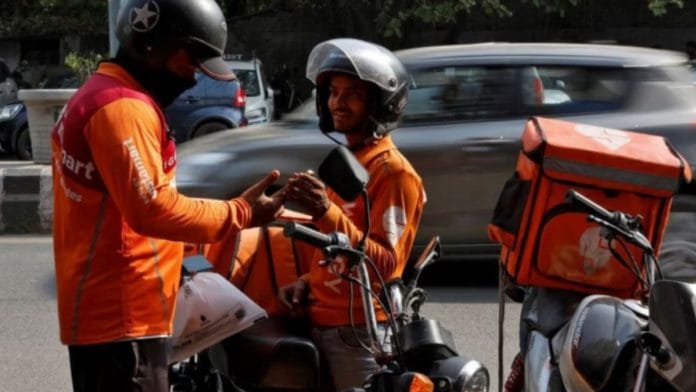



Long before Indian delivery platforms promised to get anything to you in 10 minutes, Domino’s Pizza more or less invented the idea of quick delivery in America. In the case of Domino’s, the promise was that their pizzas would reach your home within 30 minutes of the time they were ordered.
There was a price to be paid for this. But it wasn’t Domino’s that had to pay it. In 1989, a driver crashed and died outside Indianapolis while speeding to deliver a pizza. It turned out that there had been another fatal accident involving a driver shortly before this one. The family of the dead driver begged Domino’s to abandon the 30-minute guarantee. Labour unions cited other cases of accidents caused by the pressure to deliver the pizzas in half an hour. The company was not moved.
Then, in 1993, a jury in St. Louis heard a case about a woman who had been hit by a speeding delivery guy. The jury decided that Domino’s was at fault for putting too much pressure on its delivery people, which caused them to drive recklessly. It awarded $78 million in punitive damages against Domino’s. By some estimates, 200 other people sued the company for causing drivers to recklessly speed while trying to deliver pizzas in 30 minutes.
This time, Domino’s did have to pay a price. So it did listen. The 30-minute guarantee was dropped by all of its American stores.
And for many years, that was that. Companies accepted that it was wrong to make promises about extremely fast deliveries. All over the world, most delivery services promised efficiency without putting unnecessary pressure on their staff.
According to Vandana Vasudevan, the author of the excellent book, OTP Please!, she couldn’t find other countries where such extravagant promises about speedy delivery were made. The only example she found came from Brazil, and even there, the companies did not guarantee a 10-minute delivery.
So why did Indian companies make these promises despite the global experience? One possible reason could be that India (like Brazil) has a large pool of unemployed people who desperately need work and will accept any kind of unnecessary pressure from their bosses to make a living.
Arguments, counterarguments
The Indian government’s new directive to delivery companies to abandon promises of extreme delivery times probably stems from a concern that multi-billion dollar businesses put unbearable pressure on their delivery guys only because they can. If they refuse, then the delivery men (and it’s usually men) can easily be replaced. In this economic environment, there are too many people chasing too few jobs, so the corporations are in a strongly advantageous position.
It is concerns like these that have contributed to the current backlash against the big corporations. The people who have to speed to deliver goods have no safety net. They are what we call gig workers. They are not employees with regular jobs and don’t have the benefits and guarantees that come with employment. Their incomes vary according to the number of deliveries they make in a day. And if they don’t manage to deliver packages (or pizzas) quickly enough, then they end up getting fewer orders and earning less money.
I don’t think anyone seriously disputes that gig workers should never have to live with the relentless pressure that 10-minute delivery times impose. But the argument has now gone further. Should these tech companies operate on the basis of poorly paid gig workers? Or should these corporations, with their massive valuations and billionaire bosses, be made to give their gig workers proper jobs with the protections that come with regular employment? Why should the guy who rushes breathlessly to bring you a package not have the same employment guarantees that a factory worker has?
There are arguments and counterarguments to be made. First of all, are gig workers really paid that badly? The corporations say they aren’t. On the other hand, Soumyarendra Barik, a journalist for the Indian Express who worked as a gig worker for several delivery companies, saw it differently. He handled 23 deliveries in 15.5 hours and earned Rs 34 an hour before expenses. It was, he reported, a sad, dehumanising experience full of pressure and humiliation for not much of a financial reward.
But this is how the employment market works, say defenders of the corporations. There is no shortage of gig workers, so how bad can the gig be compared to the alternatives?
In a thoughtful post on X, one founder of a tech company made the valid point that those who criticised the gig worker model acted as though getting rid of it would lead to all the gig guys getting regular jobs. In fact, some of these employment opportunities would disappear, and people would be forced to scramble for a living in the informal sector, where they would be even worse off.
Also read: Dehradun, Bareilly, Tamil Nadu attack—Indians are turning violent. Don’t keep blaming politics
India’s invisible street vendors
At some level, no matter how much we dance around it, this debate is about inequality in India. The tech companies are celebrated as symbols of a resurgent nation where first-generation entrepreneurs have created enterprises worth billions by harnessing new technologies. What we avoid saying is that most of the beneficiaries of this resurgent India are from the middle class. It is clear that the poor have not benefited much from it. Their primary function has been to facilitate the enrichment of the new billionaires.
We also avoid saying that it’s wrong to blame the corporations alone. The consumers are as much at fault. How often do you really need something delivered in 10 minutes? Just as some companies exploit gig workers only because they can, consumers make them run around needlessly only because we can. How many people who order a 10-minute delivery ever think about the process behind the instant gratification of super-fast delivery? Do we realise that, for all this talk of new technology, it only works because there are poor people at the centre of the process who face the pressure of fulfilling our every whim?
And, to be fair to the tech barons, it’s wrong to single them out. The guy who delivers your pizza or biryani deserves a better deal. But as unhappy as his situation is, he is much better off than the roadside vendor who struggles to feed his family by making chole bhature on the streets, hassled by municipal officials and robbed of his meagre earnings by corrupt policemen.
But nobody makes an issue of the plight of street vendors. Perhaps it is because we have less to do with them than we do with the delivery guys. They don’t come to our door to deliver packages. In fact, if they tried to enter most buildings where middle-class people live, the guards would turn them away.
So it’s important to keep a perspective on the gig economy. And one reason why we blame the tech companies and their super-rich founders is that they are visible and we know their names. The street vendors, on the other hand, are invisible to us. We may see them on the streets, but we look through them. They merge into our urban landscape and vanish.
What we should learn from the current controversy about gig workers is that, for all its selectivity, the fuss is necessary. Vasudevan believes that it’s foolish to ignore the contribution of tech companies to our economy. But it is also true that we usually spend too little time looking at the workers who help power this contribution. So a controversy or a furore that makes us look at the downside of this boom and the condition of those at the bottom of the pyramid is a useful balance.
I broadly agree. The end of 10-minute delivery is a good outcome. And I hope that we will not stop there. Much more needs to be done.
Vir Sanghvi is a print and television journalist and talk show host. He tweets @virsanghvi. Views are personal.
(Edited by Prasanna Bachchav)