






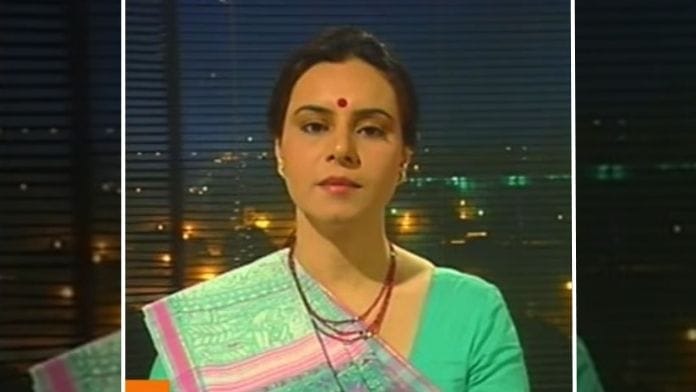



Sarla Maheshwari passed away on Thursday. The news was received as a personal loss by a certain generation of television viewers. It was not because they knew anything about her, but because it reminded them of themselves.
Back then, one didn’t know of the ‘behind-the-scenes’ lives of people on screen. They were not on billboards, nor on Page three of newspapers. The newsreaders back then came on screen somewhere between the ever-entertaining Chitrahar and the much-awaited weekly socially relevant teleseries.
The set for the news broadcast would be called uber minimal today. No virtual sets, LED lights or even green screens. You could almost see the ply and feel the cloth in the background. Except that you didn’t ‘see’ it, because there was nothing else to compare it with.
The only design element was the Doordarshan logo. On a black-and-white screen, the news set was two shades of grey. Not much thought was given to the set because one sat up to listen to a calm and collected Maheshwari reading the daily news with poise and calm that never wavered; it could be the most tragic train accident or the excitement of the Asian Games.
Maheshwari heralded the coming of colour television to India with the same quiet dignity that she always carried in her news broadcasts. One can’t help but think of the on-screen hysteria a similar major technological breakthrough would unleash today.
Now, influencers have access to apps on their phones that they can read text off of while they ramble on. Doordarshan news readers did not have teleprompters for the longest time. Reading the news involved looking down and reading from a sheaf of papers and then looking up intermittently at the single camera pointed at them.
Also read: Shyam Benegal: From photographing the 1st ‘Amul Babies’ to changing the direction of Indian cinema
An inspiration to many
One had to be familiar enough with the text on the paper to be able to look up convincingly. To not just know the text, but to understand it, so a fumble could be deftly handled. The fumbles were few when someone like Maheshwari was on screen, but then there was the ever-reliable occurrence of technical errors and the sudden appearance of a hand-painted sign that read, ‘Rukawat Ke Liye Khed Hai’.
The newsreader was expected to pick up immediately from where they had left off once regular broadcasting resumed. Anyone who has worked in live television will vouch for how nerve-racking that could be. No one ever got to know this then because the professionals carried on and overcame the glitches with minimal discomfort to us.
Unbeknownst to them at the time, newsreaders like Maheshwari were an inspiration to many. Several of the social media posts about her demise have people not just reminiscing about old times but also talking of how they chose to be journalists or went on to find a career in broadcasting because of her.
They wanted what she had—a quiet, dignified, intelligent manner of communication. However, the seeming ease with which she read the news was undoubtedly achieved after a lot of hard work. Those who worked for Doordarshan or All India Radio back then, as this writer did as a child, were put through the wringer by producers when it came to pronunciation and intonation. A newbie could study old tapes of Maheshwari reading the news and learn both. She was as reliably and consistently good as a textbook.
Back then, glamour was a word reserved for film stars and fashion models. Women news anchors (or newsreaders as they were called then) were expected to be attired in ‘sober’ sarees with barely-there make-up, their hair away from the face and neatly tied behind their ears. Despite these almost school-teacher-ish rules, the women managed to have a fan following that would make today’s screen divas beg for tips.
Before Maheshwari, there was Pratima Puri. People waited for her hint of a smile at the end of the broadcast. Then there was Salma Sultan with the trademark rose in her hair. She started a fashion trend before naming trends became fashionable. And then there was Maheshwari, with her own quiet sartorial defiance in the way she wore her saree with a ‘seedha palla’. Women and girls approved of her style. What better way to let the beautiful ‘palla’, often the most gorgeous part of any saree, show!
In Maheshwari’s passing, we bid adieu to the simpler times in our own lives. A time when we expected gravitas, dignity and grace, without shiny and loud packaging, and we got it.
Arti Jain is a podcaster at StoryJam and the Digital Editor of Nayi Dhara. Views are personal.
(Edited by Saptak Datta)