






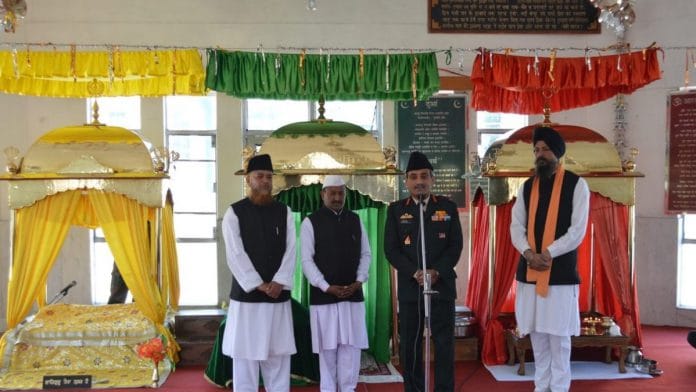



On 25 November, the Supreme Court upheld the Delhi High Court’s order dismissing Lt Samuel Kamalesan for “acts of misconduct” under Army Act Section 19 read with Army Rule 14. The colonial-era ‘offence’ was Kamalesan’s refusal to participate in certain religious activities at his regiment, 3 Cavalry, which he said conflicted with his Christian faith.
The “acts of misconduct”, cited in the show-cause notice dated 31 January 2019, pertained to his refusal to “enter the Regiment Sarv Dharm Sthal, which comprises Mandir, Church and Gurudwara” and non-attendance of religious functions in the regiment. “On explaining the ethos of the Indian Army and its secular approach and the necessity to bond with men, you have been indifferent and resolute on your stand,” it added.
As per Kamalesan’s petition, the unit was of a fixed class composition with subunits of Sikh, Rajput, and Jat troops, and that it did not have a Sarv Dharm Sthal but a separate Mandir and a Gurdwara. Written orders calling the regiment to the weekly religious parades referred to them as the “Mandir Gurdwara Parade”, and even in common parlance the term “Sarv Dharm Sthal” was not used in the regiment. He further contended that he attended all religious parades/festivals, and only sought exemption from entering the innermost part or sanctum sanctorum of the temple where religious rituals were conducted due to his monotheistic Christian faith. He would nonetheless remain present with his fellow troops in the temple courtyard, after duly taking off his shoes and belt, with clean hands and a turban on when necessary.
Both the High Court and the Supreme Court primarily focused on the adverse impact of the officer’s actions on discipline — disobedience of lawful command, cohesion, and morale — and held that individual religious beliefs cannot override these factors.
However, the larger issue, which is the root cause of the problem, escaped scrutiny: the non-secular composition of the concerned unit and the bulk of the Indian Army on the basis of religion, region, and caste, and its prevailing religious practices.
This composition and the current religious practices are in conflict with the Constitution in terms of equality and secularity. While this was a rare case where an officer’s individual religious beliefs came into conflict with the Army’s religious traditions, in the prevailing environment of politicised religiosity and the military hierarchy pandering to the same, it is time for introspection and reforms.
Also Read: How SC order against Lt Samuel Kamalesan overlooks the genius of Indian secularism
Unconstitutional composition and religious practices
Even 78 years after independence, the Indian Army continues to retain the colonial legacy based on the dubious martial class theory of fixed class composition at the unit or subunit level in most fighting arms, and to some extent in artillery and engineer units as well. ‘Class’, in military terms, implies a single religion, caste, or region.
Based on the policy of divide and rule, the British gave overriding importance to religion in the fixed class units. Religious teachers were authorised for 120 soldiers of any religion. Religious parades and ceremonies were made mandatory. No major event or activity could begin without a religious ceremony. Rather than merely looking after the spiritual needs of soldiers, religion became all-pervasive.
It is these traditions that are blindly followed even 78 years after independence. The justification is that religion, caste, and regional pride enhance cohesion, which is a battle-winning factor as has been proven in wars before and after independence. However, this is illogical, as the performance of all all-class mixed units is no less.
Indeed, cohesion — the emotional bond between soldiers — is a battle-winning factor. Soldiers are motivated to fight because they do not want to let down their comrades or be seen as a coward by them. Cohesion is built by living, playing, training, and facing privations and danger together. Religion, caste, or region play little or no role. The Brigade of Guards, the bulk of artillery units, and all units of the services prove this point. The Indian Navy and the Indian Air Force, with only merit-driven recruitment, too are stellar examples. These two services do not have religious teachers or institutionalised places of worship. They do not follow the rigid system of mandatory religious parades. Religion is considered a private affair and all are free to practice it.
The case of Lt Samuel Kamalesan should be viewed in light of the above. It is the system itself which requires radical reforms, as it is against the idea of India and impinges on constitutional fundamentals of equality and secularity, apart from the universal norm of meritocracy.
Reforms fall short
The adverse impact of class-based composition and undue importance to religion has been kept in check by rules, regulations, military law, and a merit-driven all-class officer corps. As a result, the overall ethos and conduct of the Army has remained secular. It was, however, tested to the limit in 1984 when a number of Sikh units mutinied in the wake of Operation Blue Star. Most of these mutinies started from the unit Gurdwara. The Army took a decision to gradually change to all-class units. One battalion per regiment was raised on this basis. But since the officer corps and the hierarchy were a product of, and seeped in, the existing system, the reforms were scuttled after a few years and status quo ante restored.
The second reform undertaken in the late 1980s was the creation of Sarv Dharm Sthals in all-class units and in some stations. Holy books and other essentials of worship of all religions were placed in one room, with soldiers free to pay obeisance on their own terms. The Institute of National Integration was raised in 1984, where all religious teachers are trained, keeping in mind the nation’s secular ethos. Apart from their own religion they are familiarised with the basics of all other religions. At the Sarv Dharm Sthals, the religious festivals of all faiths are celebrated. However, the codification of the procedures to be followed has not been formalised. Surprisingly, even for the existing system, norms have not been specified. Regulations for the Army, Volumes 1 and 2, have just three cryptic paragraphs — 332, 1125, and 1385 — to cover management of religious practices. By default, units evolve their own system, generally based on teaching at the Institute of National Integration and regimental traditions.
There is an urgent need for the Army to extend the concept of Sarv Dharm Sthals to all units and codify the norms of conduct of ceremonies and celebrations of festivals. Stand-alone worship places of specific religions must be done away with. The introduction of the Agnipath scheme, where Agniveers are recruited on all-India, all-class merit and will in due course make up 75 percent of the Army, makes Sarv Dharm Sthals a necessity. This opportunity must not be missed. The norm of one religious teacher for 120 soldiers of a religion must be reviewed to avoid default domination by the majority community. A pool of religious teachers of different faiths can be kept at the formation or station level to meet the spiritual needs of all units.
Religion is not the predominant factor for creating unit cohesion, and must only focus on spiritual needs. Thus, the concept of mandatory parades and attendance must be reviewed. An open house must be maintained, and attendance must be voluntary.
Hierarchy compounding the problem
Since around 1990, religion has been dominating the national discourse. It has polarised politics and society, and there has been a very assertive and visible resurgence of the majority religion in the public domain. The minorities, forever perceiving an existential threat, have followed suit.
Despite the younger generation of the armed forces being a product of this society, the macro-level secular military ethos, rules and regulations, and military law have prevented any adverse fallout, even with the flawed composition and religious practices.
However, there should be no doubt that the secular military ethos is under stress, which is compounded by the unethical conduct of a section of the military hierarchy.
Either for personal gains in the form of promotions or post-retirement benefits, or what is even more disturbing, due to conviction, a number of senior officers are publicly identifying with political ideology seeped in civilisational past and religion. They are literally in competition with each other to be seen in religious places, hobnobbing with religious leaders, linking military events to mythological religious past, and giving new religious names to organisations.
This is a very dangerous trend for an institution in which it is expected that a soldier shed his personal beliefs and identity to be subsumed by the organisation’s collective apolitical and secular ethos.
Also Read: India’s military leaders should steer clear of political bombast. Give professional advice
Time to bury the colonial past
Lt Samuel Kamalesan was found guilty of violating the religious practices of the existing colonial system. It is for consideration whether the actions of a conscientious objector, who did try to partially adhere to the norms, could impact the cohesion and morale of 3 Cavalry, a 103-year-old unit. More so when the unit, as per my assessment, did not have a Sarv Dharm Sthal, and there is nothing on record to show that any objection raised by the soldiers. The matter could either have been ignored, or he could have been transferred to an all-India, all-class unit. The case was mishandled by the chain of command, to say the least.
Prime Minister Modi is committed to making India shed the colonial mindset in 10 years. He had also conveyed his intent to the armed forces during the Combined Commanders’ Conference in 2021. The Indian Army must take the lead to transform its colonial composition and religious practices. It is in the national interest for the armed forces to remain apolitical and secular in the true spirit of the Constitution. Last but not least, the hierarchy must set an example.
Lt Gen H S Panag PVSM, AVSM (R) served in the Indian Army for 40 years. He was GOC in C Northern Command and Central Command. Post retirement, he was Member of Armed Forces Tribunal. Views are personal.
(Edited by Asavari Singh)
The author is a retired Army Cdr, one of the top 6 in the hierarchy. Hard to fathom this post retirement empathy on such a silly issue when he was in a position to change things. Did he? Nopes. Why does all this gyan and enlightenment boil to the surface post retirement in the top brass? Let’s address this issue first and leave cases of insubordination to the organisation and the courts.
I’m sorry but I’d disagree with the claim that this dismissal reflects a ‘colonial mindset’.
Such narrow-mindedness belongs neither in politics, nor in the armed forces. The officer’s misconduct lies not in his Christian faith (or someone’s hypothetical Muslim faith), but in the idea that religion, to them, is conclusive, exclusive, separative, and competitive (explained below). This view of religion underlies reactions like his, and it is precisely why the common all-faiths worship tradition of the military was anathema to, and ill behoves, an officer.
(Explanations of terms)
Conclusive: One’s faith is God’s final word.
Exclusive: No other belief system is valid or, as often implied and sometimes stated, even respectable.
Separative: All beliefs and practices not conforming to God’s word must be shunned and condemned.
Competitive: Different faiths are in a perpetual mutual competition as a means of salvation.