






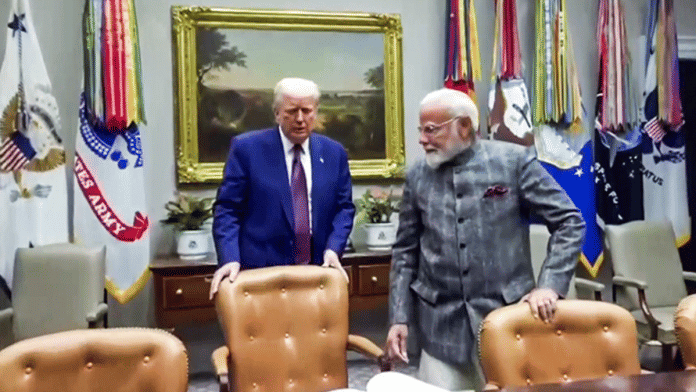



After months of stop-and-start diplomacy, New Delhi and Washington have finally unveiled a framework for a trade deal. It is light on detail, rich in political theatre, and already crowded with competing narratives. Tariffs on Indian exports, the Trump administration said, would plunge from 50 per cent to 18 per cent. India, in return, would purchase $500 billion in American goods and services over time.
Most dramatically, Washington asserted that New Delhi would also halt purchases of Russian oil. These claims are calibrated as much for domestic applause as for diplomacy. Yet, as with many framework announcements, the fine print is either unfinished or intentionally elastic. Prime Minister Narendra Modi, in response, took a different tone, emphasising partnership, shared prosperity, and democratic affinity.
Cooperation between “two large economies and the world’s largest democracies,” he argued, would unlock opportunity and benefit the people. “Wonderful to speak with my dear friend President Trump today. Delighted that Made in India products will now have a reduced tariff of 18 per cent,” PM Modi said.
The new trade understanding arrived amid an atmosphere of tension and misread signals between New Delhi and Washington, instantly fuelling talk of a reset. The familiar epithets, such as “natural allies,” a “defining,” even “consequential” partnership of the 21st century, suddenly rang hollow. In the first year of Trump’s second term, the relationship has been turned on its head, recast through punitive tariffs, coercive bargaining, and unapologetic geopolitical conditionality.
The trade agreement, however opaque its contours are, offers a momentary reprieve. By easing punitive tariffs and reopening space for selective market access, it halts, at least for now, the downward drift in the partnership. Yet the central question persists: does it offer an opportunity for a genuine reset or merely stabilises an increasingly transactional and uncertain relationship? The answer is not to be found in trade mechanisms alone. The durability of any thaw will depend on how larger geopolitical currents evolve: the trajectory of US-China rivalry, the persistence of tensions with Russia, and India’s own commitment to balancing without binding.
Therefore, the meaning of the agreement lies less in its fine print than in the strategic logic that produced it. If the deal reflects a deeper convergence of interests, it could become the foundation for renewal. If it is simply a tactical pause driven by short-term necessity, uncertainty will remain the defining feature of the relationship.
A deal forged in geopolitics
India and the United States have been negotiating new terms of economic engagement for years, including a long-pending Bilateral Investment Treaty (BIT). Yet the intensity and the public acrimony with which Donald Trump’s second administration has conducted itself over the past year has triggered an upheaval unlike anything seen in the partnership’s recent history. As tariffs swung like a pendulum, the strategic foundations of the relationship, though buttressed by steady institutional cooperation, began to look increasingly exposed to geopolitical shock.
As Donald Trump poured greater personal capital into brokering a settlement between Russia and Ukraine, India’s defence and energy partnerships with Moscow moved to the centre of Washington’s gaze. But the more the United States pressed, the narrower the political space in New Delhi became to offer concessions. What Washington framed as hard-nosed bargaining landed in India as coercion. Public admonitions, hints of secondary sanctions, and expectations of visible alignment ran headlong into India’s strategic culture that prizes autonomy above approval.
As the rhetoric sharpened, India accelerated diversification. Business with Moscow continued where interests demanded it. Engagement with Beijing was recalibrated cautiously. And Europe emerged with renewed urgency as India sought to broaden its options, culminating in the long-sought announcement on an India-EU Free Trade Agreement (FTA).
The India-US trade deal did not arise from the standard procedures of diplomacy. It was negotiated in the long shadow of geopolitical churn and the unmistakable pressure of economic coercion. Over the past year, Washington escalated tariffs on Indian exports, citing trade imbalances and New Delhi’s import of Russian oil. Hence, the agreement undoubtedly creates immediate economic and strategic talking points that both governments can package as victories. Yet the larger signal demands closer scrutiny. Market access and trade concessions are now tied to expectations of strategic behaviour more explicitly than at any point in the relationship.
If this linkage becomes the operating principle of engagement, the partnership begins to change its nature. It shifts away from the promise of durable strategic convergence and toward something more conditional, defined by transactions, shaped by circumstance, and sustained by reciprocity rather than trust.
Also read: US-India interim agreement shows strategic use of trade language—millets, almonds, DDGs
A diplomatic reset or a strategic repositioning?
Does the trade deal restore predictability to the relationship? “Trust” in international politics is often invoked as sentiment, but in practice it is an operational principle sustained by deliberate policy choices and favourable circumstances. Over the past year, that foundation has been shaken by geopolitical and geoeconomic shocks—some structural, others clearly manufactured.
The agreement nonetheless offers reassurance. It signals that cooperation continues to generate value in both economic and strategic domains. The decision to negotiate rather than extend confrontation in itself shows that neither side appears willing to let the partnership drift into open estrangement.
However, the new brand of transactionalism and geopolitical conditionality attached to the deal reflects some warning signals as well. Transactionalism is not new, but it was rarely presented as a fait accompli. If economic engagement with the US now comes tethered to expectations of strategic alignment, the future may look far more uncertain than reassuring.
For India, this cuts to the core of its long-held commitment to strategic autonomy in dealing with a materially superior power. For Washington, however, such precedents generate usable leverage, normalising the turn to economic coercion as an instrument of diplomacy. Should the deal be read in Washington as a successful test case, the temptation to replicate the model might grow.
If there is one thing that the second term of Trump’s presidency made the “new normal”, it is the apprehension among partner countries that his next social media post or a new executive announcement might upend previously committed deals or agreements. This concern continues to linger, and the trade deal or diplomatic niceties are not likely make this disappear.
The trade deal reflects domestic complexities as well. In Washington, performing economic toughness resonates with constituencies anxious about trade deficits, de-industrialisation, and supply-chain vulnerability. In New Delhi, shielding politically sensitive sectors, especially agriculture and dairy, is simply non-negotiable.
The durability of the partnership will, therefore, depend on whether both sides can institutionalise dispute resolution mechanisms rather than rely on episodic political bargaining. For India, diversification and creating choices of foreign policy will remain imperative.
This will translate into deeper engagement with Europe, greater reliance on regional trade arrangements, continued investment in the Russia partnership, and a cautious, interest-based stabilisation with Beijing. These are not signs of strategic drift but are insurance policies aimed at cushioning the shocks generated by America’s own uncertain equations with Europe, China, and Russia.
Monish Tourangbam is a Fellow at the Chintan Research Foundation (CRF), New Delhi. Views are personal.
(Edited by Saptak Datta)