






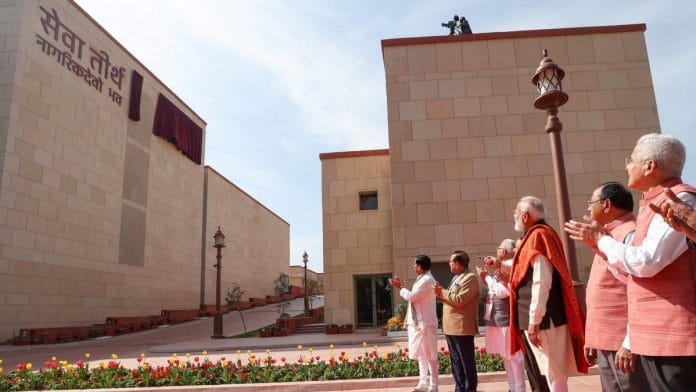



This has been a few days of new beginnings. Headlines in major newspapers signalled winds of change across many spheres. Prime Minister Narendra Modi inaugurated new offices for the PMO and central secretariat: Seva Teerth and Kartavya Bhavan. The use of an entire set of colonial-era buildings came to an end with this migration.
At our eastern borders, neighbouring Bangladesh conducted fresh general elections under the hawk’s eye of interim leader and academician, Muhammad Yunus. The Bangladesh Nationalist Party, led by Tarique Rahman, the son of the late former PM Khaleda Zia, secured a landslide victory, with a two-thirds-majority. Rahman, who returned after almost 20 years in imposed exile, is now set to be sworn in as the prime minister of Bangladesh.
The past week also saw the glad news that India will be inducting 114 Rafale jets into the Indian Air Force. Under the MRFA (Multi Role Fighter Aircraft) project, 90 of these will be manufactured in India. Defence Secretary Rajesh Kumar Singh stated that this is the first time these jets will be manufactured outside France, with deliveries commencing after 2028. In addition to this, the DAC (Defence Acquisition Council) has authorised the purchase of long-range SCALP missiles for the existing Rafale fleet, as well as 288 anti-aircraft missiles for the Russian-made S-400 air shield system.
Today, India kicked off the world’s largest AI summit, with delegates from over 100 countries participating. AI has been the greatest disruptor in recent years, and organising an event of this magnitude, with over 100 global CEOs expected to attend, is no mean feat.
Verse 13.13 of the Bhagavad Gita, where Lord Krishna explains the Supreme Truth, is loosely translated as: “I shall now explain the knowable, knowing which you will taste the eternal. This is beginningless, and it is subordinate to Me. It is called Brahman, the spirit, and it lies beyond the cause and effect of this world.”
The above verse postulates that an ultimate reality transcends creation, destruction, and material existence.
Also Read: Ghaziabad suicides show social media is the new opium. India’s policy must curb it
New buildings, new beginnings
Last Friday, PM Modi shifted the PMO to Seva Teerth, a modern, state-of-the-art facility designed to “consolidate key executive functions and enhance administrative efficiency.” The ministries of Finance, Defence, Education, Culture, and Law and Justice were also among those relocated to Kartavya Bhavan-1 and 2.
We can interpret Gita Verse 13.13 in this context to mean that colonial structures have outlived their utility, even though they were once presented as enduring and civilisationally transformative. Belonging to the domain of transient material constructs, the old has served its purpose, and its persistence in post-colonial life only serves as a reminder of a dark, subjugated past. New India needs to be judged by new changes, new constructs, and new beginnings.
De-colonisation, therefore, becomes a due process of institutional reform, political realignment, intellectual redevelopment, and cultural reconstruction. The new buildings stand as a physical manifestation of PM Modi’s Panch Pran vision for Viksit Bharat 2047 — a set of five guiding principles. These include a resolve for a developed India by the 100th anniversary of independence, freedom from a colonial mindset, pride in India’s heritage and roots, unity and solidarity among citizens, and the fulfilment of civic duties with honesty and integrity.
New defence systems and civilisational endurance
We are, with patience and diligence, trying to find pathways to a new India. Purchasing state-of-the-art defence mechanisms that will protect our borders and citizens is the need of the hour. Citizen First, Country First is the policy of New India, as shown also by the historic touchdown made by PM Modi on India’s first emergency highway in Assam on 14 February.
Gita Verse 13.13 can be interpreted here as well: advanced weaponry is impermanent and must be updated for a larger civilisational continuum and for the greater good of the country. India’s acquisition and modification of advanced Rafale aircraft and modern missile systems reflects a pragmatic attempt to secure the sovereignty and unity of her borders, and serves as a deterrent in a volatile regional environment. Military prowess, like that of historic empires, remains contingent upon evolving threats, technological advancements, and shifting geopolitical sands.
The impending Rafale acquisition, therefore, is based on security derived from civilisational endurance, prudence in strategy, and ethical restraint. Rafales do not represent an ultimate guarantee of power, but are merely an instrument in India’s broader pursuit of stability, geopolitical autonomy, and regional peace. The Make in India programme for Rafales and the new missile systems will result in code-sharing, where the weapons can be adapted to meet India’s strategic defence requirements. This is the need of today’s India.
Brothers in arms
Despite India playing a major part in the existence of Bangladesh, there was an anti-India, anti-Hindu phase sweeping the neighbouring nation, with whom we share so much more than a border. A common language, a shared love for art and culture, and susheel and sabhya bhadralok can be found on both sides of the Gangetic delta.
However, as Verse 13.13 indicates, nothing except God is eternal. The recent elections, held after a long period of Sheikh Hasina’s rule, and the chaos that ensued, have brought about winds of change.
PM Modi’s congratulatory message to prime minister-designate Tarique Rahman, who has been elected democratically, welcomed the victory of democracy.
“As two close neighbours with deep-rooted historical and cultural ties, I reaffirmed India’s continued commitment to the peace, progress, and prosperity of both our peoples,” PM Modi posted on X. The new establishment in Bangladesh has responded with cautious optimism, speaking of “mutual respect” and a “diplomatic reset”.
In light of the above verse from the Gita, the turbulence of Bangladesh’s politics illustrates the distinction between enduring societal consciousness and transient political power — a reminder that legitimacy rests in alignment with the moral and civil aspirations of the people. A shared value system and common genetics cannot be eroded by current geopolitical opportunism. India looks forward to a positive reset in the centuries-old shared ethos of the Bangladeshi and Indian people.
Also Read: India-EU FTA gives template for shared governance. It will rewire a market worth €27 trillion
The ultimate disruptor – AI
AI has turned the entire world topsy-turvy in the last couple of years. It is transforming what computer science education looks like, and those even in other fields, unless they embrace AI at the earliest, risk being left behind, uneducated, and unskilled. AI is everywhere — in writing, in movies, and even in scams.
India is seen as a massive prospective market for AI, and ChatGPT has even offered an India-only tiered subscription plan, including a free version. To explore AI, India is playing host to one of the largest AI events in history between 16-20 February.
Verse 13.3 explores a reality beyond the material form. Could that be a predictor of the world in the era of AI, when a programmed brain may be able to outperform a human brain? Or does the verse’s metaphysical reference allude to an inferior intelligence generated through code, one that will never equate itself with consciousness or the ultimate knowledge system described in the Gita?
Bharat has recognised that AI has the power to transform economies and governance, and is adapting to its speedy evolution. Bharat has also created its own Sarvam AI, which reportedly outperforms ChatGPT and Gemini on several benchmarks. This underlines the impermanence of technical paradigms and the rapid obsolescence of technology-driven innovations. Will AI become an endpoint of knowledge? Or will it remain a transient tool in humanity’s search for wisdom and ethical knowledge? These and many other discussions will make the AI summit an exciting and invigorating experience.
Good administration is about Citizens First and Country First. As the Gita reminds us, material forms are transient, but sewa and kartavya endure. It is these that India’s leaders are weaving together to build a Bold Bharat.
Meenakashi Lekhi is a BJP leader, lawyer and social activist. Her X handle is @M_Lekhi. Views are personal.
(Edited by Asavari Singh)