






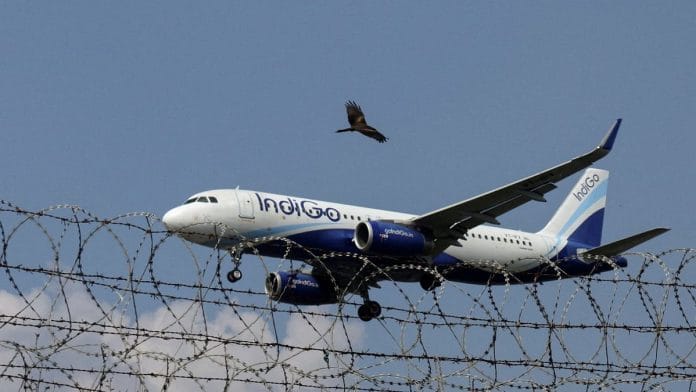



The last time ‘indigo’ occupied so much of print space was during the Champaran Satyagraha in 1917.
India’s civil aviation sector descended into unprecedented turmoil in the first week of December, literally grounding the entire nation. What began as a routine enforcement of long-overdue safety regulations spiralled into a nationwide meltdown, exposing the fragility of an industry burdened by unchecked expansion and regulatory complacency.
Much has been written in the last few days on the genesis of the crisis and the underlying factors. Broadly speaking, three aspects stood out:
- IndiGo failed (miserably) to anticipate and plan for changes in safety regulations that were two years in the making.
- The Ministry of Civil Aviation (MoCA) and the designated regulator—the Directorate General of Civil Aviation (DGCA)—were found clueless in the hour of crisis.
- The passengers were left to fend for themselves in an information vacuum, unable to resolve their grievances.
A similar crisis unfolded in Ireland in 2017. It offers lessons on how India can navigate the IndiGo implosion.
Lessons from Ryanair crisis
Ryanair is an Ireland–based low-cost airline that follows a business model similar to that of IndiGo. The airline operates over 640 aircraft, largely comprising Boeing 737 and Airbus A320 variants.
In 2017, from September to December, Ryanair faced an unprecedented pilot shortage, which was initially blamed on rostering—a crew planning process—that failed to account for planned pilot leaves. It led to cancellations of over 2,000 flights, affecting nearly 400,000 passengers.
Ryanair took a significant reputational hit, exposing underlying pilot shortages and poor management. CEO Michael O’ Leary admitted the airline’s shortcomings and blamed the crisis on a “rostering issue“. However, the incident highlighted broader industry challenges with low-cost carriers struggling to retain experienced pilots due to better conditions offered by rivals.
There is more than one similarity with India’s current crisis.
- Both issues stemmed from preventable pilot rostering failures at high-volume low-cost carriers, amplifying into massive cancellations during busy periods. The factors leading to the situation were well known to the planners.
- Thousands of stranded passengers were left looking for answers. The airline’s apologies, refunds, and compensation overpromised and underdelivered, compounding the crisis of trust.
- Both crises highlighted the risks inherent in a lean staffing model. IndiGo’s minimal buffers in crew availability mirror Ryanair’s rostering philosophy.
- December is usually the holiday/wedding season in India, generating high demand for airlines, similar to the early winter season in Ireland.
- Both crises featured an unhappy crew (pilots) and not-so-muted dissent.
Ryanair’s leadership ignored the crisis for the first few days. It took some time for the airline to appreciate the gravity of the situation, after which the focus shifted from dissing the crew to addressing their concerns. Ryanair began quietly improving pilots’ pay and working conditions, with O’Leary publicly admitting that the airline had “messed up” pilot allocations and needed to repair trust, with the crew as well as its passengers. The efforts paid off and Ryanair is in a strong financial position today.
IndiGo could take a leaf out of Ryanair’s playbook. Besides fixing the rostering department, the airline needs to work in a mission mode to repair trust with the operating crew and passengers alike.
Also read: India needs a hybrid aviation model. Passengers deserve safety and reliability
Three solutions
The IndiGo crisis demands not palliatives but structural overhauls. Here are three targeted recommendations drawn from global best practices.
1. Resource mapping
All operating rights, expansions, or regulatory shifts must be preceded by mandatory resource mapping. This analysis must look at available crew, fleet serviceability, airport and airline infrastructure, availability of necessary backups, and regulatory capacity before issuing approvals. There would be no need to introduce additional paperwork for this measure, as all the airlines already submit ICAO Air Transport Reporting forms (A to N) to the DGCA. These forms essentially provide feedback on crew detailing, flight schedules, personnel, and compliance forecasts.
The same submissions could be integrated with AI tools to provide a dashboard displaying existing resources. This would help predictive analytics. The data can be used to track fatigue metrics and capacity gaps, as is done by the European Union Aviation Safety Agency for slot allocations. Similarly, the DGCA could use this information to restrict airline–specific operations as the US Federal Aviation Administration (FAA) did in 2022 to curtail Southwest Airlines operations after the 2022 fiasco.
2. Liberating the DGCA
The DGCA must be reorganised into a fully autonomous Civil Aviation Authority (CAA), mirroring the FAA’s independence, with adequate budgetary allocations untethered from MoCA grants.
The staffing at DGCA/CAA must be reflective of the needs of this specialised sector. Instead of hiring UPSC-approved generalists, the focus must be on recruiting aviation professionals. An independent and autonomous DGCA/CAA should be able to attract the best talent by offering prevailing market salaries and allowances. The large pool of aviation professionals available with the Indian Armed Forces can be used for this purpose.
Officers could be brought on deputation or absorbed post-retirement. The FAA proudly claims that one-third of its personnel are former military. In the UK, the CAA recognises the qualifications achieved during military service and helps veterans transition to civil aviation. The DGCA must be overhauled so it acts proactively instead of merely reacting to the crisis.
3. Aviation Ombudsman
The current means to address passenger concerns are far too inadequate to meet the sector’s rising demands. There is a need to establish a statutory Aviation Ombudsman with quasi-judicial powers to adjudicate complaints.
The ombudsman should have the powers to impose instant compensation, pending final resolution. The funding required for the working and staffing of the ombudsman could be drawn out of penalties and levies imposed on erring airlines. This institution could be modelled on Australia’s nascent Aviation Industry Ombudsperson, which was launched in 2024 with binding resolutions and a Rights Charter.
The IndiGo implosion of last week was no freak storm. It was a reckoning for an aviation sector that soared on the wings of deregulation and crashed on complacency’s rocks. Stranding lakhs amid festive cheer, it inflicted not just economic scars, but a profound erosion of public faith. Passengers, from Delhi’s harried commuters to Mumbai’s medical evacuees, became collateral in a game of corporate greed and regulatory reticence.
India must use this opportunity to learn its lessons, bring in sectoral reforms, and come out stronger. Or we could simply wait for the next crisis to ground our dreams.
Group Captain Ajay Ahlawat is a retired IAF fighter pilot. He tweets @Ahlawat2012. Views are personal.
(Edited by Prasanna Bachchhav)
Socialist India is very bad at copying good things from developed countries. Hence, India can’t be expected to copy US FAA.