






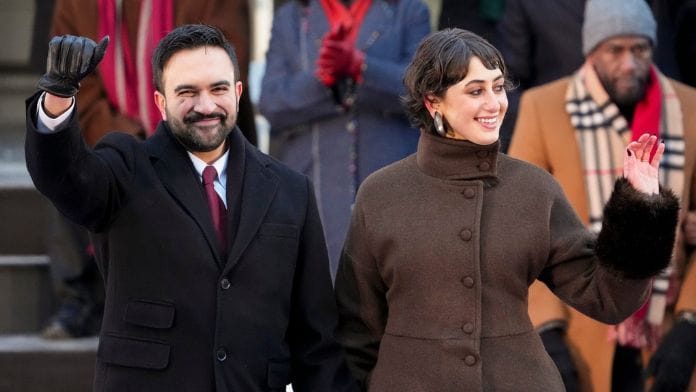



NYC’s maverick mayor, Zohran Mamdani, is learning the hard way that campaigning in poetry is easy, governing in prose is difficult. He famously quoted these lines in his victory speech in November last year, but his shaky politics have now come home to roost.
Mamdani and his Syrian wife, Rama Duwaji, have often been questioned about their support for Palestine. Mamdani has insidiously and strategically deflected questions about his wife’s personal likes and ideologies and has correctly pointed out that it has no relation to his work as the mayor or his politics.
Until this weekend. At a press conference, Mamdani was asked about his wife’s illustration for a book of essays — Every Moment Is a Life: Gaza in the Time of Genocide — edited by Palestinian-American author Susan Abulhawa. The mayor, instead of defending Abulhawa, who has repeatedly spoken out against Israeli aggression in Gaza, called her rhetoric “reprehensible,” while clarifying that his wife had never interacted with the author directly and that any connection between them was through a third party. As many on social media pointed out, he defended his wife by “throwing [the Palestinian author] under the bus”.
And he did that after building his politics around the Palestinian cause, speaking like a true champion of those oppressed in Gaza and the West Bank, and describing the Israeli government as “committing a genocide” while standing next to President Donald Trump.
And yet, when it came to a Palestinian voicing those and similar views, he couldn’t hold his ground even for a moment and labelled her tweets as “patently unacceptable” in an attempt to disassociate his wife from those tweets, quietly playing into the hands of the American right.
Well done, Mamdani, you not only handed them a stick to come back harder at you with their scrutiny — and come back they will — but also dismissed a figure like Abulhawa who speaks from her lived experience. Associate with the community, disassociate with an individual from that community.
Here’s what makes Mamdani’s seemingly routine political clarification feel like a betrayal.
Palestine, he once claimed, was the “core” of his politics. In his own words, Palestine drew him toward the Democratic Socialists of America, which officially describes Israel as an “apartheid, settler-colonial state”. During his mayoral campaign, he refused to recognise Israel as a Jewish state, saying that he supports its right to exist only “as a state with equal rights.” He also backed the boycott movement and promised to honour an international arrest warrant against Benjamin Netanyahu if the Israeli prime minister ever set foot in New York.
All that made Mamdani the celebrated poster boy of unapologetic ideals in the face of racist attacks—the politician who stood his ground in a polarised environment.
Now, it just seems like he is proving Trump right when the latter told reporters in his presence that “he [Mamdani] is going to change also. We all change.”
Mamdani and his politics of support
When he burst onto the political scene with his all-encompassing, funky, multi-lingual campaigns, Mamdani championed the cause of an alternate form of politics, and his supporters cheered him on.
But politics has a long memory. When you build your public identity around one defining cause (in Mamdani’s case, the issue of Palestine), every statement is going to be measured against that standard.
Mamdani cannot capitalise on a war, build a political brand around it, win office with it, and then expect immunity when contradictions appear. And contradictions are appearing.
Writer and activist Susan Abulhawa responded with a scathing but graceful rejoinder to Mamdani.
“In this instance, you have erred. You succumbed to forces that seek to pick away at you, your talented, beautiful wife, and your work, clawing harder with each apology or concession you make. If you aren’t careful, they will siphon your soul before you even realise it,” she pointed out. Here’s why it’s significant.
Abulhawa is not just any commentator. In the world of Palestinian literature and activism, she is a towering figure. To dismiss her criticism or, worse, allow her to be dragged while distancing oneself is bad-faith politics. Her words are not generalisations, but expressions of a historical reality.
The controversy surrounding Abulhawa also touches on a deeper intellectual concept, that which Adrienne Rich described as the “oppressor’s language.” The idea, rooted in post-colonial and feminist theory, examines how dominant languages, communication styles and norms of civility are used to maintain power and impose cultural hierarchies. Here, the same language used to colonise or oppress often becomes the only tool available to the marginalised to resist, protest and demand rights.
For the sake of drawing parallels—albeit in a different context—think of marginalised communities in India: Muslims, Dalits, Christians or even people from the Northeast. These communities have historically been subjected to labels and language imposed by those in power.
But what happens when they start using that language again? When they reclaim it? Will Mamdani denounce a Muslim voice speaking against mob lynchings to appease the Hindu Right in New York, if he doesn’t like their way of expression? Abulhawa’s response to Mamdani fits squarely into that tradition.
There is also an element of hypocrisy here.
Imagine for a moment that the roles were reversed. Imagine a mayor from the political Right using Mamdani’s language to dismiss a Palestinian voice and then brushing off any criticism. The cancellation from the Left and liberals would be immediate. Yet Mamdani’s defenders insist this moment should be viewed through nuance.
Perhaps it should, but then nuance cuts both ways.
No one is saying Mamdani had to endorse everything Abulhawa has ever said. Disagreement is part of political life. But there were a hundred ways to express disagreement without publicly discrediting a Palestinian intellectual.
The fact that even Rama Duwaji has not made any statement on this is telling. As someone who endorses Palestinian artists, it is almost impossible to believe that both Duwaji and Mamdani did not know about Abulhawa’s work, even if assigned through a third party.
Also read: Indians have a complicated relationship with Zohran Mamdani
Mamdani’s politics of compromise
The deeper issue here is not whether Mamdani is right or wrong about Abulhawa. The real issue is political consistency. If your politics are built on solidarity with marginalised voices, then distancing yourself from them when the pressure rises inevitably looks like compromise.
And compromise is something Mamdani has already been learning about in the office.
Sure, governing NYC is a complex task. It contains the largest Jewish population outside Israel and one of the largest Muslim populations in the US. Previous mayors, from John Lindsay to Rudy Giuliani, have taken strong stances on international conflicts, but they usually aligned themselves with positions that were politically safe for the city’s dominant constituencies.
Mamdani is functioning in far riskier territory. He has already moderated on several domestic fronts — his praising of the New York Police Department, engaging with Donald Trump, and navigating tensions within the Democratic coalition. But the Israel-Palestine question appeared to be the one area where he apparently refused to soften his views.
And that refusal is now colliding with the realities of governing. For someone like him, this is not new.
During his mayoral campaign, Mamdani was subjected to relentless Islamophobic attacks. His Muslim identity, his views on Palestine and his socialist politics were all used against him. He experienced firsthand how public narratives can be weaponised to isolate and delegitimise people.
Which is precisely why many expected him to respond differently now. Mamdani himself once warned about that language.
In his oath-taking speech, he promised that “there will be Palestinian New Yorkers in Bay Ridge who will no longer have to contend with a politics that speaks of universalism and then makes them the exception.”
Which is why the tension here is not simply about Mamdani versus Abulhawa. Sure, Mamdani is not an activist but a politician. He has to be moderate. But in Mamdani’s case, the issue is whether radical political language can survive the transition to democratic governance.
As writer Audre Lorde famously warned: “The master’s tools will never dismantle the master’s house.”
Mamdani still has three-and-a-half years left in office and in the master’s house. He might have campaigned in poetry with his rhetoric about justice, liberation, and solidarity. Now he is learning that governing in prose is messy, compromised and scrutinised.
(Edited by Prashant Dixit)
I am sympathetic to you Debdutta. I know you describe yourself as a fan-girl of Mamdani and you have cheered him on ever since he announced his candidature for NYC mayoral race.
I too was such a supporter of the Aam Aadmi Party (AAP) when it started out initially. Don’t you see the similarities between the first days of AAP/Kejriwal/Yogendra and the Mamdani brigade?
We all know how the AAP story played out – right now, it’s just another political party. The same will happen to Mamdani too.
But I do wish to caution about one thing. Just like AAP played with fire by courting Khalistanis in Punjab, Mamdani too courted Islamist radicals during his campaign. He played to the gallery and got in bed with all kinds of hardline and radical elements – the most ‘reprehensible’ lot. And it will come back to bite him.
Your sympathy for the Palestinians is well founded. But your description of Israeli military action as ‘genocide’ is grossly misplaced. Israel never ever committed any kind of genocide in Gaza (or even elsewhere). Look around the middle-east and you will observe that Israel is the only liberal democracy – a place where LGBTQIA+ and others of every kind and belief systems are free to do as they please. There is no point in vilifying Israel and making a devil out of it.
Mamdani is from the privileged class – what does he know of suffering and deprivation? He did whatever he needed to do to win the votes.