






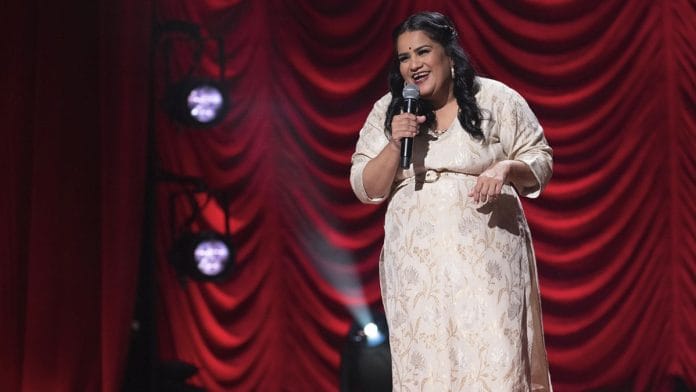



Zarna Garg didn’t offend the Indian diaspora with a punchline. She did it with a generalisation. The Indian-American comedian is facing immense backlash from overseas Indians – who once rooted for her – after claiming on a podcast that the Indian community “loves Trump”.
For many in the diaspora, this was a textbook case of the model minority argument, delivered confidently, sweepingly, and with the authority of someone claiming to speak for millions.
The criticism is blunt: she is performing respectability politics and calling it truth.
That charge is valid. But ironically, the outrage isn’t really about MAGA. Plenty of people hold conservative views. Some immigrants genuinely believe playing by the rules gives them moral authority, even safety. Garg is allowed her politics, her opinions, and the kind of jokes she wants to perform.
Punching inward
What rattled people was the flattening. She suggested Indians as a group “never got on board” with undocumented immigration, and framed legal immigration as a moral badge of honour. She is accused of speaking as though Indian-Americans form a single grateful, law-abiding bloc – the perfect immigrants in the US.
Even that isn’t my biggest problem with Garg.
My problem is that her MAGA moment merely exposed something that was already baked into her comedy.
For 16 years, Garg was a full-time mother and family caregiver. Her life was organised around other people’s needs before she finally carved out a space of her own during the pandemic, encouraged by her children. That alone is not nothing. For many women, that “permission” slip can be rare and hard-won.
Which is why it’s disappointing to ask the obvious question: now that she has the microphone, the sold-out tours, the bestselling book, the specials, the algorithm and the applause – what exactly does she want to say?
Because if you strip the claps and the cultural familiarity, Garg’s comedy often feels like an endless parent-teacher meeting. The jokes arrive pre-loaded: the loud Indian mother, the emasculated husband, the entitled children, money as religion. You don’t so much listen to the punchline as wait for it, like a microwave countdown. Beep. There it is.
This is IKEA furniture disguised as observational comedy. Recognisable parts, assembled quickly, no tools required. And like IKEA, it is popular. But popularity is not proof of quality.
Stand-up comedy has always thrived on exaggeration, sometimes reinforcing stereotypes. And to be fair, stereotypes can be powerful. But when a stereotype is repackaged as cultural truth, it stops being sharp and starts being lazy. That is the problem with Garg.
Her jokes don’t punch up or sideways; they punch inward. Immigrant life becomes a caricature frozen in time, stripped of contradiction or evolution. The Indian woman she performs exists in a cultural time capsule: perpetually shrill, transactional, emotionally stingy, and never impressed. There’s no curiosity about who she might become, only reassurance about who she already is. The comedy tells the audience exactly what they already think.
Garg’s public remarks about Trump and immigration felt jarring and familiar because the worldview was already there. When she jokes or speaks about undocumented immigrants being “rewarded” while Indians wait patiently in line, she is extending her stereotypical comedy universe. The order is good. Hierarchy works. Obedience is a virtue. Gratitude is survival. The politics simply gave language to what the jokes had long implied.
Contrast this with what other South Asian-origin comics have done with similar raw material. Hasan Minhaj turned family trauma into political commentary. Aziz Ansari interrogated masculinity and dating with self-loathing as a method. Kumail Nanjiani unpacked immigration and illness with vulnerability that risked sentimentality, and survived it. Vir Das, not an immigrant, built an entire brand – and found roaring success in the US – by politely saying the uncomfortable thing.
Their identities are not their punchlines. They annoyed their own people. They annoyed everyone else, too. That friction is the point Garg misses. Her comedy reinforces Indian stereotypes as if to say: we’re just like the cliches you already know, only louder.
Also read: The Chomsky–Epstein link exposes a blind spot in intellectual hero worship
The no-nonsense Indian mom
Let’s talk about who is finding her funny, because she is no doubt successful. Part of Garg’s audience is diaspora children laughing at their parents from a safe distance. Another part is mainstream American viewers enjoying the comfort of a familiar immigrant archetype that confirms their long-held beliefs. The laughs she draws are more relief than recognition. Relief that immigrant life in the US is legible, non-threatening, even grateful. Don’t worry, the joke says. We know our place.
Garg is comfortable with the brand of comedy that brought her success. But now that it has drifted into politics, the rhetoric sits uneasily beside a career built on caricatured immigrant resilience. Whether intentional or not, the message aligns with the values embedded in the jokes.
This is where the laughter curdles. When a comedian with Garg’s reach speaks confidently for an entire community, stereotypes harden into statements. The “no-nonsense Indian mom” stops being a character and becomes a worldview. The jokes about control begin to sound like endorsements of it.
This is the missed opportunity. Garg knows the audience. She knows the culture. She knows the constraints placed on women who look like her. She could dismantle the stereotype from the inside, ask why the Indian mother must always be angry, why love is expressed as control, why success is measured in property and pay cheques. Instead, she reinforces the structure and charges admission. Her comedy is consequence-free.
None of this is to deny her skill as a performer or her right to speak as she chooses. But comedy, like power, invites scrutiny when it accumulates. Sixteen years of waiting to be heard should lead somewhere. Right now, it leads back to the same joke – just told louder, on a bigger stage. This repetition is not rebellion. It’s reruns.
Views are personal.