






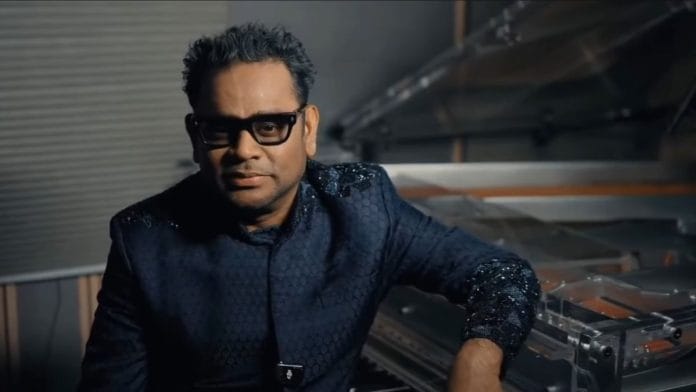



When you are a child, you don’t really know what a ‘music composer’ is. But even as a child, I knew A R Rahman. This is because no Republic Day or Independence Day celebration was complete until people had performed on his iconic song ‘Maa Tujhe Salaam’.
Thus, the recent turn of events is particularly upsetting to me.
Rahman, after days of sustained backlash over his remarks in a recent BBC interview, released a video message attempting to clarify his position. “India is my inspiration, my teacher, and my home,” he said. “I understand that sometimes intentions are misunderstood. But my purpose has always been to uplift, honour and serve through music. I have never wished to cause pain, and I hope my sincerity is felt.”
That such a statement had to be made at all is telling.
Rahman, after all, is not just another music composer. He is the soundtrack of modern India’s emotional and political memory. From Vande Mataram and Maa Tujhe Salaam to Jai Ho, from Roja and Bombay to Swades, Rang De Basanti and Dil Se, he has repeatedly lent his voice to moments of national aspiration, grief, rebellion, unity, and healing. His music has carried India across borders, into global consciousness, culminating in the unprecedented success of Slumdog Millionaire.
For over three decades, Rahman has been a cultural ambassador of Indian pluralism. And yet, in today’s climate, that legacy seems disturbingly fragile.
Rahman’s nationalism was never loud
In his BBC interview, Rahman remarked that work from the Hindi film industry has slowed for him over the past eight years. Instead of sparking a conversation about changing industry structures, evolving musical tastes, or the shrinking space for experimental and socially rooted art, his words were quickly reframed as complaint, bitterness, or worse, a political statement. What followed was a familiar ritual: outrage, suspicion, dogpiling, and eventually, an apology.
The speed with which we turn on our cultural icons should worry us.
Rahman’s career has been defined by an insistence on emotional complexity and moral nuance. His compositions for Bombay stitched together grief and reconciliation in the shadow of communal violence. Roja blended patriotism with vulnerability. Swades reimagined nationalism not as chest-thumping pride but as ethical responsibility. The Swades tune gives me a flashback of my country, and I still live in it. Rang De Basanti gave voice to youthful dissent, while Dil Se explored love and loss against the backdrop of insurgency.
His nationalism was never loud; it was introspective, searching, human.
This is a far cry from today’s dominant cultural mood, where nationalism is increasingly reduced to spectacle, volume, and rigid binaries. Over the last decade, mainstream cinema has mirrored this shift. Subtle storytelling has often given way to blunt messaging. Complex characters are flattened into ideological symbols. Patriotism is performed rather than felt. Moral ambiguity, once the hallmark of serious storytelling, is increasingly treated as suspicious.
In such an environment, Rahman’s music feels almost anachronistic. It refuses easy answers. It resists communal categorisation. It remains deeply invested in shared belonging rather than divisive identity. And perhaps that is precisely why discomfort with him has grown.
We now live in a cultural moment where artists are expected not just to create, but to perform ideological allegiance. Silence is suspect. Complexity is inconvenient. Nuance is dangerous. Every word, every pause, every interview becomes an opportunity to assign loyalty or betrayal. In this atmosphere, even someone like Rahman, whose work has consistently articulated India’s plural soul, can suddenly be viewed through a lens of mistrust.
Also read: The problem isn’t Honey Singh’s ‘vulgar’ remark. It is Indian society’s hypocrisy over sex
Defending the cultural ecosystem
What does it say about us that a man who gave us Vande Mataram must reassure us of his love for India?
The phenomenon of “cancellation” is not merely about social media outrage. It reflects a deeper anxiety, a shrinking tolerance for ambiguity, a growing impatience with dissent, and a moral absolutism that leaves little room for human imperfection. We increasingly demand ideological purity from artists while denying them emotional complexity. We want them to be symbols, not individuals. When they fail to conform to our expectations, we are quick to withdraw grace.
Yet Rahman’s life and work have consistently demonstrated what cultural grace looks like. His collaborations have crossed linguistic, religious, and national boundaries. His soundscapes have woven together Sufi mysticism, Carnatic precision, electronic innovation, and global pop. He has shown that Indian identity is not something to be guarded behind walls, but something that grows richer through exchange.
The tragedy is that instead of celebrating this expansive vision, we now interrogate it for hidden motives.
This is not about defending Rahman alone. It is about defending the cultural ecosystem that once allowed figures like him to thrive. When did we get so outraged that we started cancelling people for speaking their truth?
When we turn on icons who once unified us, we reveal something unsettling about ourselves.
Rahman’s music has long reminded us that India is not a slogan, it is a conversation. A conversation between histories, faiths, languages, and emotions. To cancel such a voice is not just to silence an artist. It is to shrink the space of our collective imagination.
I have seen people on the internet taking offence to ‘salaam’ in the ‘Maa Tujhe Salaam’ saying it should have been ‘pranam’. When we have made such a fragile ecosystem around us, how can we dispute his claim of communal politics in the system?
Anyway, Rahman to me will be a nationalist. I will play his songs on Republic Day or Independence Day, or whenever India swells with pride. After all, what was ‘Jai Ho’ if not an Indian pride anthem of the century?
(Edited by Saptak Datta)