









World’s largest, world’s tallest, world’s highest, world’s greatest—these epithets have haunted us since grade one GK quizzes. They have been so overwhelming that my knowledge of the world’s superlatives is now all I have to offer when my friends do trivia nights.
As I write this, the world’s largest *sighs at the redundancy* Shiva Lingam, is travelling all the way to Bihar from Mahabalipuram. It will be installed in the Virat Ramayana temple on 17 January. The 33-feet-tall lingam is so large, so humongous that Bihar does not even have the infrastructure to actually install it—two cranes are travelling from Bhopal to do the job.
One cannot not ask the question: Why is a state that could not get its bridges right (170 bridges collapsed and 202 people died in the last five years) so eager to set up the largest lingam in the universe?
The logical move would be to fix basic infrastructure first, chase cosmic superlatives later. Alas, ’twas not to be.
What is this obsession with claiming the biggest, the largest something? The Gujarat government, under Modi, set off to build the Statue of Unity, the tallest statue in the world after spending Rs 29 billion. In August 2024, a 90-foot Hanuman statue was built in Texas, US. That statue, with all its vastness, has now become a bit of a lump in the throat for MAGA supporters.
These neck-hurting, tall structures, in all their supposed prowess, serve an end. An end that—while being a waste of public resources and space—carries symbolic meaning that stretches even further than the structures themselves.
They are less about utility and more about posturing. For modern nation-states, colossal structures are essentially a symbolic display of their machismo. To be the tallest, largest are a display of an aspiration to be counted as big in the global conversation. It arises out of a complex. If you apply Freudian analysis to this, it boils down to the oldest question: Who is bigger?
Also read: India is an aerospace giant on paper, importer in practice—what China did right and we didn’t
Symbols of a city
If one were to look around, especially in big cities, this Sisyphean pursuit of trying to immortalise one’s regime has found a very loyal fanbase. There is a 108-foot tall Hanuman statue in Delhi that pops up right outside the Blue Line metro and has become Bollywood’s favourite establishing shot for “struggling migrant arrives in the big city.” That statue was unveiled in 2007 and has been silently auditioning for background roles ever since.
But let’s go back even further. At first there were domes. Glowing, pearly domes, visible from far away, dripping with grandeur and legacy and the general vibe of “history happened here.” So did this obsession really start with the Industrial Revolution, when production went on steroids and the world started dishing out magnanimous things like the Burj Khalifa, or the structure that has now become new-age Bollywood’s default hangout spot, Antilia? Or is this just the same old human itch, wearing newer, shinier concrete?
In India, a country that has been doing rather poorly on development metrics over the last decade, we have, quite impressively, been excelling at building very large things. Take Bharat Mandapam, a convention centre in the heart of Lutyens’ Delhi, unveiled just in time for the G20 Summit in 2023. It is sleek, stylish, and comes with a name firmly rooted in cultural gravitas. A neat little symbol of the new India in the making, one that seems increasingly keen to be Bharat more than India.
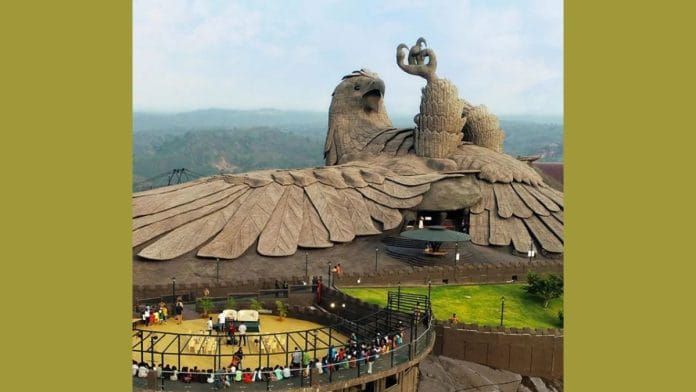
While travelling through Kerala, I was gently but persistently nudged by tourists to visit what they proudly advertised as the “largest bird sculpture” in the world at the Jatayu Earth Centre. A sculpture meant to “honour” a demi-god from the Ramayana. A millennia-old mythology, now accompanied by a very modern logistical question. How does one reach this monument? Drum roll, please. By heli-taxi. A helipad sits right in the middle of the wilderness, delivering equal parts spiritual elevation and Wakanda-lite vibes.
And more recently, the Prime Minister inaugurated a park called ‘Rashtra Prerna Sthal’, the latest addition to Lucknow’s competitive park scene. Uttar Pradesh has long treated parks as a political rite of passage. Mayawati, Akhilesh Yadav, and now Yogi. Acres were laid, statues were raised. This one comes with three 65-foot tall figures of Atal Bihari Vajpayee, Deen Dayal Upadhyay, and Dr. Shyama Prasad Mukherjee. If nothing else, it is a screaming illustration of what size means in the politics of symbolism. You build a 60-foot statue, I will build a 65-foot one.
Then there is the 125-foot tall Ambedkar statue in Vijayawada, Andhra Pradesh, unveiled in 2023. It arrived at a politically convenient moment, just as the Congress-led INDIA bloc was running a relentless campaign to “save the Constitution” ahead of the 2024 Lok Sabha polls.
I often board trains from a railway station in Bhopal that used to be called Habibganj and is now called Rani Kamalapati after a shiny makeover. The slick is there too. A massive structure that people say looks more like an airport than a railway station, except it has fewer benches, for people to sit on, than there were in the old Habibganj. Irony may have died many deaths, but this marriage of muscular nationalism and technocratic infrastructure lives on.
Until the Shiva Lingam finally reaches the pedestal it is meant to be propped on, we are left with just one question. Do we need any more giant structures? In the timeless words of Percy Bysshe Shelley’s Ozymandias:
“Nothing beside remains. Round the decay
Of that colossal Wreck, boundless and bare
The lone and level sands stretch far away.”
Views are personal.
(Edited by Theres Sudeep)
As if India homes the record for tallest biggest in everything ? All the nations of the world are obsessed with such things. It is basic human nature. Stop the unnecessary dissection.
Bigger thing are good.
Cleaner things are better.
Bigger and cleaner things with an ounce of civic sense is the best of the best of the best.
Obsession should be for cleanest and best streets.