






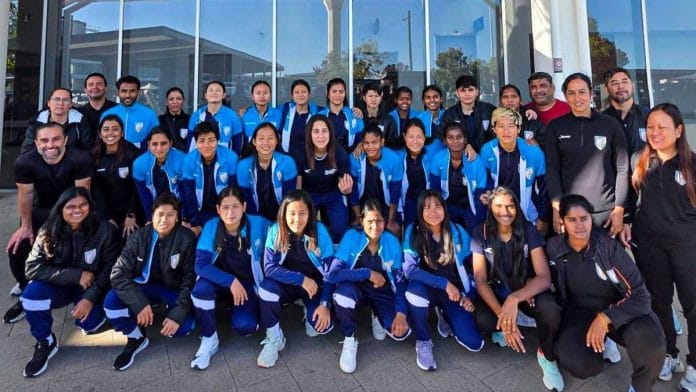



Indian women’s football team bowed out of the 2026 AFC Women’s Asian Cup in Australia after finishing at the bottom of Group C with zero points. The team, which qualified for the tournament on merit after 23 years, conceded 16 goals and scored just twice in three matches. But the 3-1 defeat to Chinese Taipei doesn’t capture the rise of the Indian women’s football team.
It’s a horrendous performance on paper, especially when Japan netted 11 past the Indian goalkeeper Panthoi Chanu Elangbam, and Chinese Taipei secured an easy, gifted victory due to the silly defensive errors.
But, there’s a bigger picture we are missing — the progress of India’s women’s football team. All the teams — Japan, Vietnam and Chinese Taipei — that India faced in the group stage are ranked higher than the Blues and enjoy a better sporting ecosystem in their respective countries.
In 2011, the Japanese women’s team defeated the United States in the final of the FIFA Women’s World Cup and lifted the trophy. This victory made Japan the first Asian team to win a senior FIFA World Cup. They also invest heavily in youth development.
The women’s team of Vietnam has already qualified for the World Cup in 2023 and continues to invest heavily in youth development.
Progress matters
On the contrary, India is still building the basics of its women’s football ecosystem. Domestic leagues remain relatively new, grassroots scouting is limited, and financial support is nothing compared to other nations participating in such a grand tournament. Also, to top it all, women participating in sports is still a taboo in India.
Overcoming such shackles, the women of India are proudly representing on the same stage with Japan, China, and Vietnam, among other teams. And, this is exactly how progress happens. Teams first qualify, then adapt to compete, and eventually begin to challenge stronger opponents.
In Asian football, qualifying for the AFC Women’s Asian Cup does not come easy. It requires overcoming the regional qualifiers where teams are increasingly investing in women’s football.
And, India did exactly that. It routed Mongolia 13-0 — biggest ever-win in the qualifier stage. The ‘women in blue’ continued their dominant performance and went on to emerge victorious against Timor Leste (4-0), Iraq (5-0), and Thailand (2-1).
The qualification matters because the tournament acts as a pathway to the FIFA Women’s World Cup. Even if India does not reach that stage yet, regularly appearing in Asia’s premier tournament is the first step toward global competitiveness.
This is something Indian football fans should recognise. For years, the Indian national football team on the men’s side has also struggled in continental tournaments.
The women, on the other hand, are quietly building that dominance. All good things take their own sweet time.
Also read: Delhi’s Women’s Football League has lawyers, teachers, mothers as players. It’s a safe space
A story of perseverance
It was easy for the crowd to look away from these hurdles and just focus on the ‘humiliating’ defeat that quickly overshadowed the broader achievement of participating in the tournament. And, under what circumstances?
Let’s take a look at the football administration in India — a country where the top-tier footballing event, the Indian Super League (ISL), was almost about to collapse due to multi-layered failure of governance, legal, and financial planning.
With such inconsistent football administration, uneven infrastructure, and fragile grassroots systems, the Indian women’s team has quietly managed something remarkable. And, we should appreciate it.
Coming from a football background, it isn’t difficult to see the hardships of the game in India. People used to turn up in practice only for an afternoon meal, which otherwise would have been difficult to secure at home.
Well, football is often dubbed as the ‘poor man’s’ game. And, rightly so, it just requires a football and a pair of shoes; at times, even those are not needed. But, Marta Vieira da Silva or Ronaldinho would not have reached the heights if Brazil had failed to provide proper infrastructure, training, and diet after their selection into the national team.
And, mind you, Brazil is a much poorer country when compared to India.
As of now, the women’s national team depicts a story of perseverance, which soon will be translated into performance.
To expect India to suddenly rout top-class teams is irrational. My friend, it only happens in video games.
Views are personal.
(Edited by Aamaan Alam Khan)
Brazil is much richer and has been much richer than India on a per capita basis.