






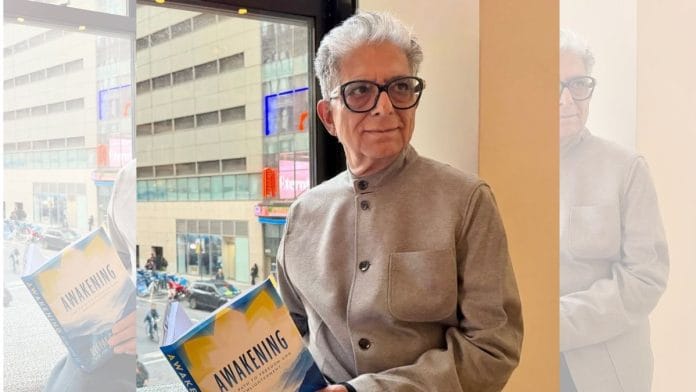



Deepak Chopra is no holistic guide. He is a master of packaging — a global merchant of comfort, calm, and cosmic language, who learned long ago how to sell India’s civilisational vocabulary to a restless, wealthy West. For decades, he has occupied a rarefied moral pedestal in the United States — one of those wellness gurus who arrived during America’s post-1960s hunger for meaning, rode the cultural fascination with the East, and converted mysticism into a lucrative, celebrity-backed industry. That carefully cultivated authority now collides with the Epstein Files.
Chopra’s name appears repeatedly in the latest tranche of documents linked to the late sex offender Jeffrey Epstein. In one exchange attributed to him, the man who built a career preaching consciousness and higher awareness wrote: “God is a construct. Cute girls are real.” Where, exactly, does spirituality go when a self-appointed moral voice sounds indistinguishable from the language of the very elite ecosystem now exposed as one of the most protected and predatory in the 21st century?
The 79-year-old has since issued a statement insisting he never engaged in criminal or exploitative conduct and expressing remorse for the “poor judgment in tone” of some past emails. But such damage control feels feeble not merely because of the grotesque source, but because of what it exposes: a decades-long pattern of Indian spiritual and alternative-medicine figures being embraced uncritically by Western audiences and elevated to celebrity status with minimal accountability. Chopra is the most recent face of that pattern. The Epstein Files have exposed him and, along with it, the Indian guru-industrial complex.
‘Eastern wisdom’
In the 1960s and 1970s, figures such as Maharishi Mahesh Yogi and Rajneesh Osho became fixtures of Western popular imagination. Maharishi’s Transcendental Meditation was embraced by Beatlemania elites; Rajneesh’s retreats drew seekers in droves. They were cultural phenomena, branded across magazines, television interviews, and Hollywood circles.
That fascination reflected a West disillusioned with its own institutions and material excess. Indian gurus offered something exotic and apparently transformative. They were marketed as spiritual dispensers of answers Western modernity claimed it lacked. What was framed as “Eastern wisdom” hardened into a multi-million-dollar lifestyle industry.
The Epstein Files puncture the myth that protected this ecosystem for decades — that fame and influence are not proxies for virtue.
For years, Chopra’s authority in the West has rested on a vocabulary designed to sound scientific without being answerable to science. “Quantum healing”, “mind-body intelligence”, “consciousness-based medicine” — phrases that travel easily across talk shows and corporate conferences, but collapse under professional scrutiny. Repeated debunking of his claims by scientists and medical experts did not dent his standing. If anything, controversy burnished his reputation as a misunderstood visionary in a culture that treats scientific pushback as proof of intellectual daring. His books kept selling, the invitations kept coming, and his aura remained intact.
Chopra had already crossed over from being evaluated as a medical or intellectual figure to being protected as a cultural asset — the benevolent Indian yogi who softened corporate America, humanised ambition, and offered elite audiences a conscience without confrontation.
The business model was simple: wrap ancient vocabulary around modern anxiety, keep the claims expansive and unverifiable, and position the messenger above ordinary professional accountability.
Also read: Dear Deepak Chopra, yes, cute girls are real. So are perverts at Epstein parties
A shield cracked
Chopra’s influence catapulted him to a social figure who circulated comfortably among financiers, celebrities, political elites, and corporate patrons — precisely the class of people for whom Epstein functioned as a social facilitator. The line about “cute girls” is not an accidental lapse of judgement. It fits the register of a world in which influence is lubricated by misogyny, sycophancy, and entitlement.
Chopra became the perfect product of the Western appetite for readymade mysticism, a spiritual celebrity engineered for consumption. Effortless enlightenment, alternate healing techniques, and personalised transcendence were repackaged for elite comfort.
Rajneesh and Mahesh Yogi also enjoyed long periods of mythic protection before their contradictions surfaced. Till then, critics were dismissed as narrow-minded and scrutiny was reframed as hostility toward non-Western cultures.
Thanks to the Epstein Files, that shield has now cracked in a far more unsettling way. And it also corrodes a larger story of spiritual depth, moral seriousness, and civilisational wisdom that India has spent decades exporting through personalities rather than institutions. When authority flows this way, reputational hygiene becomes optional.
God is a construct but the system that insulates men like Deepak Chopra is very real and very rigged.
Views are personal.
(Edited by Aamaan Alam Khan)
Once again….
This opinion piece is a textbook example of agenda-driven journalism masquerading as cultural criticism. The author uses Deepak Chopra’s indefensible emails as a convenient excuse to launch a sweeping attack on Hindu spiritual figures and traditions—while conspicuously ignoring comparable or worse scandals across other religious communities.
Let’s be clear: Chopra’s comments were reprehensible, and he deserves scrutiny. But notice how quickly the author pivots from one individual’s misconduct to indicting an entire “guru-industrial complex,” dragging in Rajneesh and Maharishi Mahesh Yogi to paint all Eastern spiritual teachers with the same brush. This is intellectual laziness at best, deliberate malice at worst.
Where is this same energy when Catholic priests, bishops, and cardinals are convicted of systemic child abuse spanning decades? Where are the searing op-eds about the “Church-industrial complex”? Where is the outrage over documented cases of sexual abuse in madrasas by Islamic clerics? These aren’t hypotheticals—they’re well-documented scandals involving thousands of victims. Yet they receive no mention here.
The author’s closing line—”God is a construct but the system that insulates men like Deepak Chopra is very real”—reveals her true agenda. This isn’t about accountability or protecting victims. It’s about using one man’s failures to delegitimize Hindu spirituality itself, while conveniently ignoring that systems protecting predatory religious figures exist across ALL traditions.
If your concern is genuine—if you truly care about holding spiritual authorities accountable—then apply that standard consistently. Critique abuse wherever it occurs, not just when it allows you to take potshots at Sanatana Dharma. Otherwise, this isn’t journalism. It’s selective outrage in service of prejudice.
Chopra may have responded inadequately, but at least he responded. Show me the mullahs and bishops who’ve shown similar accountability. I’ll wait.
**Disclaimer or not, publishing myopic hit pieces like this on a media platform doesn’t make them legitimate analysis—it just amplifies bias.**
—
Feel free to adjust the tone or emphasis as needed.
I agree that Chopra is a fake who translated indian Vedic texts pretending to be original that were a revelation for the West.
But we can’t paint the whole clan black . There are genuine spiritual teachers from India who have a universal holistic wellbeing approach and are helping uplift humanity – I know at least 2 – Sadhguru and Amma (pls research them yourself and perhaps take one of the programs with Isha to make up your mind) . Thank you !