






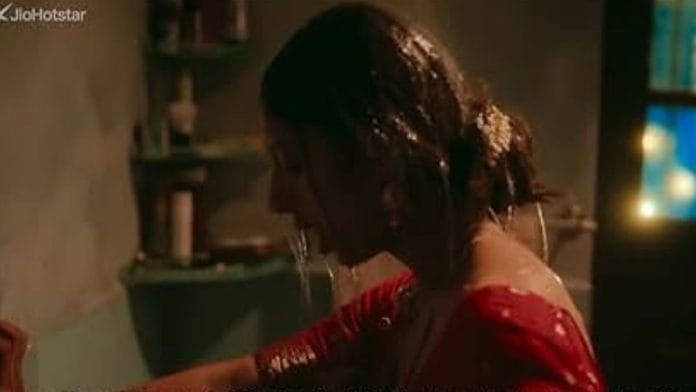



Streaming on JioHostar, the new series Chiraiya starring Divya Dutta, Siddharth Shaw and Prasanna Bisht, takes on a difficult question often ignored in India—consent within marriage as well as the legal and cultural invisibility of marital rape in our country.
In a media landscape where we are spoonfed stories that depict marriage as the ultimate happy ending, Chiraiya does something radical. It begins the story there and dismantles the illusion we associate with marriage as the ultimate destination for love. Chiraiya is, in turn, a remake of the Bengali web series ‘Sampurna’ streaming on Hoichoi.
For as long as I can remember, society and popular culture have treated marriage as a moral blanket. Once it is draped over a relationship, everything becomes permissible or at least private. We are hushed under the ambiguity that what happens inside the marriage, it stays between the husband and wife. The contract becomes binding; legality precedes consent.
Marital rape is structural
Chiraiya confronts this head-on and shows us how absurd this claim is, how tradition is used as a beating stick to keep women in check. And how internalised misogyny makes women look at other women as objects as well.
This can be seen by a devastatingly simple exchange in the series. After the protagonist, Pooja (Prasanna Bisht), is sexually assaulted by her husband, her sister-in-law, Kamlesh (played with an unsettling conviction by Divya Dutta), attempts to rationalise the abuse.
If someone takes their own things out of their cupboard, she argues, does that make them a thief?
To everyone watching, the flawed logic of the line cannot wash away the feeling of the familiar sentiment we have grown accustomed to. This is exactly how marital rape keeps getting normalised in our society, with metaphors that reduce women to property. Wives are looked at as ‘things’ you can have access to or take from whenever you want.
Pooja’s rebuttal to this statement is simple. “I am not a thing,” she says, “I was not bought”. A fairly simple statement that isn’t revolutionary. But when you connect to the context of Indian law, where marital rape is still not criminalised except under special circumstances, it becomes a statement of defiance.
What we also need to understand is that marital rape as an act doesn’t stand in isolation. It is not just physical but structural. It is embedded in language, in legal frameworks that provide caveats to abusers, in family dynamics where women are subjected to the keywords “adjust”, “compromise”, and if she is graced with an ounce of dignity, “forgive” for Indian women, who are the testing ground of patience and endurance.
What makes this reality even more suffocating is the backdrop of the normalcy of domestic life. Women are expected to fulfil the ‘marital act’ as a duty and also perform domestic and emotional labour, a facet of which we explore in Sanya Malhotra starrer ‘Mrs’.
Also read: In this Women’s History Month, Dhurandhar 2 is the biggest hit. Let that sink in
Series like Chiraiya important
Conversation about consent, in recent years, has started entering mainstream discourse. We have a lot of films exploring the importance of consent, one of the important movies being Shoojit Sircar’s Pink (2016) and also the less talked about movie about date rape, Satyaprem Ki Katha (2023). But films about marital rape are yet to make the cut.
But this topic is equally, if not more, important. To put it into perspective, for 163 years, raping your wife has not been considered a crime in India.
It doesn’t stop there. Some Indian judges have even ruled that the denial of sex is mental cruelty, as seen in the observation made by the Allahabad High Court in May 2023, while granting divorce to a husband, the petitioner, who filed for divorce from his wife, alleging “mental cruelty”, when she refused to live and have sex with him.
These “observations” then surrogates the same legal foundation that legitimises marital rape. Because according to the Indian legal system, sex is owed, it is a marital duty, denial of which is manipulation and cruelty. Then how does taking what is owed to you by force amount to a criminal act? Consent needs to have a “sufficient” if not a “valid” reason, as it is “implied”.
Marriage in India, actually the subcontinent, is plunged deep in the pits of patriarchy and is directly proportional to property and permanence. Thus, consent becomes arbitrary, a formality, maybe not even that.
As of January 2026, the Supreme Court held that due to Exception 2 of Section 375 IPC, the husband could not be prosecuted for rape. Thus, I feel the series Chiraiya and the discourse around it is of the utmost importance, especially when it comes at the auspicious time of Women’s History Month. Because in a society where marital rape is still debated as an idea rather than acknowledged as a reality, that insistence is, in itself, a form of resistance.
(Edited by Saptak Datta)