






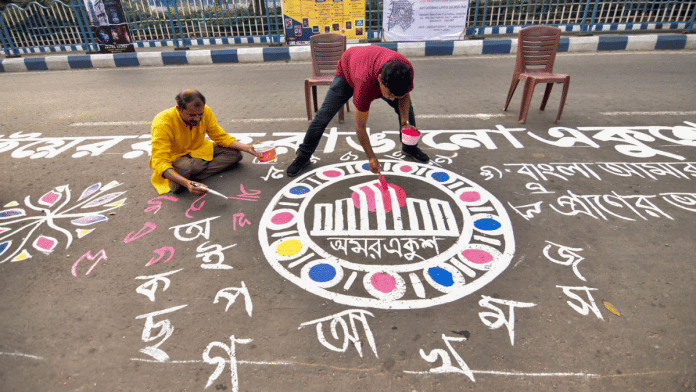



Three ‘Ps’ are a favourite with Bengalis: Pride, prejudice, and pomposity. Yes, we are proud. We chant that age-old phrase, “Ami gorbito ami Bangali”, with conviction, boasting about a legacy long lost in the past.
It’s still acceptable to be proud of a culture that now remains under a smog thicker than Delhi air. What we do not accept is that the past shall not come to rescue us. Not unless we pop the bubble of our delusional elitism, and get up from the lazy settee to revive the “pride” in its actuality. Because the pride fades the moment “Bangla” tries to assert itself. Irony thumps when you realise this sitting in Kolkata, West Bengal.
At a time when we are talking about the revival of a culture, we get a song, ‘Order Chara Border Cross’ — it has verses like ‘Nokol Visa’. If a song like that played inside a pub, Bengalis will not even tiptoe to its tunes, for we might just be noted thought of as Bangladeshi. Music exposes us. At any Bengali wedding or a pub, your ears will ring with anything but Bengali songs. It has becomes way too “local”, and some might even mutter, “Bangladeshi”. The panic is real. Back in 2023, I was travelling from New Jalpaiguri Junction near Siliguri to Darjeeling and wanted to play music in the car. But the chauffeur firmly said, “Bangladeshi gaana mat chalana, please (Don’t play Bangladeshi songs).”
Weaker hooks and an over-analysing audience never go hand-in-hand. In songs such as ‘Tumpa Sona’, ‘Paglu’, the merging of Hindi words in Bengali songs drift the core apart—what is “Paglu…thoda sa karle romance (Paglu… have a little romance)” ? This urge to go pan-Indian by merging our songs with Hindi words has left us with a severe identity crisis.
Songs like ‘Shing Nei Tobu Naam Tar Singha’, ‘Jibone Ki Pabo Na’, ‘Banya Banya E Aranya’ and many more, are now long-forgotten. These are the songs that can be danced to — but are such songs remade?
Badshah comes, picks up verses from ‘Boro Loker Biti Lo’, and lo-and-behold, we have the makings of a hit party number with ‘Genda Phool’. Ratan Kahar, who received Rs 5 lakhs from Badshah (as the composer, who fetched lines from his song), said, “Yes, my son confirmed Rs 5 lakh from Badshah has entered my bank account. But money is not everything, I am happy as he has credited me as the composer of the lyrics.” The Bengali folk artist from Birbhum says he was happy with just the “recognition”. Our problem is that we do not realise, and therefore, do not know who or how to give recognition, and when. We are just bruised and battered still stuck on “Once upon a time”.
Ratan Kahar exposed that wound. It is not that Bengali roots lack power, rhythm, or mass appeal, but Bengalis themselves hesitate to foreground them until someone else does it for us. We wait for validation to arrive from outside, through pan-Indian music composers, global filmmakers, and others, to get that stamp of approval. We do not call our own “worthy” in the first place. So by the time it happens, “recognition” becomes a happy consolation.
Sowing seeds of discrimination
Discrimination has increased in Hindi-speaking states over time. Every time I bump into a “Probashi Bangali”(a Bengali speaker living outside of Bengal) most of them prefer not to be identified as a Bengali. Even if they speak the language, they do not acknowledge the culture.
In every Hindi-speaking state we visit, we see a constant obsession with our surnames; if not, you might at least come across one native telling you, “This is not Bengal, this is…” However, this sentiment is not contemporary; we can trace it back to the colonial legacy, the post-Partition influx and more, which has led to the annals of massacres that keep haunting our spines, even today with discriminatory slurs and slangs.
With time, everything got sanitised. Our weddings, festivals, and pubs now hum popular Bollywood hits, for in 2026, sophistication means pretending to be something we are not. The media also mirrors a similar format.
We continue to credit heritage because we seldom build spaces where our songs could thrive without translation. We struggle because we like to romanticise outsourced confidence. And that’s why the “gorbo” (pride) keeps losing its voice.
Shatakshi Ganguly is an alum of ThePrint School of Journalism currently interning with ThePrint.
Views are personal.
(Edited by Insha Jalil Waziri)