









It’s five in the morning when the city remains undecided. Closed stores, dim streets, and stories yet to form for the day. Winter or not, the road learns her before the city does — a woman on a cycle cuts through time. That’s Lata didi for you — saving Rs 20 a day by declining autorickshaws, pedalling across six households that earn her Rs 15,000 a month. She has an unemployed husband and two working kids, aged around 18-19, who earn about Rs 12,000 per month.
Lata didi is conscious of her vanity — well-coordinated accessories, checked nail paints, and a matching purse. She is very careful not to repeat an outfit more than twice a week. Lata didi lives a meticulous life, and by the time we see Bangla or Hindi cinema wake up to a woman like her, she has already lived a life that our filmmakers rarely know how to pen.
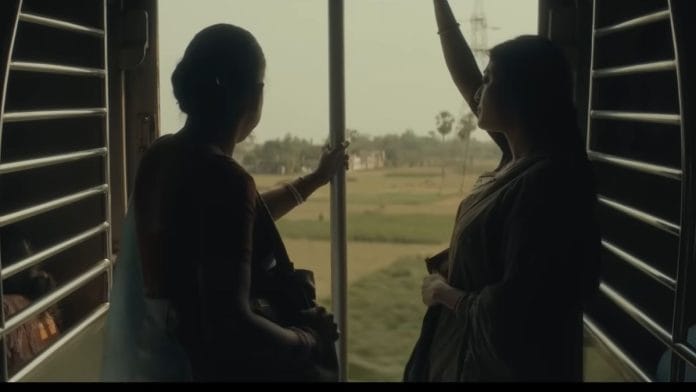
But the unusual happened this year in Bengal with Ram Kamal Mukherjee’s film Lokkhikantopur Local. And that is how I saw Lata didi in a different light. In the film, urban families hire domestic workers after life batters them with anticlimactic vicissitudes. One might argue: why would anyone hire a domestic worker if there is no apparent need? But the question should delve deeper into the vulnerability of their work status. The film zeroes in on the daily commute of three women — Malati (Chandreyee Ghosh), Kalyani (Paoli Dam), and Saraswati (Saayoni Ghosh) — who travel via the Lokkhikantopur Local train. It contrasts their struggle with the urban lifestyle — something that deeply mirrors my Lata didi pedalling to work on a cycle at a time when we speak only of cabs. At the end, the narrative immaculately intersects the journeys of the families and the domestic workers, through universal desires and similar destinies.
An evolution
Bengali cinema, not long ago, portrayed domestic workers as the epitome of timidity.
In Tapan Sinha’s Galpa Holeo Satyi (1966), a domestic worker ends up in a dysfunctional family and brings the members closer. One fine morning, Dhanonjoy (Rabi Ghosh) knocks at the door of a chaotic joint family, where no domestic help wants to work for long.
Soon after Dhanonjoy gets hired, the chaos in the family fades — but at what cost? It was possible because of Dhanonjoy’s “at your service” attitude, doing all the chores at “minimal cost”, and maintaining humility. Overburdening of the labour class is just a passing concern here. His presence exposes how comfort is not achieved through reform but through exploitation. Dhanonjoy’s low-cost service becomes the lubricant that keeps a broken home running.
Again, the 1996 film Puja, directed by Subhash Sen, draws a line between the “jhhi” and “maalik/kortababu.” Puja (Rina Choudhury) works as a servant at Pratap Chowdhury’s home. The lady of the house tortures Puja whenever she makes a mistake. Later, Puja becomes the saviour of Pratap’s daughter Moina — again, ‘saviour complex’. To earn a pedestal, women like Puja have to become ‘messiahs’. Puja later gets romantically involved with Chayan, Moina’s brother-in-law. The infamous song Chhi Chhi Chhi Ami Barir Jhi (Ew, I am the housemaid) comes right after. It is followed by Amar sathe prem kora ta tomar saje ki (Does it suit you, romancing me?) — where we learn that two people of unequal status can’t fall in love.
Also read: AI can replace my job, but not my vibe
The shift
Rituparno Ghosh’s Bariwali (2000) primarily explores the isolation of a wealthy landlady, Banalata. It also subtly draws the viewer’s attention to Malati, a domestic worker. We see Malati under Banalata’s firm control. But, Malati is also a free, liberated, sexually active woman, who stands in contrast to Banalata’s life. Here, we witness a shift — shift in recognising that a woman like Malati can taste the nectar of liberation, even though she encounters thorough scrutiny by Banalata.
That, lastly, brings me to Mrinal Sen’s 1982 film Kharij, which offers an eye-opening look at the employment of underage servants. Child labour is a reality in India and worldwide — I refer to Lata didi’s two kids here, too. Kharij itself becomes the metaphor, therefore, releasing the unspoken truth about how often a society dismisses the uncomfortable truth, blatantly refusing to talk about the very roots of child labour.
Cinema, by and large, has been a medium for us to learn, to feel. The most radical thing cinema can do is resist dramatising domestic workers. Because by the time the city fully wakes up, shops pull up their shutters, and we get the hang of the day’s grammar, Lata didi has already completed half her workday. Cinema will continue to debate, theorise, and occasionally sympathise. But does Lata didi wait for representation anymore?
Views are personal.
(Edited by Aamaan Alam Khan)