









The US-based Pew Research Center is one of the world’s best opinion and attitudes research organisations. It is less agenda-driven than many others, even though to call it completely free from inherent biases would be difficult, since its roots are in Christian America. Put simply, I respect it for its non-ideological, non-political approach to finding out what people think all over the world on specific issues and topics. (You can read about the organisation here). But this can sometimes result in perverse results.
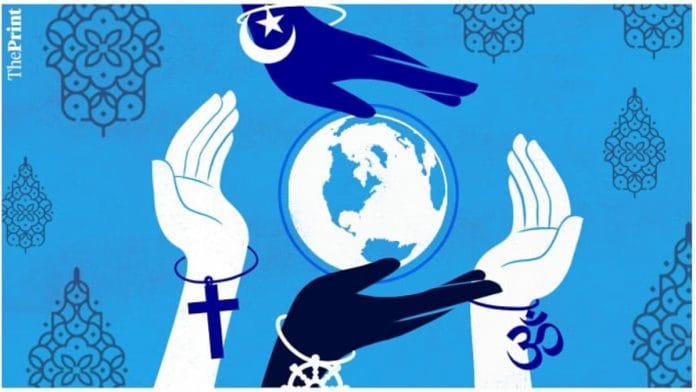
Pew’s survey on religious diversity around the world is interesting, but simply lacks enough nuance to warrant serious consideration. Its study of religious diversity uses a simple metric: how evenly various religious groups are represented in each country. It restricts the religions counted to seven categories, Christian, Muslim, Hindu, Buddhist, Jew, those with no religious affiliation, and those who don’t fall into any of these categories. The survey compares changes between 2010 and 2020.
Before we discuss the details, a few caveats are in order.
One, religious diversity in any country is only a statistical demographic exercise for Pew. Populations that are evenly divided among the seven categories (or even fewer categories) score the highest (10 on the religious diversity index), and domination by one religious category can send it to the bottom (zero where a country has only one religious group).
Two, diversity here does not mean highly tolerant. A country with a fairly even distribution between two or three religious communities can be deemed diverse, even though its communities are at daggers drawn.
Three, the survey tends to treat the category called “religiously unaffiliated” as a diversity plus, but it can have perverse results. The US is seen as the most religiously diverse country because the share of those who do not see themselves as belonging to the Christian majority has risen, thus balancing the overall 64 percent majority who remain Christian. Netherlands, where the share of this unaffiliated category has risen to more than half, slips to a lower diversity category because it is now less Christian. China, where the non-religious category is huge at 90 percent, ranks 126. One should ideally see countries with fewer religious affiliations as a part of diversity, not lack of it.
Four, the survey does not consider diversities within religions – which Pew admits – because the exercise would then become too complex. Treating the various Christian denominations as part of diversity would have improved the USA’s rank, but not considering India’s internal religious diversity within Hinduism is not the same when Hindus are often a category defined by excluding other religions. We get to 79 percent Hindus in India by eliminating Muslims, Christians, Buddhists, Jains and Sikhs out of the total numbers. The internal diversities within Hinduism and Christianity and Islam are not the same for Hindus do not have a sense of a common founder or widely accepted fundamentals. Most Hindus can easily identify as Hindus not because of a common definition, but because Hinduism gives people wide latitude to believe in any god, many gods, or even no god. Treating diversity in monotheistic Abrahamic traditions on a par with non-monotheistic or even non-theistic traditions like Hinduism, Buddhism or Jainism is not right. In my view, adjusted for this, India would be among the most religiously diverse countries in the world, and does not deserve rank 78 in the list.
This is apparent when one looks at the countries at the bottom of the list. Eight of those countries that are religiously non-diverse are Muslim, and two Christian, both Abrahamic religions. All 10 at the bottom belong to monotheistic belief systems.
The other problem with the methodology used is that it tends to bring very small countries, whose defining feature may not be about religion, to the top. Of the top 10 religiously diverse countries, five have populations of under 10 million, with Suriname, the second after Singapore, having just 6.4 lakh people.
The defining characteristic of Singapore is not religious affiliation, but ethnic affiliation and single party rule. Three-quarters of Singaporeans are ethnically Chinese, and no religious community steps out of its boundaries as the limits are defined by the Chinese majority, which itself is religiously diverse. Small countries, with much to lose if there were busy fighting identity battles within, have a common interest in maintaining the peace. They are different.
Conclusion: the Pew study, while methodologically transparent, does not make any worthwhile point on diversity.
R Jagannathan is an editor and the former editorial director at Swarajya magazine. He tweets @TheJaggi. Views are personal.