









For once, it is very clear that the war between Iran and US-Israel is not ending anytime soon, despite reports that Islamabad will be the meeting point for Iranians and Americans to negotiate. The bombings by both Israel and Iran has continued. The war is likely to drag on until either side in the conflict feels it has achieved its objective. This has obviously shaken the global economy, but it has also left Iran’s neighbours in a quagmire where, like Tehran, they are waiting for clearer answers to the questions being asked there today: will the war go on forever, or will it end when “Israel is destroyed and America retreats?” Or when “Iran is in complete ruins and we [Iran] surrender?”
Besides struggling to survive and ensuring that neither the country nor the state collapses, Tehran has also demonstrated its ability to play a complex strategic game. There are five aspects to its approach:
First, continue to fight and keep the US confused about how much arsenal it has to hit back at American troops, thereby encouraging Washington to think more carefully about any possible land operations.
Second, while continuing to appear belligerent vis-à-vis the US and Israel, Tehran has also continued to bomb its neighbours, increasing the cost of hosting US troops so that these Persian Gulf littoral states impress upon Washington the need to stop the war.
Third, allow non-partisan states and regional neighbours to move ships and cargo through the Strait of Hormuz, making it difficult for countries like India and Pakistan to take a clearer or more hostile position vis-à-vis Iran.
Fourth, signal to other neighbours, such as Saudi Arabia, through diplomatic channels, encouraging Riyadh to reconsider deeper involvement in the war.
Fifth, keep the Strait of Hormuz closed to put pressure on the world, which could then convince the US to back down from its war against Iran.
Needless to say, many other states, such as Sri Lanka, are wary of getting involved in a war that seems to have no end and was started by an American president for whom the main currency is power — exercised globally with little justification or consultation.
Washington’s ambitions, compounded by Iran’s strategy, make things even more difficult for Tehran’s immediate neighbours, which, despite their politics, are unable to stay out. Two such states are Saudi Arabia and Pakistan. While they may want to see the Iranian state collapse, they are careful not to escalate the conflict themselves, fearing it could trigger a situation they would find difficult to manage or contain.
Also read: Can Pakistan stay neutral on Iran? Saudi Arabia holds the purse strings
Pakistan Army chief understands the risks
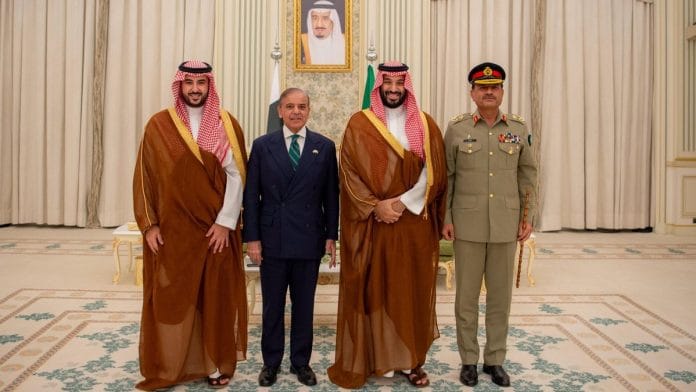
While Riyadh hosts American troops and air force assets, Pakistan has been engaging enthusiastically with Washington, especially since 2022. Notwithstanding Islamabad’s eagerness to join Trump’s Board of Peace coalition for Gaza, the Iran war is a different matter. Islamabad has been unwilling to get involved in an American war against Iran. However, it remains committed to protecting Saudi Arabia if the latter responds militarily to Iranian actions.
Pakistan’s strategy so far has been to work quietly as an interlocutor, especially by warning Riyadh of the consequences — a direct war between Tehran and Riyadh would bring destruction not only to Saudi Arabia but also to Pakistan.
Pakistan’s army chief, Field Marshal Asim Munir, may have become more conscious of these risks following reactions among Shia communities in Gilgit-Baltistan after Ali Khamenei’s killing in February, as well as his recent interactions with Shia religious leadership. Reportedly, he was direct and firm, warning them against involvement in the conflict or inciting sentiments in favour of any side. His intention clearly was to deter overt support for Iran.
At one point, he reportedly told members of the gathering to go to Iran if they pursued pro-Iranian politics. Munir was also reportedly angered by attacks on military installations in Gilgit-Baltistan, for which he has little tolerance. He warned that such incidents would be treated on par with the alleged May 9 attacks by Pakistan Tehreek-e-Insaf (PTI) and dealt with accordingly. Narratives emerging on social media, especially from Shia sources, have further complicated matters. The concern is that any domestic conflict this time may not remain confined to one group but could draw in other disaffected actors who believe Iran is justified in fighting the US.
Munir’s strong messaging also appears to be part of a broader strategy to prepare for a scenario in which Islamabad is asked, or compelled, by Saudi Arabia to invoke their mutual strategic security agreement. Pakistan has historically committed to the kingdom’s security, especially under the pretext of protecting the holy cities of Mecca and Medina.
In the early 1990s, when Pakistan’s then army chief, General Aslam Beg, refused to participate in the US war on Iraq, forces were nevertheless deployed to Saudi Arabia for its protection, though away from the Iraq border. If Riyadh were to enter the current war, it would be framed as a matter of Saudi security, something Islamabad cannot refuse.
Can Pakistan stay out of Iran war?
Though many believe Pakistan will stay out even if Saudi Arabia intervened militarily, this assumption is worth questioning given Pakistan’s economic dependence on Riyadh. The Saudi government, which signed an agreement with Pakistan in September 2025, was aware of Islamabad’s economic vulnerabilities and, as per a source, factored these into its commitments to secure Pakistan’s support.
There is, therefore, a view among some analysts that if Saudi Arabia enters the war, Pakistan may have limited room to decline involvement. This position has also been echoed in political messaging. According to Prime Minister Shehbaz Sharif’s spokesperson, Musharraf Zaidi, “right at the top, there is no question of if and when. Whatever is needed from Pakistan vis-à-vis Saudi Arabia, Pakistan will be there before it is needed [and] similarly for Saudi Arabia…”
This raises further questions about how much Saudi Arabia knew of US plans to attack Iran. It is possible that Riyadh had a clearer sense of the direction events were taking after the Israeli attack on Doha, prompting it to build its security cushion, including seeking assurances from Pakistan.
Some Saudi strategic analysts argue that Pakistan’s support could extend to a nuclear umbrella. Such claims may have risen less from explicit commitments and more from long-standing perceptions created by Saudi financial support for Pakistan’s nuclear programme. One is reminded of the rare access granted to Saudi Defence Minister Prince Sultan bin Abdulaziz, who visited the Khan Research Laboratories in Kahuta near Rawalpindi shortly after Pakistan’s nuclear tests in May 1998.
However, Pakistan’s military is very conscious of the repercussions of any nuclear proliferation or transfer of technology without US approval. Such approval is unlikely, especially in a scenario involving Israel. Any such move would also intensify scrutiny in Washington over the safety and purpose of Pakistan’s nuclear arsenal, which is officially framed as a deterrent against India.
Hence, the aura of a Pakistani nuclear umbrella for Saudi Arabia remains more myth than reality, something that can only be verified once used. Until then, Islamabad is likely to continue offering conventional security support and assurances to the Saudi royal family. As far as the current West Asia conflict is concerned, Pakistan will likely continue its dual approach: verbal commitment to Saudi defence, while working toward de-escalation. It is possible that Pakistan may now have a greater role in bringing Iran and the US to the same table.
Ayesha Siddiqa is a senior fellow at the Department of War Studies at King’s College, London. She tweets @iamthedrifter. Views are personal.
(Edited by Prashant Dixit)