







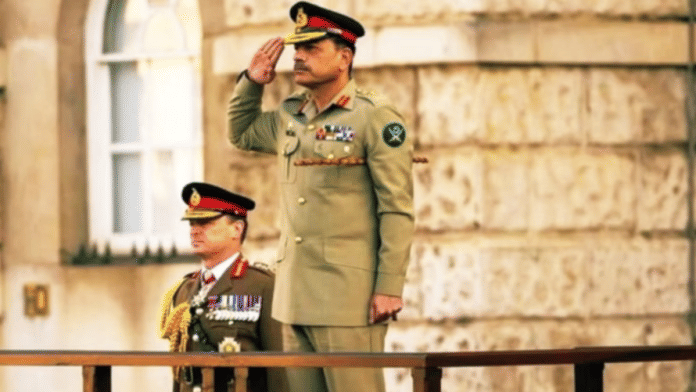



Pakistan’s newly appointed Chief of Defence Forces (CDF), Field Marshal Asim Munir, visited Bahawalpur in the last week of January, one of the sites targeted by India in May last year. The optics of the visit, together with his remarks emphasising the military’s preparedness for future conflicts, signal Pakistan’s readiness against India. New Delhi’s new modus operandi vis-à-vis responding to Pakistan undermines Islamabad’s asymmetric nuclear posture, particularly its battlefield nuclear weapons. This ‘new normal’ represents a clear break from previous restraint. As a result, meeting evolving security challenges and restoring deterrence against New Delhi has become both a justification and a necessity for reaffirming military supremacy within Pakistan’s domestic constituency. The promulgation of the 27th constitutional amendment consolidated the military’s command over the civilian government in Pakistan, restructured inter-service dynamics across the three branches of the military and granted the army sole authority over nuclear command and control. These developments pose a significant risk to stability in nuclear South Asia.
Deterrence Post-Operation Sindoor and the Impact of the 27th Amendment
The latest crisis between India and Pakistan was the sixth since both countries acquired nuclear capabilities. Operation Sindoor allowed India to redefine the regional deterrence framework and provided greater space to escalate actions below the nuclear threshold. Pakistani assessments described the country’s response as a practice in “responsible deterrence”—a deliberate choice to exercise restraint, retaliate in a calibrated manner, and focus on crisis management. According to these perspectives, Pakistan’s objective was to restore deterrence promptly without further escalation. However, the launch of Operation Bunyan al-Marsus suggested otherwise. Over the years, Pakistan’s nuclear posture has evolved from minimum credible deterrence to credible minimum deterrence, and subsequently to a full-spectrum deterrence—including tactical nuclear weapons—guided by a Quid-Pro-Quo-Plus (QPQP) approach. The Pakistani Finance Minister and Deputy Prime Minister, Ishaq Dar, described the country’s “new normal” as a QPQP strategy, reflecting Pakistan’s intent to keep its response one step ahead of India’s. Senior officials have reiterated that this approach has successfully reinforced regional stability.
The latest crisis between India and Pakistan was the sixth since both countries acquired nuclear capabilities. Operation Sindoor allowed India to redefine the deterrence framework in the region and provided greater scope to escalate below the nuclear threshold. In the aftermath of the May crisis, a Gallup poll showed that 93 percent of respondents viewed the military positively, with 96 percent of the more than 500 respondents believing that Pakistan had won the conflict. The Chief of Army Staff was subsequently accorded the title of Field Marshal, and the 27th constitutional amendment was passed into law, effectively redefining the terms of engagement between the three branches of the military and the civilian government, as well as the internal dynamics within the services.
Through this amendment, the operational authority of the Navy and the Air Force over their own affairs has been diluted. These changes risk exacerbating differences within the three branches of the military, despite assertions that they aim to create a ‘unity of command’ and expedite decision-making. A case in point is the formation of the Army Rocket Force Command last year, intended to expedite decision-making during a crisis by ensuring strike plans originate from a single point. This dedicated force, responsible for conventional missile and rocket systems, has a separate command to oversee handling and deployment, and while it allows Pakistan greater scope to act below the nuclear threshold, decision-making authority remains with the army. The abolition of the office of the Chairman of the Joint Chiefs of Staff Committee effectively removes an institutional check on the army chief’s powers. Even before the amendment, although the position could be held by officers from any of the three branches, it had been dominated by the army, with 15 of the 18 chairmen coming from it.
Factors Shaping Pakistan’s Nuclear Command and Control
Pakistan has emphasised developing a robust nuclear triad to secure second-strike capabilities and strengthen its post-tactical nuclear weapons (TNW) use response mechanism. The US Defence Intelligence Agency (DIA) assessment noted that Pakistan is likely to continue modernisation, including “the development of more TNWs to offset India’s conventional military advantage.” The numerical strength of TNWs provides the Pakistani military with confidence to exercise restraint vis-à-vis New Delhi. However, operationally, Pakistan lacks clearly defined ‘when, where, and how’ parameters for executing its first-use doctrine during a crisis. This ambiguity allowed New Delhi, during Operation Sindoor, to carefully establish a new modus operandi characterised by a conventional military response.
In the pre-27th Amendment period, the Employment Control Committee (ECC) within the apex National Command Authority (NCA) remained the primary decision-making body, with civilian oversight responsible for delegating orders and authorisation codes to the Strategic Forces Commands (SFCs) through established channels in the Strategic Plans Division (SPD). Despite this three-tiered structure, questions persist regarding whether “tight and exclusive civilian control” over the authorisation of nuclear use was maintained at all times.
Figure 1: The National Command Authority (NCA) of Pakistan pre-27th Amendment

Source: Tahir Mahmood Azad & Karl Dewey
Post-27th Amendment, several changes have occurred within Pakistan’s nuclear command and control. First, the NCA-led command structure transitioned to the National Strategic Command (NSC), reducing civilian oversight over nuclear use. Second, the abolition of the post of Chairman of the Joint Chiefs of Staff Committee (CJCSC) and the vesting of powers in the Chief of Defence Forces (CDF) eliminated a neutral interservice bridge between the military and civilian authorities. The pre-existing tri-service composition of the NCA is now more army-dominant. Third, the creation of the CDF, which also serves as the army chief, makes him an indispensable member of the decision-making process, with primacy over nuclear use. Even the commander of the newly established NSC, overseeing nuclear arsenals, is appointed by the Prime Minister on the recommendation of the Chief of Army Staff (COAS) and is represented by the Pakistan Army. Fourth, the NSC grants the army both operational and strategic authority over nuclear weapons. Under the former NCA, decisions were made by consensus, with the military acting as the de facto decision-maker in the event of a tie.
In such a scenario, the first line of Pakistan’s asymmetric nuclear posture—battlefield TNWs—will come to the forefront. The Pakistan Army already controls a significant proportion of nuclear delivery systems, alongside authority over the Strategic Plans Division (SPD) and a historical record of dominance in the country’s security mechanisms. Whether, and to what extent, the rational calculations of the air and naval components of nuclear forces are incorporated into decision-making remains unclear. This creates a more dangerous, crisis-prone environment, exacerbated by Islamabad’s growing overconfidence in managing escalation amid the maturation of credible second-strike capabilities. ‘Nuclear restraint’ is therefore more likely to be compromised during a crisis. The restructuring of nuclear command and control has also introduced a legal misalignment with the pre-existing NCA Act of 2010, generating ambiguity about roles and responsibilities. In the absence of transparency, misperceptions may incentivise serious miscalculations, with significant implications for strategic stability in South Asia.
Implications and Strategic Considerations for India
Given the historical precedent in Pakistan’s civil-military relations, the worst-case scenario cannot be ignored. The consolidation of military control over nuclear weapons represents a regressive step for the ‘responsibility’ of command and control and the ‘restraint’ component of Pakistan’s nuclear posture. It increases the risk of early nuclear coercion and inadvertent escalation in a future crisis. Operationally, it weakens the norm of nuclear restraint and enables negative control, giving battlefield commanders greater autonomy. In an army-dominated nuclear command-and-control framework, smaller battlefield munitions, such as nuclear artillery, could evade detection by India and the US before real-time use. Islamabad’s overconfidence, fuelled by the maturation of second-strike capabilities, primarily the nuclear triad, exacerbates this risk. Consolidating the Pakistan Army’s authority over nuclear use could incentivise New Delhi to adopt preemptive measures, with destabilising consequences for strategic stability in South Asia.
India should focus on developing five strategic options. First, conduct a comprehensive, crisis-scenario-based assessment to evaluate the effectiveness of its processes, mechanisms, and apex-level decision-making structures. Second, revise its nuclear doctrine to address the Pakistan-centric challenge. A ‘two-tier doctrine’—separately addressing the Pakistan and China contingencies—could resolve ambiguities around India’s assured retaliation and incorporate a quantitative enhancement of its nuclear arsenal. Third, strengthen the network of air-defence mechanisms. Fourth, enhance the intelligence, surveillance, and reconnaissance (ISR) architecture for precise target detection. Fifth, develop non-nuclear strategic arsenals for counterforce targeting, thereby expanding the range of available options.
Rahul Rawat is a Research Assistant, Defence and National Security, Strategic Studies Programme, Observer Research Foundation.
Shivam Shekhawat is a Junior Fellow with the Observer Research Foundation’s Strategic Studies Programme.
This article was originally published on the Observer Research Foundation website.