






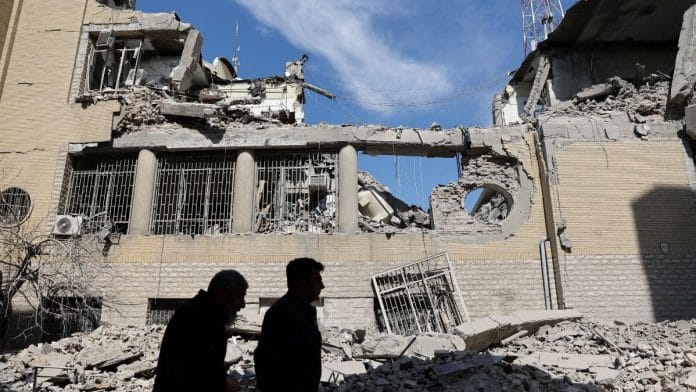



After reports confirmed the death of Iran’s Supreme Leader Ayatollah Ali Khamenei, who was sitting at the helm of Tehran’s political, Islamic and military institutions, the debate in India primarily revolved around whether Prime Minister Narendra Modi should have personally condoned the killing. The issue for debate should have been the way forward in a situation which could take a serious turn in a couple of weeks.
There are three likely scenarios as far as the present situation is concerned. If the resistance to the combined attacks by the US and Israel continues for seven to ten days, the Majles-e Shurâ-ye Eslâmi, the 290-member Iranian Parliament, might convene under a new leader elected by the 12-member Shurā-ye Negahbān (Guardian Council). The new leader could agree to negotiations, and meanwhile, dig his heels deeper in the corridors of power in Tehran.
If the new regime can announce a series of reforms and promise to scale down the nuclear programme—both very doubtful—it could be, albeit temporarily, the end of a regime change push in Iran.
As Ayatollah Khomeini’s 56-year-old son, Sayyed Mojtaba Hosseini Khamenei, has been elevated to the position of the country’s Supreme Leader, the probability of reconciliation with the US and Israel looks bleak.
To frustrate this plan, since the US has been advocating regime change, it will have to find an alternative leader, probably Reza Pahlavi, the son of the deposed ruler of Iran’s last shah, and airdrop him in Tehran as soon as possible. However, US President Donald Trump isn’t very keen on Pahlavi, preferring ‘someone from Iran and who is popular’.
This looks easier said than done. In 2001, the US pulled off a similar move in Afghanistan after dethroning the Taliban and bringing in Presidents like Hamid Karzai and Ashraf Ghani, among several other leaders. However, the Taliban kept eyeing a comeback and returned to power in 2021.
A herculean task
Unlike the Taliban or the “Tibetan government in exile”, Pahlavi doesn’t seem to have a team. He will depend on a group of advisors provided by the White House. The pro-Khamenei groups will organise street resistance and engineer protests against the anti-old regime groups. Besides, the Hezbollah, Houthis, Hamas, Asaib Ahl al-Haq, Zaynabiyoun Brigade, Fatemiyoun Division and Saraya al-Ashtar and other outfits may increase sporadic terror attacks in areas of their influence.
The third possibility is a total elimination of the present system of Shia Islamic religious leadership, replacing it with a democratic setup presided over by political parties, none of which are anywhere close to being organised. This will need time and capacity building, which could be a long-drawn-out project requiring ground presence by the US administrators, who don’t appear to be very competent in the given context. The move can be carried out by the United Nations (UN) through UNDP, which, for some strange reason, has been missing for decades.
In any case, the fallout of the current impasse doesn’t seem to be easing any sooner. The energy crisis is looming large. Except for Japan and China, which reportedly have oil reserves to suffice for more than two hundred days, no other countries stand a chance to survive over a month. According to the Indian government, it has about 50 days of oil reserves.
What if the crisis continues indecisively for a longer period, like the one between Russia and Ukraine? The government needs to have a long-term plan rather than put out statements that sound like placating the markets, which are already down due to negative sentiments.
Though India’s dependence on Iranian oil is only about 2 per cent, the fossil fuel supply comes mainly from the Gulf and West Asia region. Iran has mounted several attacks on US military bases in Saudi Arabia, Kuwait, and the UAE. The passage of oil tankers has taken a hit as the Strait of Hormuz, through which nearly 40 per cent of oil trade takes place, has been shut down for transhipment.
The closure is said to be mainly due to the cancellation notices issued by seven of the 12 Protection and Indemnity (P&I) Club agents who reportedly account for 90 per cent of the war risk insurance coverage in the Persian Gulf. War risk insurance rates for the area have surged from about 0.1 per cent over the past year to as high as 1.3 per cent, and many insurers have stopped offering cover for Strait of Hormuz transits.
Also read: How China sees Iran’s post-Khamenei trajectory. It depends on four factors
India must step up
The central government should fast-track the formation of India P&I Club, a domestic P&I agency, through the Insurance Regulatory and Development Authority of India (IRDAI) to provide domestic liability coverage for Indian-flagged vessels, thereby reducing the country’s dependence on international P&I club cartels.
The regime change issue in Iran is not a mere local conflict. It could potentially trigger a tectonic shift in the emerging new world order. The crisis has already engulfed the entire region, pitching Iran against every other country in West Asia. Both Russia and China have condemned the killing of Iran’s supreme leader, but have done very little militarily or otherwise in support of the present regime.
Deeply engaged with Ukraine over an unending four-year-old conflict, Russia cannot afford to send any military hardware to Tehran, risking a setback in its ongoing war. Also, Putin’s personal equation with Iran’s former Supreme Leader served a limited economic purpose for Moscow. The Russia-Iran axis was a more strategic posturing after the end of the Cold War and the disintegration of the erstwhile USSR.
Iran was of little use to Russia when Bashar al-Assad of Syria was dethroned and had to be flown to an unknown destination somewhere in Russia. Russia and China could do very little when Maduro of Venezuela was airlifted to the US at midnight. One reason for the non-intervention of these two powers could be the lack of benefit and interest the intervention offers.
India could face a severe oil crisis, trade disruption, foreign exchange and market fluctuation and issues arising out of diaspora and deportation of Indians studying and working in the conflict region. New Delhi should accept the reality that the attack on Iran is not merely for regime change but to exercise control over the region and its oil trade, take over supply and value chains and ultimately regain the strategic space for America.
India has to play a seminal role in this process of reshaping the regional balance, or else lose the strategic, economic and geopolitical gains made in the past decades.
Seshadri Chari is the former editor of ‘Organiser’. He tweets @seshadrichari. Views are personal.
(Edited by Saptak Datta)
A disappointing piece from such a senior commentator. Only s few possible scenarios are sketched out. The seminal role for India is simply mentioned but no details are given. In contrast , at least the Chinese have sent an emissary to the gulf , though the initiative may not be ” seminal “. How can India role be seminal when our PM expresses such pain for the Israeli victims of Oct 7 th , but hardly a word for the 125 school children killed by the US bombing in Iran ?