






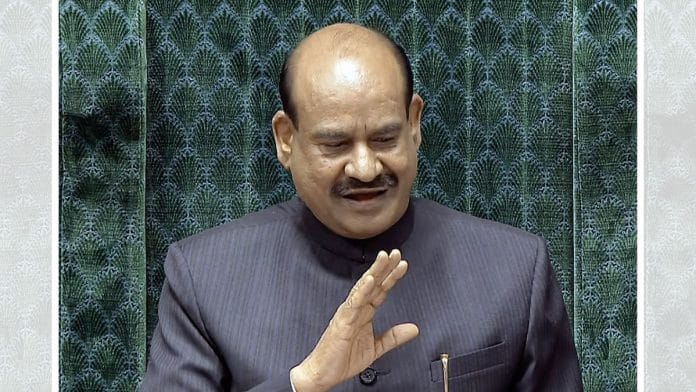



On his first day in the Lok Sabha as Speaker on 19 June 2019, Om Birla was greeted with warm tributes to his mild manner and ready smile—traits parliamentarians across party lines said defined his public persona.
Prime Minister Narendra Modi, congratulating the second-term lawmaker from Rajasthan’s Kota, said he sometimes worried that Birla’s humility and soft-spoken style could be taken advantage of in the House.
“In the House also, we have seen that even if he smiles, he smiles very gently. Even if he speaks, he speaks very softly,” Modi said then, recalling Birla’s long political journey—from the BJP’s Yuva Morcha to being elected an MLA and working as a social activist.
Moments later, Adhir Ranjan Chowdhury, then the Congress’s floor leader in the Lok Sabha, dedicated a couplet to Birla: “Khuda se kya maangu tere vaaste, Sada khushiyo se bhare ho tere raaste, Hansi tere chehre par rahe is tarah, Khushboo phoolo ke saath rehti hai jis tarah.” (What should I ask from God for you? May your paths always be filled with happiness. May a smile remain on your face, just the way fragrance always stays with flowers.)
While wishing Birla well, Chowdhury reminded him that the Speaker’s duty is “to protect us properly in the House because you are the presiding officer, the custodian of this House.”
Seven years and one Lok Sabha election later, the mood had shifted sharply. On 10 February 2026, the Congress-led Opposition submitted a notice seeking Birla’s removal as Speaker, accusing him of acting in a “blatantly partisan” manner “indicative of an abuse of this constitutional office”.
The move—emblematic of sharpening political polarisation and the erosion of a middle ground—also pointed to a widening trust deficit between rival benches and the Speaker, underscoring Birla’s arc from a figure once associated with an easy smile to one increasingly greeted with scepticism.
That is why Om Birla is ThePrint’s Newsmaker of the Week.
Also read: The Modi Lok Sabha speech that never happened: Why Speaker Om Birla ‘urged PM not to come’
The first confrontation
Birla’s initial elevation to the post had been anything but predictable. His selection during the previous Lok Sabha had caught political circles, and reportedly Birla himself, off guard.
In his first term as Prime Minister in 2014, Modi had turned to seniority and experience, choosing veteran parliamentarian Sumitra Mahajan, then an eight-term MP, to preside over the House. Five years later, he opted for Birla, then only in his second term as MP, signalling a departure from convention in favour of a relatively younger face.
In Birla’s first term in office—particularly the early years—he earned plaudits for ensuring that first-time MPs and lawmakers from smaller parties got opportunities to speak.
The year 2023, his fourth year in office, marked his first major confrontation with the Opposition.
As many as 146 MPs—100 from the Lok Sabha and 46 from the Rajya Sabha—were suspended during the winter session of Parliament after they demanded a statement from Union Home Minister Amit Shah on a security breach in the House premises.
Expectedly, Birla’s re-election to the post was far from smooth, and his first day in office during his second term reflected the chill that had set in between him and the Opposition benches, which had a larger presence this time. Birla became only the second Speaker after Balram Jakhar in 1985 to be re-elected to the post after serving a full five-year term.
The Opposition forced an election for the post, only the fourth in the history of independent India, fielding the Congress’s Kodikunnil Suresh. Birla was re-elected with a voice vote.
The election was necessitated by a lack of agreement between the treasury and Opposition benches, with the latter insisting that consensus was possible only if the government agreed to give the Deputy Speaker’s post to the Opposition, citing parliamentary “convention”.
Also read: How Congress is sending a message as it considers resolution to remove LS Speaker Om Birla
Battle lines
In many ways, the speech made by Rahul Gandhi—who became Leader of the Opposition in the Lok Sabha owing to the Congress’s increased strength—to congratulate Birla on his re-election proved a harbinger of the fractiousness ahead.
“The idea that you can run the House efficiently by silencing the voice of the Opposition is a non-democratic idea and this election has shown that the people of India expect the Opposition to defend the Constitution…” Rahul said. Some Opposition MPs who spoke after him were more unsparing.
TMC’s Sudip Bandyopadhyay, a five-term MP, said Birla, on certain occasions, “had to bow before the ruling party”. NCP’s Supriya Sule said Opposition members carried a deep sense of hurt over the suspension of MPs in the previous Lok Sabha, while the NC’s Aga Ruhullah Mehdi said Birla’s record would also be remembered for a Muslim MP being “called a terrorist” under his watch in the House.
Battle lines were further drawn when Birla read out a resolution, on his very first day in office in his second term, condemning the Emergency, which the Opposition saw as continuity of the government’s “confrontational” line.
A week later, as Rahul rose to speak during the debate on the Motion of Thanks to the President’s address, he underlined what he called a stark contrast in how Birla greeted him and Modi after being re-elected Speaker.
“When Modiji went and shook your hand and I went and shook your hand, I noticed something. When I shook your hand, you stood upright. When Modiji shook your hand, you bowed down,” he said, to cheers from Opposition MPs.
That, in a way, set the tone for what followed. The extraordinary step by the Opposition to seek Birla’s removal, then, had been a long time in the making—one bitter confrontation after another, one suspension after another, and the hurried passage of one Bill after another.
Views are personal.
(Edited by Theres Sudeep)