






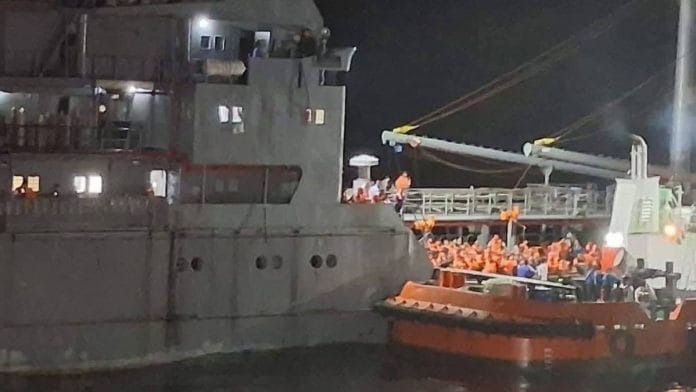



The conflict in Iran has yanked India into its dragnet, first with the questions over silence from New Delhi over the killing of the Iranian Supreme Leader Ayatollah Ali Khamenei, and more recently due to the sinking of an Iranian warship that had just participated in a naval exercise reviewed by President Droupadi Murmu in Visakhapatnam. India joined the rescue mission to find downed personnel with Sri Lanka, but the announcement came a day later.
The crisis has exposed the tightrope New Delhi is walking between Washington and Tehran — a key source of energy imports — putting India’s consistent policy of hedging sides without taking one under scrutiny, making it ThePrint’s Newsmaker of the Week.
The conflict began on 28 February with a mid-day strike on Tehran by the US and Israel, killing Khamenei and members of his family, in what seemed to be a daring raid of a similar vein pulled off by the American military in Venezuela in January, when it captured President Nicolás Maduro and his wife Cilia Flores.
However, Iran vowed retaliation and the region has since descended into full–scale violence, with Tehran retaliatory strikes impacting half a dozen countries in the region, including Saudi Arabia, Kuwait, Bahrain, Oman, Qatar, and the United Arab Emirates.
India’s veil of silence
India’s original silence on the crisis led to pushback from the Indian opposition. Congress leader Sonia Gandhi led the charge, with an opinion piece in The Indian Express calling India’s silence on the issue an “abdication” of its responsibilities.
“The killing of a sitting head of state in the midst of ongoing negotiations marks a grave rupture in contemporary international relations. Yet, beyond the shock of the even, what stands out equally starkly is New Delhi’s silence,” Gandhi wrote.
She added: “The government of India has refrained from condemning the assassination or the violation of Iranian sovereignty. Initially, ignoring the massive US-Israeli onslaught, the Prime Minister confined himself to condemning Iran’s retaliatory strike on the UAE, without addressing the sequence of events that preceded it.”
Hours later, the Indian government reacted, issuing a formal statement calling for a return to dialogue and diplomacy amongst the warring countries, keeping in mind the global energy requirements, the holy month of Ramadan, and the almost 10 million Indians that live in the region. India maintained its silence on the killing of Khamenei even in its official statement on the war.
Days later, Foreign Secretary Vikram Misri signed the condolences book at the Iranian Embassy on Thursday on behalf of the government of India, finally breaking India’s silence on the matter in a way.
The Government of India has maintained a veil of silence in a sense to allow it to manoeuvre with the US, a country supremely important for Indian exporters, and also an increasingly important technological partner.
Hezbollah, the armed militia in Lebanon, joined the conflict, launching rockets at Israel in defence of Iran and expanding the conflict from the Gulf countries till Beirut. At the same time, the US has muddied its own justifications for the war.
While calling for regime change, as Trump originally did, the Republican Party has offered different reasons for the conflict. Secretary of State Marco Rubio, earlier this week, said that it was a pre-emptive strike, as Israel was going to attack Iran, leaving US assets in the region vulnerable to Iranian retaliation. Speaker Mike Johnson claimed the war is a crusade of sorts, further shifting the US’ reason for the war.
The war has seen oil and gas prices surge, as energy production facilities in the region have been hit, further worrying India. The US on Thursday announced a 30–day waiver for Indian energy imports from Russia, provided the oil is already stranded at sea, which has impacts on the war in Ukraine as well.
Also read: Exploiting Iran’s ethnic fault lines can solve one problem for US-Israel—and create several more
The sinking of IRIS Dena
The IRIS Dena, the Iranian frigate that took part in the Milan exercise in Visakhapatnam in February, was sunk near the waters of Sri Lanka, opening further complication for Indian diplomacy in the region.
Kanwal Sibal, India’s former Foreign Secretary, in a post on X on Thursday, asserted that the ship was defenceless due to protocols of participating in the exercise, which does not allow it to carry ammunition.
“The Iranian naval personnel had paraded before our president. The attack by the US submarine was premeditated as the US was aware of the Iranian ship’s presence in the exercise to which the US navy was invited but withdrew from participation at the last minute,” wrote Sibal, accusing Washington of ignoring New Delhi’s sensibilities.
The Indian Navy on Thursday finally announced that it was part of the search and rescue mission for the missing Iranian naval personnel in the downed ships, hours after Sri Lanka announced that it had begun rescue operations and had found at least 32 personnel.
The Indian Navy waited almost an entire day before commenting on the issue, which led to further recrimination domestically. India has consistently claimed that it is the ‘net security provider’ in the Indian Ocean, yet an Iranian ship that had arrived for an Indian event was sunk by the US near its Southern neighbour, Sri Lanka, further raising questions of New Delhi’s positioning in the ongoing war.
(Edited by Aamaan Alam Khan)
What is wrong with this people?..this people wants India to get involved in war and same people will hit the streets asking why india us getting in war