






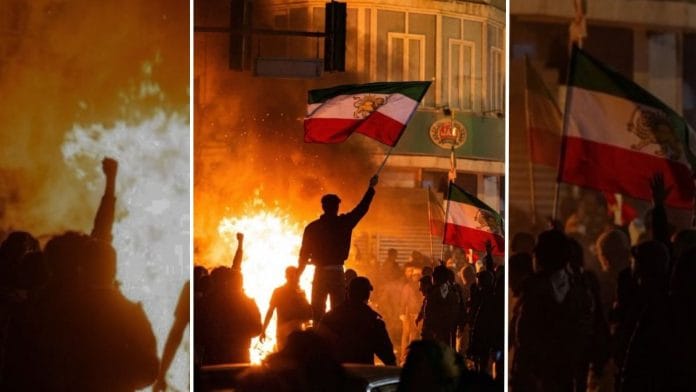



Protests in Iran have dominated global headlines. As one of the world’s oldest civilisations, Iran has perhaps witnessed it all—culture, crises and counterrevolution. Protests in Iran are not new. This time, it is rather a culmination of all concerns that have plagued the West Asian country for decades now.
Sparked by a nationwide traders’ strike and fueled by the spiralling inflation, the ongoing agitation is widely seen by analysts as the most serious challenge the Islamic Republic has faced in decades.
Unlike earlier protest waves, including the 2022 agitation triggered by the death of Mahsa Amini in morality police custody over mandatory hijab, this uprising cuts across class lines. The rich, the poor, the traders and the ministers are all on the streets. And that is why Iran is ThePrint’s Newsmaker of the Week.
Yet what distinguishes this moment is not the nature of unrest but the convergence of pressures bearing down on the country at once, one that American analyst Karim Sadjadpour, a senior fellow at Carnegie, flagged in his Foreign Affairs December 2025 article: “Will the Iranian regime Fall?”. He lists five factors: economic collapse, alienation of the elite, opposition coalition, a shared narrative binding the public and regional confrontation. Analysts note that Iran has weathered each of these before. It has rarely confronted them simultaneously, and at this scale.
Many are now looking at the future. Most analyses ask, “Will the Iranian regime fall?” or will US President Donald Trump, with his penchant for audacious attacks on sovereign countries, “intervene” in the country, having bombed it a few months ago with the help of Israel.
What led to protests?
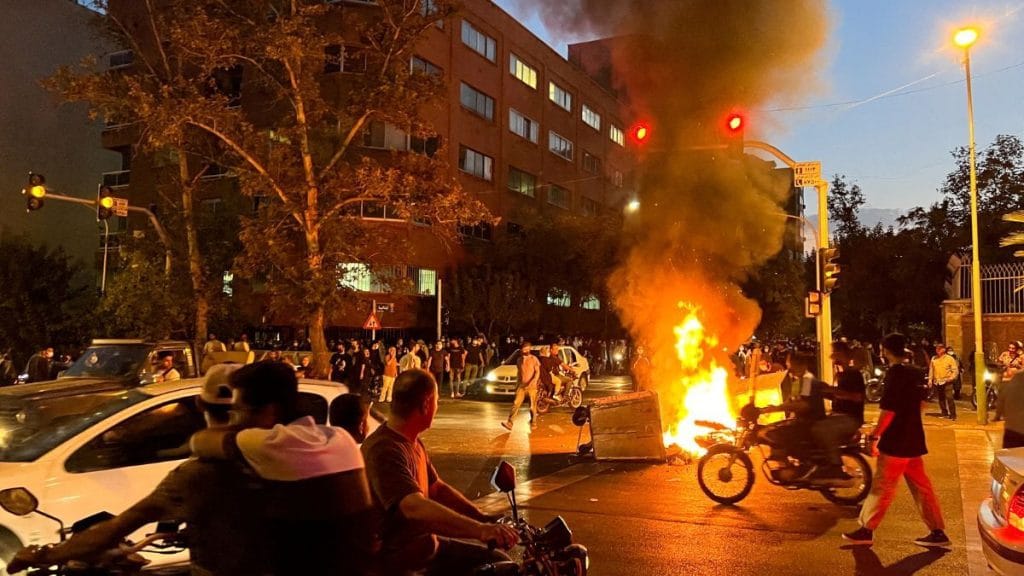
The demonstrations began on 28 December in Tehran’s bazaars, traditionally a pillar of the Islamic Republic’s social base. As the rial plunged and prices soared, shopkeepers shut their businesses in protest. The strikes spread rapidly across major cities and soon turned violent.
US-based rights groups say hundreds were killed when security forces moved to suppress the unrest over the weekend, though the figures are not independently verified amid internet blackouts and media restrictions. Iranian state television dismissed protesters as “rioters” and “terrorists.”
The roots of the unrest are mainly economic. Iran’s economy, already among the world’s most sanctioned, has buckled under renewed international pressure and domestic mismanagement. Europe reimposed “snapback” sanctions last year, accusing Tehran of violating the 2015 nuclear agreement. The deal itself had been dealt a death blow in 2018, when Trump withdrew and reimposed sweeping penalties.
Since then, conditions have only worsened. Iran’s inflation rates, which are more than 50 per cent overall and 70 per cent for food, are among the world’s highest. The Iranian rial has lost about 90 per cent of its value since the four-day war in June, in which Israel and the United States bombed Iranian nuclear targets. Oil exports fell by about 7 per cent in 2025 compared with the previous year, forcing Tehran to sell crude to Beijing at steep discounts. Power outages and water rationing have become routine.
“The economic catastrophe in Iran is the product of eight years of US policies that combine comprehensive sanctions with covert operations, cyberattacks and military strikes. While these measures were aimed at weakening the Iranian government, they devastated the economic security of ordinary Iranians. And the Iranian elite with connections to the state, particularly those linked to the Islamic Revolutionary Guard Corps, profited from sanctions evasion,” Iranian professor Nargis Bajoghli wrote in a TIME article.
In December, President Masoud Pezeshkian acknowledged the scale of the crisis with unusual candour, saying his government was “stuck” and incapable of performing “miracles.”
For a population of 92 million, many of them young, educated and globally connected, such admissions have only spotlighted the sense of chaos. According to Sadjadpour, it is also the “largest population in the world to have been isolated for decades from the global financial system”, and though they are nationalists, they are tired. The “Death to America” and “Death to Israel” are now being replaced by “No to Gaza; no to Lebanon; my life only for Iran.”
Regional chaos
As the unrest intensified, Iran’s external environment grew more volatile. After meeting Israeli PM Benjamin Netanyahu, Trump warned that the US was “locked and loaded” if protesters were killed. Israeli intelligence channels amplified anti-government messages in Persian, asking Iranians to take to the streets.
In recent days, fears of escalation mounted. Iran briefly closed its airspace, prompting airlines to cancel and reroute flights. The United States requested an emergency meeting of the UN Security Council. India, Spain, Italy and Poland advised their citizens to leave Iran.
Then, just as abruptly, the temperature appeared to dip. Trump said he had been told “on good authority” that executions of protestors had been halted. Iran’s foreign minister Abbas Araghchi denied that any executions were planned and insisted the situation was “under control”. The family of Erfan Soltani, the first protester sentenced to death during the unrest, was told his execution had been postponed.
Yet the numbers remain stark. The US-based Human Rights Activists News Agency estimates that at least 2,571 people have been killed and more than 18,000 arrested. G7 foreign ministers have warned they are prepared to impose additional sanctions over Iran’s response.
A regime showing its age
Iran’s predicament cannot be understood without looking at the long arc of Supreme Leader Ayatollah Ali Khamenei. In power for 36 years, Khamenei has governed through a rigid adherence to a theological ideology and an absolute rejection of political reform. He has long argued that loosening the system would invite collapse, pointing to the Soviet Union as a cautionary tale.
The result has been political contraction. Former presidents have been sidelined or silenced. Mir Hossein Mousavi, a founding figure and former prime minister, has been under house arrest for more than a decade after challenging the system. The ruling coalition has narrowed into what critics describe as a one-man state.
Iran’s institutions have drained as its slogans against America and Israel have hardened. The problem, analysts say, is that the regime rails against foreign enemies but offers little vision of national renewal. Add to that, Khamenei’s age and looming succession have only deepened uncertainty. Once he is gone, Iran could veer in many directions: toward military dominance, deeper repression, pragmatic recalibration or, less likely, democratic reform.
Also read: Attack on Hindus, Khaleda’s death & Jamaat—Bangladesh is grappling with crises on many fronts
A country at crossroads
In his October 2025 article, ‘Autumn of the Ayatollahs’ published in Foreign Affairs, Sadjadpour also noted that Iran has all the makings of a G-20 economy: vast energy reserves, a highly educated population and a powerful civilisational identity. Yet decades of isolation, corruption and ideological rigidity have squandered those advantages. While Persian Gulf neighbours transformed themselves into global hubs, Iran invested in “regional adventurism” and a nuclear program that yielded isolation rather than security.
Foreign powers will try to shape what comes next, but history suggests their influence is limited. The United States learned that lesson in Iraq and Afghanistan. Russia could not save its ally in Syria. China may prefer stability over chaos, but even Beijing cannot dictate Iran’s internal trajectory.
Ultimately, the outcome will be decided at home. Iranians are not calling for grand ideological visions or even democracy. What they seek, again and again, is something simple: competent, accountable government and what they call ‘zendegi-e normal’—a normal life, free from constant surveillance, scarcity and fear.
Whether the December uprising marks the undercurrent of Iran’s regime reckoning or becomes yet another recycling of repression remains to be seen. But as analysts note and history shows, regimes rarely fall from a single blow. They collapse when multiple pressures converge. Iran has rarely looked more vulnerable or more on the cusp of change.
(Edited by Saptak Datta)