






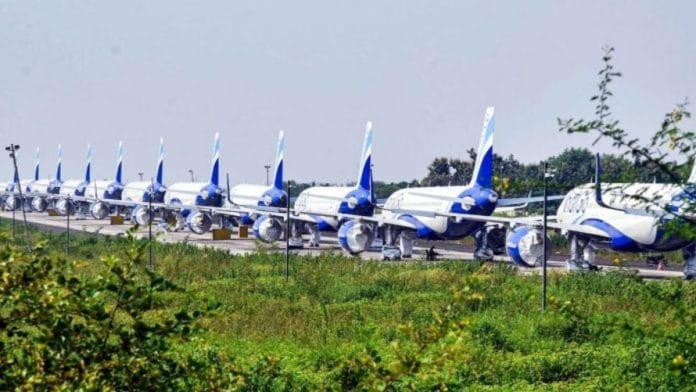



The Directorate General of Civil Aviation on Friday sacked four of its own flight operations inspectors in the wake of the IndiGo fiasco, reportedly for negligence in inspection and oversight. With this action, the regulator has finally decided to look within, two weeks after India plunged into one of its worst aviation crises. When IndiGo chaos unfolded, it was the airline that saw maximum backlash, even as passengers asked bigger questions.
The problem was never the Flight Duty Time Limitations (FDTL). Fatigue rules exist worldwide for a reason, and no aviation system should compromise on them. The real failure lies in how the DGCA, India’s aviation watchdog, did not foresee the operational havoc that IndiGo would unleash as it scrambled to comply. It’s missing teeth, apparently. For many observers, this was yet another reminder of the airline’s near-monopoly muscle and its ability to nudge, pressure, or simply outpace a regulator that has long lacked structural independence.
The questions that matter are not just about IndiGo’s preparedness but the DGCA’s situational awareness, alleged monitoring lapses, and the broader culture that allows the world’s fastest-growing aviation market to be overseen by a body that still does not have true statutory authority. It’s a regulator forced into the spotlight once again, exposed by a crisis it should have anticipated, and finally compelled to act against its own. And that is why the DGCA is ThePrint’s Newsmaker of the Week.
The aviation duopoly
The DGCA’s revised FDTL norms were unveiled in early 2024, aiming to fix pilot fatigue by increasing mandatory rest and redefining night operations. Initially meant to take effect on 1 June 2024, the rollout was deferred after airlines sought more time, leading to months of negotiations through late 2024 and early 2025. The DGCA and carriers worked out a phased roadmap, into two phases — partially from July 2025 and fully by November this year.
Phase I began on 1 July 2025, introducing longer rest periods and stricter duty limits, followed by Phase II on 1 November 2025, for full adherence to the norms. These final provisions triggered significant operational stress, especially at IndiGo, culminating in widespread cancellations in early December. As disruptions mounted, DGCA and the government stepped in with temporary relaxations and exemptions to stabilise the crisis, valid till early next year.
Civil Aviation Minister Kinjarapu Ram Mohan Naidu told the Rajya Sabha this week that the new FDTL norms, enforced from 1 November after “thorough consultation with all stakeholders,” including IndiGo, which tightened night-duty limits and weekly rest requirements. He stressed that the ministry puts crew welfare and passenger safety first, that airlines were categorically instructed to comply, and that DGCA had held multiple meetings, offering variations and exemptions where necessary. According to him, November passed smoothly under the new rules.
But beyond this official version, the truth is that the crisis didn’t erupt overnight. It did unfold despite these meetings and reviews. The minister’s assurances aside, the crisis exposed that DGCA’s monitoring failed to anticipate the operational strain these rules would place on an airline as dominant as IndiGo.
The rules themselves were not the problem; the regulatory complacency leading up to the chaos was. IndiGo didn’t really step up to do anything for the crisis it obviously saw coming. Instead, the airline increased its daily operations from 2,000 flights in January last year to 2,200 this year. This raises the question: Did Indigo know that it could force the relaxations?
In response to a question on the limited players in the Indian aviation industry, the minister said that India has the capacity for five big airlines and that efforts are being made to encourage more airlines to join. The crisis exposed the urgent need to work on the underlying duopoly in the Indian aviation industry.
Also read: Is Virat Kohli on World Cup 2027 track? First South Africa 100s, now Vijay Hazare
Watchdog without teeth
The DGCA was formed in 1946, but didn’t have statutory powers till 2020. But it still functions as an attached office of the Civil Aviation Ministry under the old Aircraft Act of 1934. This appears to be the main reason behind the crisis.
The aviation watchdog doesn’t have the teeth to police the sector that it is meant to regulate. For bigger matters, even with statutory powers, the DGCA continues to rely on the ministry’s approval because it does not have the freedom to do otherwise.
ThePrint had exclusively reported in August on how the Air Accidents Investigation Branch’s (AAIB) fixed-wing aircraft accident reports put the spotlight on DGCA too. These reports also highlight the AAIB’s friction with the DGCA. In the 2020 Air India Express Kozhikode crash investigation, the DGCA skipped the meeting with the probe team—a direct violation of the Aircraft (Investigation of Accidents and Incidents) Rules, 2017.
It also noted that the aviation watchdog’s Civil Aviation Requirements (CAR) on monitoring of Digital Flight Data Recorder (DFDR) data for accident or incident prevention “contains ambiguities in values of exceedance parameters”.
In a 2021 final report on an accident of an aircraft operated by the Directorate of Aviation (DoA), Madhya Pradesh, the AAIB noted that DGCA wasn’t conducting adequate surveillance of critical-airfield and red-eye operations. The AAIB also found that DGCA approved the operator’s Operations Manual without proper CAR compliance. Further analysis also revealed how Flight training operators, as well as airline operators, violate norms in spite of repeated warnings and directions by the regulator.
The crisis also puts DGCA’s vacancies in the eye of the storm. Naidu told the Rajya Sabha in July this year that 190 out of 410 DGCA vacancies would be filled this year. The crisis manager now has a job at home.
(Edited by Ratan Priya)