






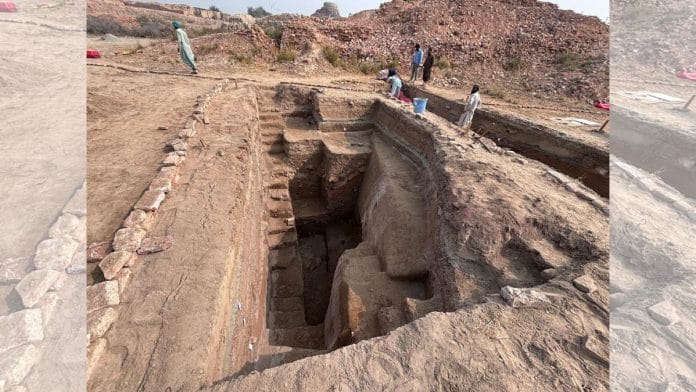



A recent excavation at Pakistan’s Mohenjo Daro yielded evidence of a seven-meter-thick wall, the earliest parts of which might go back to the very beginning of the Harappan civilisation. These remains of a rampart, also once found by Mortimer Wheeler during his 1950s stint at the site, are now dateable to 2800-2600 BCE. This pushes the antiquity of Mohenjo-daro a few centuries earlier than previously thought.
The excavation, a joint mission of the Directorate General of Archaeology and Antiquities, Sindh and the Sindh Exploration and Adventure Society, was led by Pakistani archaeologists Asma Ibrahim, Ali Lashari, and senior American archaeologist Jonathan Mark Kenoyer.
According to the excavators, Kot Dijian pottery was recovered from below the first city wall, indicating the presence of an early Harappan occupation. In short, it means that Mohenjo-daro was in existence earlier than archaeologists thought. But does this mean that the urbanisation is pushed to 2800 BCE? The answer is no.
As exciting as the recent finding is, it is certainly not the first in the story of the Harappan civilisation in modern-day Pakistan or India. Unfortunately, many appear to have misinterpreted recent media coverage, particularly a headline suggesting that Mohenjo-daro’s urban roots go back to 3300 BCE. This refers to the early Harappan or pre-urban phase at the site, which has been found at many Harappan sites, including Harappa, Rakhigarhi, and Dholavira. It doesn’t mean that a city existed at Mohenjo-daro in the fourth millennium BCE.
Some media outlets also claimed that the city of Mohenjo-daro is the earliest in the world—older than the Egyptian cities—which is a misleading, wrong claim.
So, what does the new evidence from Mohenjo-daro actually mean? Let’s break it down.
Regionalisation Era
The Harappan civilisation is best known for its well-planned cities, excellent drainage and sanitation system, and monumental architecture. After more than a century of excavating hundreds of sites within the Harappan realm, it has been well-established that the urbanisation can be traced back to c. 2600 BCE.
In other words, the urban phase of the Harappan civilisation is dateable to c. 2600-1900 BCE. This is the timeframe within which cities grew in size and were planned in a grid pattern with streets intersecting at right angles. Water-management systems, rainwater harvesting, and craft specialisation became prominent. The trade matrix intensified and seafaring activities increased sporadically.
However, these developments were not an overnight phenomenon. They were the result of a long and gradual process that unfolded over many centuries, beginning in the regionalisation or the food producing era.
The Regionalisation Era (Jim Shaffer, 1992) is the term often used by archaeologists which bracketed between c. 5000 to 2600 BCE (Kenoyer, 1991). It is also known as the Early Harappan phase, where regional cultures retained their own identity through artefacts, especially ceramics, which can be found in clusters.
For instance, at Harappa, Kenoyer found the Ravi phase, named after the Ravi River; the Hakra phase, early Harappan culture regional to the Hakra River basin; the Kot-Diji phase, named after the type-site Kot Diji; and the Soth-Siswal phase, named after the sites Sothi and Siswal in the Ghaggar basin. This indicates a cluster of early Harappan sites affiliated with similar regional material culture.
Early Harappan or the regionalisation phase is the precursor to urbanisation. It is the period when trade was established but was slow, settlements were planned but were simple, water management existed but was less extravagant. The economy was largely agrarian, but it was making strides in other professions as well. What is fascinating is that within the Harappan realm, the Early Harappan sites are in large numbers, even more than the so-called cities and towns.
At Rakhigarhi, the spatial expansion of the Early Harappan phase is twice the size of the city area. Here, the Regionalisation Era is extensive and rich with a unique settlement pattern. In fact, Mound RGR 6 at the site consists entirely of early Harappan deposits. At Harappa, the Regionalisation Era is identified by Kenoyer as the Ravi and Kot Dijian phases.
Similarly at the recent excavation in Mohenjo Daro, the excavators have mentioned the presence of Kot Dijian pottery or the Kot Dijian phase, indicating that a previously unidentified early Harappan period was noted during this field season. Remains of a defensive wall with a large number of Kot Dijian pottery fragments were found.
Also read: I turned up at Asha Bhosle’s door as a fan. She invited me home
Kot Diji
The archaeological site of Kot Diji is located in the Sindh province of Pakistan and was excavated between 1955 and 1957 by FA Khan. It is often referred to as either pre-Indus/Harappan tradition or Early Harappan culture, dated to 3300 to 2800 BCE.
The ancient settlement consisted of two parts: the citadel area and the lower town. Houses were made of mud bricks and the citadel was fortified by a defensive wall with bastions, raised over a bedrock. It was built in stone and mud bricks. The occupation at the site continued till the onset of the mature Harappan period or the Integration Era.
Toward Integration Era
From c. 2600 BCE until 1900 BCE, some settlements developed into cities, which integrated Harappan characteristics. Cities such as Harappa, Mohenjo-daro, Dholavira, and Rakhigarhi become centres of trade and commerce. With the shift in economy, society underwent several changes, which survived for 800 years.
What is usually known from Mohenjo-daro belongs to this time period. Brick structures such as the great bath, the citadel, and house complexes belong to the urban or the Harappan phase. Today, there are thousands of sites which belong to this phase. Not all the settlements are cities but some did evolve into towns, ports, and craft villages.
Against this backdrop, the recent evidence from Mohenjo Daro does not suggest that the city or the urbanisation is dated to 3300 BCE. Rather, it indicates that the site is rooted in a much earlier cultural phase. The rampart, for instance, has exhibited multiple levels of construction. The lowest levels of the wall are below the water table, which could yield early dates. However, the exposed wall is from the mid-level of the structural phase, dated to 2800 to 2600 BCE through scientific analysis. Moreover, the excavation confirmed that the later phases of the mud-brick wall began in 2600 BCE and were maintained until 2200 BCE.
Similar patterns have been observed at other sites, such as Harappa in Pakistan and Kunal and Bhirrana in India, which have also yielded regional early Harappan deposits. Kunal, located in Haryana, belongs to the same time frame as Kot Diji. Moreover, at many sites including Banawali, the lower levels have yielded Regionalisation Era deposits, which tie perfectly with the recent findings at Mohenjo Daro. In this sense, Mohenjo-daro is best understood as the latest entrant in a growing list of sites demonstrating pre-urban features, rather than a singular or unprecedented case.
Disha Ahluwalia is an archaeologist and junior research fellow at the Indian Council Of Historical Research. She tweets @ahluwaliadisha. Views are personal.
(Edited by Prasanna Bachchhav)