






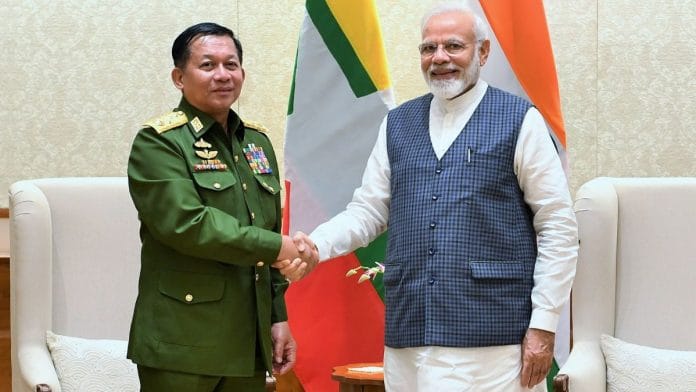



Myanmar’s Junta chief, Senior General Min Aung Hlaing, on 30 March stepped down as Commander-in-Chief of the Defence Services and paved the way to be nominated as the President of Myanmar. The development marks a formal transition from his role as military chief, which he has been since 2011, to the head of state.
In a vote held in Naypyitaw—a legislature dominated by military appointees and allies of the Junta-backed Union Solidarity and Development Party—he was selected as Vice President (a constitutional requirement to become the President).
General Ye Win Oo has been appointed as the new Commander-in-Chief of the Defence Services. Widely regarded as a close and trusted loyalist of Hlaing, Ye Win served as the Chief of Military Security Affairs (Intelligence Chief) from 2020 to 2026, a highly influential role within the military establishment. He also commanded the Southwestern Regional Military Command (located in Pathein, Ayeyarawady Region).
Ye Win’s rise to the top rank has been phenomenal. He has received multiple promotions in a very short time, which shows his closeness to Hlaing. In the process, Vice Senior-General Soe Win, the second-in-line after Hlaing, was overlooked, indicating that Hlaing was uncomfortable with the growing popularity of Soe Win, both among the masses and within the military ranks.
While this change may have gone relatively unnoticed in India, a few questions merit consideration. Will this transformation herald a much-awaited peace in Myanmar? Does this signify the end of the ousted leader, Aung San Suu Kyi and her democratic movement? How is it likely to impact Myanmar’s relations with China, Russia and other ASEAN nations? Does this new development alter India-Myanmar relations or affect the current situation in India’s Northeast? These are some questions that come to mind immediately.
Power of Tatmadav
Hlaing’s move for the presidential post aims for a transition to civilian rule, giving the government some legitimacy, headed by a person who no longer dons a uniform. This change may be seen as a mere cosmetic by many countries which have been opposed to the Junta rule and are likely to continue opposing the new government while retaining sanctions that have been imposed against Myanmar for a long time.
The move is also unlikely to usher in some semblance of peace in the country since peace depends on resolving the large-scale violence that has engulfed the country between the Tatmadav (military) on one side, as well as the Ethnic Armed Organisations (EAOs) and the pro-democracy groups like the People’s Defence Forces (PDF) on the other, since the 2021 coup. It is unlikely that Hlaing and his loyalist Ye Win (both are seen as hardliners) would make any concessions against either the EAOs or the PDF, at least in the short term.
Therefore, a return to peace anytime soon seems unlikely, and the large-scale violence that has engulfed the country is likely to continue. Further, as of now, the overall power balance seems to be tilting toward Hliang. However, traditionally, whoever heads the Tatmadav wields the power in the country. So, in future, in case of any differences between Ye Win and his mentor, Hliang, the former could become all-powerful at the cost of the latter.
Given Suu Kyi’s present failing health condition, it is unlikely that she will ever return to head a democratic government in Myanmar. The democracy movement that once centred around her has now evolved, with the flavour of democracy that the youth of Myanmar tasted when her party, the National League for Democracy (NLD), was in power. The street power of disillusioned youth in the sub-continent, incidentally, was first felt on the streets of Yangon in February 2021, immediately after the coup, much before similar protests rocked the streets of Colombo (2022), Dhaka (2024) and Kathmandu (2025).
Even now, the deep-rooted desire of the youth of Myanmar for a return to democracy exists, albeit in a suppressed form. A return to such protests in the future cannot be ruled out.
Historically, China tends to work with whoever is in power in Myanmar. Contrary to existing and popular belief, China was more comfortable dealing with the government of Suu Kyi, as evidenced by the strong economic and strategic ties that emerged between the two countries during her reign and the fast-track movement of major projects of pipelines, ports and infrastructure under the Belt and Road Initiative (BRI).
The relationship between Hlaing and China has been one of mutual opportunism layered with deep underlying distrust. The Tatmadav’s unhappiness over China’s support for the multiple EAOs is well known. Similarly, many people in Myanmar view China as supporting the Junta besides being exploitative of Myanmar’s resources. The bottom line, therefore, is that China is neither liked by the Tatmadav nor the people of Myanmar.
Beijing, on its part, will continue to pursue its projects related to the China-Myanmar Economic Corridor (CMEC) and ensure that its oil and gas pipeline project and the Kyaukphyu Deep Sea Project are not jeopardised amidst the increasing control that the Arakan Army is exercising in Rakhine State.
Also read: US talks like a hawk, acts like a chicken under fire—history shows it
Eyes of Moscow & Washington
The Russian influence over Myanmar has significantly increased after the February 2021 coup. Besides becoming the largest arms supplier to Myanmar and having rendered economic aid, Moscow is now likely to also bail out Naypyidaw from the oil crisis due to the ongoing war in the Gulf. Incidentally, by 2024, Russia was supplying more than 90 per cent of Myanmar’s oil.
For Russia, with Hlaing at the helm, it will be an increased continuum of its evolving relationship with Myanmar, besides being an alternative to China for Myanmar. This becomes particularly relevant also because of the alleged interests that the US has been showing lately in Myanmar, whether it is for the rare earth minerals of Kachin or for the ‘humanitarian corridor’.
ASEAN outlook
For Myanmar, in the face of immense ostracisation by the West, its relationship with ASEAN is critical, given the geopolitical, diplomatic and economic heft the grouping has. ASEAN’s relationship with Myanmar is unlikely to improve dramatically with the continued dominance of the Junta. ASEAN’s approach is likely to be anchored in its five-point consensus—immediate end to violence, constructive dialogue among all parties, mediation by an ASEAN special envoy, humanitarian assistance and a visit by the envoy to Myanmar.
Its ties with Myanmar may also continue to remain fractured, with countries like Indonesia and Malaysia pushing for stronger pressure and engagement with the opposition groups in Myanmar, while others like Thailand would continue to favour quiet diplomacy and engagement with the military authorities. Incidentally, the Tatmadaw and the Thai army have historically maintained a close, pragmatic, and sometimes cosy relationship, particularly after the 2021 Myanmar coup.
The significance of Myanmar to India—both its policies of ‘Neighbourhood First’ and ‘Act East’ will perpetually remain. The early completion of the Kaladan Multi-Modal Trade and Transit Project and the Indo-Myanmar-Thailand Trilateral Highway cannot be overstated. The advantage that India has (besides the historical and cultural ties) as opposed to China is that in Myanmar, India is seen as less domineering by all stakeholders.
In this context, pragmatism is the way forward for New Delhi, especially since all countries now put their supreme national interests over everything else. Although Hlaing is much maligned and condemned, India’s relationship with Hlaing can be considered better and more trustworthy than China’s.
For the record, Hlaing has visited India in 2012, 2017 and 2019. His visits largely focused on strengthening security, defence cooperation and border management between the two countries. Compare this with the only singular visit he has undertaken to China, that too as late as 2024, amidst a global pushback that his country faced. Besides, it was while Hlaing was at the helm that the joint operations of Sunrise 1 and Sunrise 2 were undertaken, in 2018 and 2019, successfully between the armies of India and Myanmar, resulting in a large number of casualties to insurgent groups of both countries.
No such equivalent operation has ever been undertaken between Myanmar and China. The two ‘drone-based attacks’ undertaken by the Indian Army against Northeast-based insurgent camps in Myanmar in July and October 2025 also degraded India’s Northeast-based militant groups significantly, killing some of their key leaders.
It would be fair to assume that the Myanmar government would have been informed before these attacks. India should therefore continue to engage and build on its warm ties with Hlaing, Myanmar’s upcoming President, and all stakeholders in Myanmar to ensure the fruition of its Act East Policy, besides a stable Eastern neighbourhood.
The author is the former Director General of Assam Rifles. He is currently the Vice Chancellor of St Mary’s Rehabilitation University, Hyderabad. Views are personal.
(Edited by Saptak Datta)