









Middle powers are experiencing a strategic inflexion point as the liberal international order that once gave global politics a degree of predictability and structure since the end of World War II has steadily weakened and now appears to be defunct. The ensuing unpredictability has undermined confidence and heightened strategic uncertainty worldwide.
Middle powers have long sought greater room for manoeuvre, but the current moment demands more than assertion, assigning them a systemic responsibility unmatched in earlier phases of international politics.
At the core of this moment lies a structural transformation in the international system. For decades, the US played the role of anchor state (albeit at times reluctantly) of a liberal, rules-based order through its security guarantees, economic openness, and leadership in multilateral institutions. Under Trump, the nature and scope of Washington’s foreign engagements have oscillated dramatically, marked by abrupt reversals, diplomacy by ultimatum, the weaponisation of trade, and a diminished emphasis on long-standing multilateral frameworks. This has not only strained traditional partnerships but also cast doubt on Washington’s reliability as a strategic partner.
In response, middle powers are recalibrating, reflecting a reactive adaptability to the unpredictability of the US. The Trump administration’s behaviour has underscored that the “rules-based order”, often criticised for its own limitations long before Trump, can no longer be taken for granted. What was already a flawed architecture, uneven in representation and enforcement, has now faced direct challenges from within one of its principal architects.
This has encouraged middle powers, including the European Union (EU), Canada, India, and others, to leverage their combined economic heft and diplomatic capital to explore alternative mechanisms to protect their interests. Canada’s recent diplomatic posture illustrates this trend. Facing threats of punitive tariffs and inflammatory rhetoric from the US, the Canadian leadership has called on middle powers to stop being passive beneficiaries of the old order and instead proactively build new coalitions and norms to defend shared values.
This dynamic has triggered a paradigm shift in strategic hedging. Over the past year, this has evolved into a more hands-on diversification strategy. For instance, countries like Australia have significantly accelerated security and diplomatic engagements that exclude the US, signalling that hedging is no longer a defensive reflex but rather a default strategic orientation in an era of US unpredictability. This also reflects a fundamental behavioural shift. Middle powers are not merely adjusting to unpredictability; they are gradually institutionalising contingency in their foreign policies.
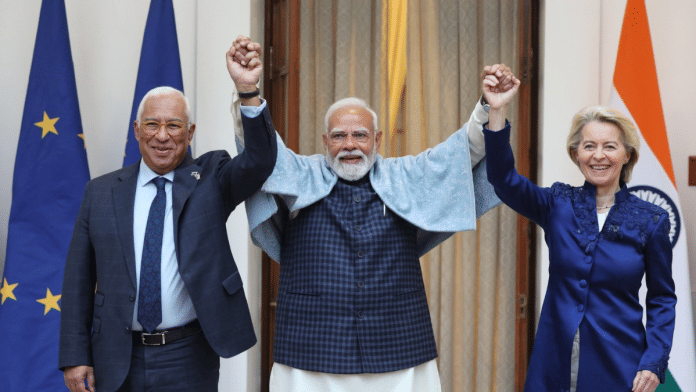
The economic dimension of this hedge is equally telling. The EU, Canada, and India are working out trade deals on their own and finding new ways to engage in global trade that may work alongside or instead of US-led institutions. The fast-tracking of the EU-India Free Trade Agreement (FTA) is another case in point, signalling a deliberate effort by two major middle powers to lock in long-term economic certainty, diversify supply chains away from over-reliance on the US and China, and jointly shape trade, technology, and regulatory standards. These moves indicate not only tactical risk management but also the mitigation of exposure to the geopolitical consequences of the US policy swings.
Also read: India-US deal doesn’t spell doom for Russia ties. Our relationship is stronger than that
The era of flexible coalitions
The crisis of predictability has led to a surge of variable geometry diplomacy—issue-based coalitions that bring together states with shared interests on specific global challenges—such as climate change, digital governance, health security, and non-proliferation. Indeed, middle power activism, rooted in historical traditions of brokerage, Cold War diplomacy, and post-Cold War soft balancing, has long been an intermittent feature of international politics, intensifying with the post-2000s expansion of coalition-building and norm-shaping reflecting broader shifts in the international system that predate the Trump presidency.
The active participation of middle powers in platforms such as the G20, ASEAN, AUKUS dialogues, and regional security forums positions them as brokers between competing interests and as advocates for enhancing multilateral governance where it remains viable.
India has presented a convincing example of middle power agency in recent years, encompassing normative leadership, economic diversification, and complementary partnerships. New Delhi’s diversified engagement platforms, ranging from forming the BRICS agenda to strengthening strategic and commercial ties with the EU, Japan, ASEAN, and Africa, demonstrate this.
Indonesia, often regarded as a sceptical middle power in the Indo-Pacific context, is a prime example of its function as a regional pivot, aiming to shape the geopolitical contours of Southeast Asia rather than merely respond to them. Japan represents a different articulation of middle power activism, one that combines autonomy with alliance integration.
This tension underscores that a middle power strategy does not equate to decoupling from great powers but to managing multiple vectors of influence simultaneously. The instances of all three countries illustrate that they are actively engineering their strategic space by balancing core security interests with economic and diplomatic autonomy.
Yet the very innovations in multilateral diplomacy pioneered by middle powers also reveal the structural constraints they now confront in a far more contested geopolitical environment. Maintaining coherence has become much more challenging in the current environment due to increased persistent volatility, weaponised interconnectedness, and sharper ideological polarisation. The international system in which middle powers are operating is not just multipolar but fractured, with strategic divergence and issue-based alignment frequently coexisting uncomfortably.
This fragmentation exposes the core tension in contemporary middle power diplomacy. While countries such as Canada, India, Japan, South Korea, and key EU states share an interest in preserving openness, institutional stability, and strategic autonomy, their threat perceptions, regional priorities, and domestic political constraints differ markedly.
As a result, coalition-building is increasingly selective and situational rather than durable and institutionalised. In this sense, the present standing of middle powers is paradoxical; they are more necessary than ever to stabilise global governance, yet constrained in their ability to act collectively.
While obstacles remain, this moment marks a turning point in the evolution of global governance, with middle powers potentially poised to play a more substantive role in the architecture of international cooperation.
Pratnashree Basu is an Associate Fellow-Indo-Pacific with the Strategic Studies Programme at Observer Research Foundation. Views are personal.
(Edited by Saptak Datta)