






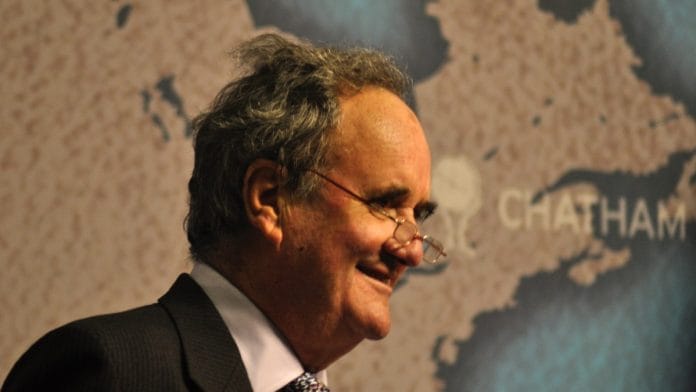



The passing of Mark Tully is sad not just for his friends and relatives, but for all people who love journalism and the news. He was one of the leading journalists for more than 20 years in India, and we have lost a sympathiser for India and Indian policy.
When I first met Mark 28 years ago, I found him to be such a lively and open person who treated everyone he met equally. He had a beautiful sense of humour. He always gave them the impression that he was a friend. I will never forget that quality of his.
We take a lesson from people like Mark Tully: if you are a journalist, treat this profession as a religion. That’s what Mark felt about journalism; he wanted everyone who was reading or hearing him to feel that his words were true and honest. His opinions were never biased. That was the quality of his journalism. He was an Indian voice telling stories about India to Indians.
Now, things have changed so rapidly, technology has improved, and one person does not really matter. But the death of Mark now means that India has lost a good friend, and the readers have lost a good person who informed them honestly and intelligently. That’s the end of the chapter on journalism, as far as I’m concerned.
Also read: Mark Tully was a colossus on the Indian subcontinent. He had sources at all levels
A prayer for journalists
I keep remembering my first meeting with Mark. We were at the Delhi airport, both going to Hyderabad. I met him as a passenger, and then we just became friends.
And when we came to Hyderabad, I thought that he was a nice guy I met, and I’ll remember him, and it was goodbye. But two or three days later, he called me and told me to be in touch. And the way he spoke to me informally and warmly, I felt very touched.
A month later, I had to come to Delhi because my father had passed. I called Mark, and he invited me to his office in Nizamuddin. I chatted with him for about half an hour. And he treated me as if I had known him for years.
I had no idea about his background. I knew the BBC was a news agency, but I didn’t know the importance of that. And a few days after that meeting, he called me again and invited me to his office.
“Satish, would you like to work for the BBC? I want you to work and help me with the news in this office,” he said over a cup of tea.
“Sir, it will be a great honour,” I started saying, but he cut me off. “No, no, no. Don’t give me speeches, just tell me whether you are free.”
When I went to Nizamuddin to work with him, he treated me as if I were a regular guy in that office. He brought a newspaper, and he said, “These are the news stories. What do you think about this one? You do this story, and I’ll do that story.”
Mark’s secretary was watching me. After he left the room, she said, “Well, congratulations. I’ve never seen Mark teaching any other journalist the way he has treated you. You are now part of the BBC.”
Even today, I have not forgotten that moment. I became Mark’s partner from that very day.
When I was doing one of my first few stories, I wanted him to read it before I could send it. I hoped I had done a good story and that I hadn’t made a mistake. But he asked me to just send it—he never checked my story. So I established a relationship with a man who was so much senior to me. He treated me like a companion and a friend.
From that day onward, for 28 years, Mark and I worked together. He made me a journalist.
If I have to talk to young journalists about Mark, I will tell them one thing: be honest. Write your own views, whatever they are. Don’t copy what others have done. It’s my prayer for journalists in India and abroad.
Don’t worry about criticism and just write what you think is the best thing about the story. I’ve always followed that, and that was the lesson I learned from Mark Tully.
(As told to Prasanna Bachchhav)
Satish Jacob is a senior journalist. Views are personal.