






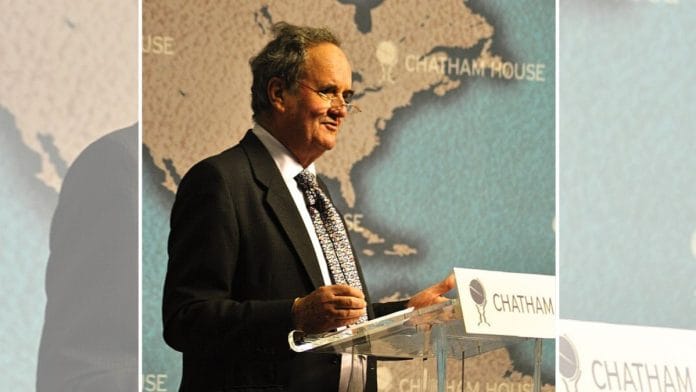



Mark Tully and I go back 60 years. That means from the beginning, ever since he came to India on the managerial side of the BBC. And it was after the Emergency that he blossomed as a first-rate broadcaster. And then there was no going back.
There was no one like him. He was a colossus on the subcontinent.
In those days, the radio was king. Those were not the days of Lyse Doucet; they were the days of Mark Tully. And the credibility of the BBC was built up by people like him.
Meeting Mark in Islamabad
I remember being in Islamabad when Zulfikar Ali Bhutto was incarcerated, and there was every chance that he would be hanged. I stayed in Flashman Hotel, where, believe it or not, Mark was my next-door neighbour.
I thought, I am a novice, this is a stalwart, so I’ll get all the news about Bhutto. Is he being hanged? I saw all sorts of priestly-looking men go in and out of Mark’s room; he had connections at all levels.
One day, I received a call in my room from my aunt in Karachi. “Bhutto has been hanged. It’s all over the BBC and the world,” she said.
I held it against Mark because he was a friend of mine. He could have tipped me off. But then Mark, before he was a friend, was a journalist.
He later told me that he had cultivated the dentist of Bhutto. That was his contact.
I was in South Africa when Nelson Mandela came out as the victor in the presidential elections. And as I was introduced to him, he asked me about Mark.
Before I could answer, he asked everyone to hush up, leaned down, and at his feet, he had kept a transistor radio. A BBC programme was on. For 27 years, Mandela had nothing, and on India, especially, he had no one else but Mark Tully.
Mark was a star. He got the Padma Shree, was knighted. There will not be a journalist, Indian or foreign, who was the kind of celebrity Mark was. And he loved India.
Both houses he stayed at in Delhi were like saloons. You went there in the evening, and you would meet politicians, writers, journalists, buffoons. And there was Mark Tully at his table with an open box of Jawa Dawson cigars.
His house was a big adda for communications commerce. If you did not know what was happening in the world, you turned up at Marx’s saloon. He was an institution.
There was a religious side to Mark. In Cambridge, he had been sent to study, to learn theology, where he failed, and he always laughed at it.
Every year, my wife Aruna has a Christmas Eve party. And last Christmas was the first in a decade that Mark missed.
Also read: Mark Tully’s BBC assignment to India wasn’t by chance. It was a karmic connection
No slant to his coverage
What I admired most about Mark was his authenticity. He never put it out unless he had made sure that it was exactly the right one. And there was never a slant to his coverage, he was never partisan. He was not a stylist. He was a straightforward reporter who balanced the story from all its angles.
He was among the legends of radio journalism. He lamented the fact that radio had taken a back seat toward the end of his career.
In 1975, Mark got expelled from India because he had rubbed Indira Gandhi the wrong way. It made him something of a darling with LK Advani. He probably may have slipped there a bit because he was on the wrong side of Gandhi. So the other side cultivated him. But it didn’t affect his journalism.
He knew not to scream into the camera, not to have shouting matches. He could be genteel, nice, decent and yet as argumentative as possible. That is his legacy.
(As told to Prasanna Bachchhav)
Saeed Naqvi is a senior journalist and commentator. He tweets @saeed_naqvijour. Views are personal.