






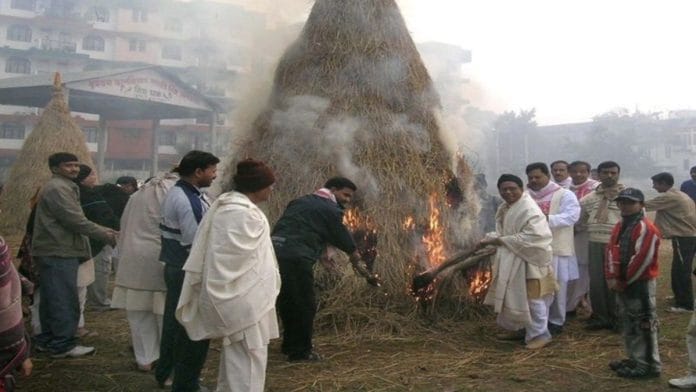



It’s the end of the harvest season in Assam and the beginning of Magh Bihu celebrations, which start a night before on Uruka. Deeply rooted in Assamese agrarian life and shaped by the state’s ancient and tribal customs, the festivals blend seamlessly with the Vaishnavite practices of the land.
Unlike Rongali Bihu, which celebrates the arrival of spring, fertility, and the Assamese New Year, and Kati Bihu, which is marked by scarcity and prayers, Magh Bihu or Bhogali Bihu celebrates abundance at the end of a successful harvest. Hence the name Bhogali, derived from Bhog, which means enjoyment or feast.
While the etymology of Uruka is nebulous, it is said to have stemmed from the word ‘Urukuwa’ used by the Deuri and Chutia tribes of Assam. It means completion or end, signifying the conclusion of the cropping season and the subsequent harvest.
On Uruka, people come together to build Bhelaghars, or Meji, in the fields that have offered their plenty. A Bhelaghar is made using straws and remains of the agricultural bounty. The night of Uruka is marked by a ritual of stealing. In this socially sanctioned theft, young people steal small items from the houses of the community for the Uruka feast. Households often leave items in their front yards or near their doorsteps as a fond gesture. This is perhaps why, more than anything else, Uruka is seen not just as the eve of Magh Bihu, but as a celebration of the freedom and rebellion of the Assamese spirit, and the triumph of communal survival.
The practice of collective cooking and feast is central to Uruka. After the harvest season, foods rich in protein and fat are historically considered essential to survive the winter. So, meat, fish, and rice beer are shared as people sit around a bonfire amidst laughter and merriment, which is the heart and soul of Uruka. It is not Bihu without the traditional til (sesame) or coconut laroos (ladoos) and pithas — an Assamese delicacy made from rice flour ground in the traditional dheki (rice pounder) and wrapped in a mixture of jaggery and til or coconut.
Also read: Krishna Talkies and Assam’s lost single screen cinema magic
Food and joy
As an old tribal proverb goes, “A house older than hunger forgets humility”. So, the Bhelaghar is lit on the morning of Magh Bihu. The fire symbolises purification and protection. It is believed that the fire of the Meji burns through the worst of the winter chill and ushers in the longer, warmer days as the sun makes its northward journey. With the lighting of the Meji, the community comes together to offer Mah Karai — a roasted mixture of rice, black gram, sesame seeds, among other ingredients, harvested from the fields, along with tamul-paan (betel nut and leaf).
There are many tribal legends and oral traditions surrounding Magh Bihu. Bodo oral traditions speak of a mother figure, Mainao Burhi, who blesses humans with bounty only if they display cooperation and communal spirit. Greed and hoarding invite the ire of Mainao Burhi, leading to famine and scarcity. So, communities come together to cook and enjoy the communal feast. Legends describe the year as like a boat with Uruka being the night when the boat docks briefly. On this night, food and joy must be shared before the year passes away with the flow of the river. With the rise and embrace of neo-Vaishnavism, Bhog offerings gained even greater devotional meaning.
On the surface, Magh Bihu is similar to, and coincides with, other harvest festivals in India. But with the anti-hierarchical and rebellious spirit at the heart of its rituals, and given its tribal origins and customs, Magh Bihu maintains its distinctly Assamese soul.
Shabnoor Rahman is a Civil Servant (Assistant Commissioner of State Tax), Government of Assam. Views are personal.
(Edited by Aamaan Alam Khan)
This article’s central premise – that Magh Bihu is fundamentally different from and “rebellious” compared to Pongal and Makar Sankranti – creates artificial divisions where none exist.
The author, a civil servant rather than a historian or cultural scholar, offers no consultation with academic experts or historical sources to support these sweeping claims about the festival’s supposedly unique “rebellious” character. This lack of scholarly rigor shows in the problematic framework employed.
The piece presents tribal customs and Vaishnavite practices as two separate traditions that merely “blend seamlessly,” rather than recognizing that tribal communities across Bharat have always practiced their own indigenous expressions of Sanatana Dharma. The suggestion that “neo-Vaishnavism” added devotional meaning later ignores centuries of organic Dharmic continuity in the region.
Every harvest festival across India – whether Pongal in Tamil Nadu, Makar Sankranti in other states, or Magh Bihu in Assam – shares the same civilizational roots: gratitude for abundance, worship of the sun’s northward journey, communal celebration, and offerings to the divine. Regional variations enrich this tradition; they don’t make festivals “rebellious” or fundamentally different.
The characterization of communal feasting and egalitarian practices as uniquely “anti-hierarchical” is particularly misleading. These elements exist across Indian harvest celebrations and reflect Dharmic values, not rebellion against them.
Rather than celebrating unity in India’s cultural diversity, this piece unnecessarily emphasizes difference and division.