






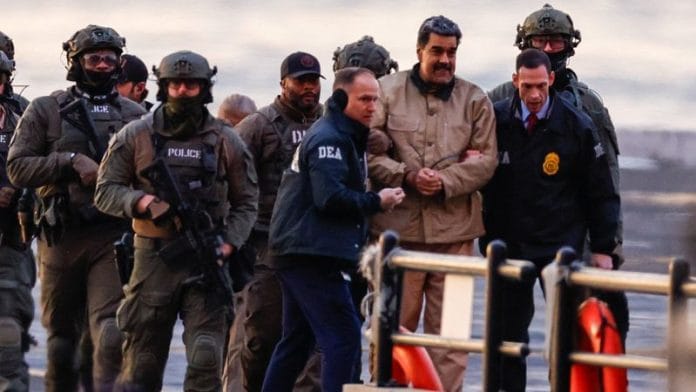



The capture of Nicolás Maduro and his wife has electrified the world and generated immense discussion about its impact on the future. In thinking about that future, it’s important to separate the military, political, economic, and legal strands. The military operation was brilliantly executed. However, this was a raid, which means that all U.S. forces withdrew. Maduro’s officials, including his vice president, remain in charge of Venezuela. The Trump administration proposes to work through these officials, not through the Venezuelan opposition. This will likely fail, requiring additional air and missile strikes. President Trump wants a revival of oil production, but stability is a prerequisite. In the background, the courts will decide the constitutional issues raised by this operation. Those decisions will shape future U.S. operations but will have little effect on the situation in Venezuela.
A Brilliant Military Operation
At the January 3 press conference, President Trump and other administration officials were effusive in their praise for the operation and the service members who conducted it. Many observers tend to discount the president’s exaggerated rhetoric, but in this case, it was appropriate. This raid will likely be regarded as one of the classics in military history.
U.S. military performance here was a vast improvement over previous efforts. In 1980, the Carter administration tried to rescue U.S. hostages in Iran (Operation Eagle Claw). That operation failed because the rescue team’s elements did not work well together. This failure led to the creation of the U.S. Special Operations Command. During the 2003 invasion of Iraq, U.S. forces failed to locate and eliminate senior Iraqi officials despite extensive efforts and several strikes.
It’s worth noting a few reasons why this operation deserves superlatives:
- The United States acquired precise intelligence on where Maduro was. This includes CIA agents on the ground and national intelligence assets, such as signal intelligence and overhead surveillance.
- The U.S. forces pushed into Venezuelan airspace despite Venezuela’s significant air defenses, landed a ground force, and successfully extracted it. These air defenses consisted of 53 long- and medium-range systems, dozens of short-range missile systems, over 440 anti-aircraft cannons, and a small fighter force. The United States suppressed these air defenses, which could have wreaked havoc on the slow helicopters. At the same time, it paralyzed Venezuela’s ground forces, which numbered 93,000 and might have interfered with the U.S. ground force.
- The United States got in and out quickly, taking only about two and a half hours total, with 30 minutes on the ground, according to General Dan Caine, the chairman of the Joint Chiefs of Staff. There were no U.S. equipment losses or fatalities.
- General Caine also described the coordination of thousands of troops and hundreds of elements from every one of the armed forces in a precise timetable, sequencing 150 aircraft—bombers, fighters, intelligence, reconnaissance, surveillance, and rotary wing—launched from 20 different land and sea bases.
- The United States achieved total surprise, despite the enormity of the force employed.
No other country in the world, with the possible exception of Israel, could have conducted an operation like this. The coordination, planning, and training requirements are far beyond what, for example, China could do if it tried a similar operation against Taiwan.
A Setup for Political Failure
The widespread expectation before the raid was that the United States would install the Venezuelan opposition if the Maduro regime fell. The opposition had been widely recognized as the legitimate government and had bipartisan U.S. support. The head of the opposition, María Corino Machado, just won the Nobel Peace Prize.
However, President Trump said he had not been in contact with the Venezuelan opposition and barely mentioned them in his press conference on January 3. Indeed, he depreciated Machado, saying, “It would be very tough for her to be the leader if she doesn’t have the support within, or the respect within the country. She’s a very nice woman, but she doesn’t have the respect.”
Instead, the president will leave the existing government in place and “run” Venezuela until it transitions to a new government. The president talked with the acting Venezuelan President, Delcy Rodríguez, and said she is “essentially willing to do what we think is necessary to make Venezuela great again.”
This will never work. A government of Maduro loyalists will not willingly follow directions from Washington. Indeed, acting President Rodríguez has been defiant: “What is being done to Venezuela is an atrocity that violates international law…. There is only one president in Venezuela, and his name is Nicolás Maduro.” She has reportedly just visited Russia. Recently, she has been conciliatory: “We prioritise moving towards balanced and respectful international relations between the United States and Venezuela.” Still, it’s as if the United States had conquered Nazi Germany and, after Hitler had committed suicide, decided to conduct the occupation through his successor, Admiral Karl Dönitz, and keep the Nazi government in place.
Transitions like this typically have some military or civilian implementing organization on the ground to oversee compliance. U.S. plans do not appear to provide for such an organization. President Trump believes that the threat of force will be sufficient to compel compliance: “They’re acting much differently now than they would’ve acted two days ago.”
Instead of complying, Maduro loyalists will delay, evade, and subvert U.S guidance to retain power. That will likely impel the United States to conduct air and missile strikes in the future, though it may be several months before the Venezuelan’s obstructionism becomes undeniable.
The Moribund Economy and Oil Industry
The oil industry is central to Venezuela’s economy, so its collapse from producing 3.5 million barrels a day in 1997, just before the Chavez revolution, to 1.1 million barrels a day in 2025 has been devastating. Oil was not initially part of President Trump’s narrative about Venezuela, but it has grown in recent weeks. In the January 3 press conference, oil figured prominently, with President Trump demanding that the United States be repaid for “stolen oil” and confiscated infrastructure. He also talked about doing right by the Venezuelan people, so there are two competing goals: U.S. reimbursement and Venezuela’s well-being. He wants private foreign investment to rebuild the neglected infrastructure, and that is consistent with analysis in the oil industry.
Business analysts are already speculating about the future of Venezuela’s oil industry, and President Trump will no doubt return to the subject frequently, but such talk is irrelevant until the political situation stabilizes. Investors won’t move until they have some assurance that their assets will be secure for the long term. Venezuela won’t be in that situation until it has transitioned to a stable government friendly to the United States and established its authority throughout the country. It may take several years to bring about those conditions.
The Legal Controversies
The Trump administration has framed the operation as a law-enforcement effort, not a military effort. Secretary of State Marco Rubio stated at the January 3 press conference: “Remember… at its core, this was an arrest of two indicted fugitives of American justice, and the Department of War supported the Department of Justice in that.” Therefore, the legal aspects will be important to the outcome. The United States will need to build a strong legal case against Maduro and his wife that goes beyond the political arguments the administration has made so far. The United States was able to do that against Panamanian General Manuel Noriega. In any case, there will be extensive legal maneuvering over the prisoners’ status, habeas corpus, admissibility of evidence, and the administration’s consistency in applying the law.
Many commentators argue that the raid was illegal and make three related but separate arguments:
- The raid violated the UN charter, particularly Article 2: “sovereign equality of all members,” “settle disputes by peaceful means,” and “refrain from the use of force.” This resonates with the Europeans, who like to see UN resolutions passed before countries take military action. There was one before Desert Storm, for example.
- The administration needed congressional authorization for the use of military force (AUMF). These authorizations have largely replaced declarations of war in recent decades. Not surprisingly, this criticism resonates with members of Congress. The AUMF’s value lies in specifying the circumstances under which force may be used and in providing authorization from Congress, which has the authority to declare war under the Constitution. However, many administrations have stretched earlier AUMFs. The Trump administration argues that the president’s authority under Article II of the Constitution (as commander in chief, sworn “to preserve, protect and defend the Constitution”) extends to this situation.
- Finally, the War Powers Act requires prior notification of military action and post-operation reports. The administration did not provide these. However, past republican and democratic administrations have often ignored these requirements.
Until U.S. courts determine the legality of the raid, criticisms that it was “illegal” are opinions, not facts. One beneficial side effect of putting the Maduros on trial is that these arguments will get a hearing in court. Given the gravity and constitutional nature of many legal issues at hand, the case will end up at the Supreme Court. That process could well take years.
The legal process will be important for establishing justification for future U.S. operations overseas. It will likely have little effect on foreign policy or Venezuela’s future because it is hard to imagine the courts ordering Maduro’s release and allowing him to return to Venezuela and potentially reclaim power. The courts could convict the Maduros on some charges while throwing out most of the administration’s claims. If most charges are thrown out, the administration might opt to find a country to take the Maduros in exile. This is the deal that the administration apparently offered Maduro several weeks ago, but that Maduro turned down.
What Happens Next?
This is not the end of the Venezuelan crisis but the middle. The president, the secretary of defense, and the secretary of state have rightly celebrated the precision and success of the military operation. However, the military operation is not an end in itself. It is, as Clausewitz argues, the means to a political end. That political end is unachievable as the administration has described in its plans.
Instead of trying to work through the rump Maduro regime, the administration should bring in the opposition, which is regarded as legitimate both inside and outside Venezuela, despite what President Trump said. If the United States does not want to impose the opposition government on Venezuela, it could push for a quick election, which the opposition will likely win.
It’s important to note that President Trump has not talked about a democratic government in Venezuela. He said nothing about elections in his initial press conference but did foresee them “at the right time” in a later briefing, though he prioritized the oil sector. Although he talks frequently about better times for the Venezuelans, he sees that occurring mainly through the restoration of oil production and the elimination of the cartels. He might be satisfied with an efficient but authoritarian government under former Maduro officials.
A stabilization force on the ground often facilitates transitions because the existing government, which created the current policies, cannot be trusted to embrace their change. The Trump administration abhors the possibility of U.S. boots on the ground, despite the president’s statement that he has not ruled them out. So such a force might come from other Latin American countries or Spain, which retains close relations with its former colonies. The new government will need to purge elements of the previous regime from the government and security forces, analogous to the post–World War II de-Nazification of Germany and the post-2003 de-Ba’athification of Iraq.
The legal process will operate slowly in the background. It will be outside the administration’s control, making it a wild card. Although the Supreme Court has trended conservative in recent years, the Trump administration has nevertheless lost many cases.
The bottom line: Venezuela will be an issue for many years to come, even as the president’s political advisers will want to shift the agenda to domestic concerns like affordability.
Mark F. Cancian (Colonel, U.S. Marine Corps Reserve, ret.) is a senior adviser with the Defense and Security Department at the Center for Strategic and International Studies in Washington, D.C.
This article was originally published on the Centre for Strategic and International Studies website.
I was appalled at the changing tunes of the US media after reading a headline by CNN. And here too the columnist is “implying” the same. We are back to the day and age when imperialism is good and acceptable. With the younger generation having no idea of history of imperialism and the associated genocide that came with it these powers are now being given cover fire in the name of “responsibility” lies with the USA for Venezuelan future. What a digusting scenario and look at all the “free” press in the USA suddenly ok with this concept. I think these oldies want lots of young people to perish in the fire of war.