






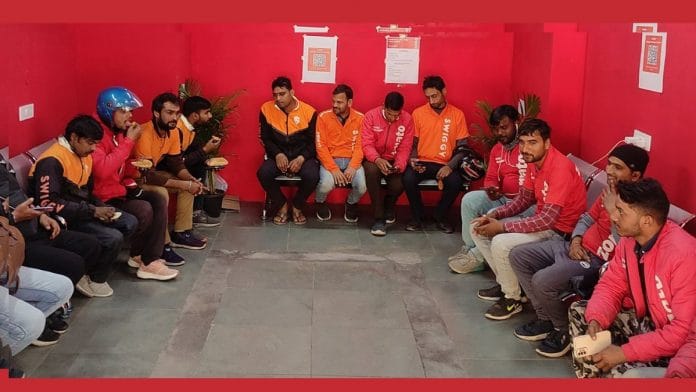



If you are one of the millions of Indians who stayed at home and celebrated New Year’s Eve, chances are that you too were affected by the nationwide gig workers’ strike. These delivery partners or ‘Swiggy/Zomato walas’ brave sunshine, hail, rain, and North India’s toxic smog to ensure that your food package reaches you in time.
Members in my family use delivery apps frequently, as is the case with most urban households in metropolitan cities in India. A recent report stated that post-Covid there were 80 million monthly active users on food delivery platforms in India in 2021, and this number is expected to rise to a whopping 200 million in the coming years.
These delivery apps have been in the news since New Year’s Eve, as gig workers went on a strike, alleging unfair pay, lack of safety, and opaque algorithms. Allegations and counter allegations flew fast and furious between unions and aggregators, with the latter claiming record deliveries and the unions calling out their intimidation tactics.
What numbers say
This Swiggy/Zomato/Blinkit economy, where you can order literally anything instantly through an app, has given rise to the ten-minute delivery model. Expecting guests and your hand towels are shabby? Don’t fret, Instamart will deliver these to you within five minutes. Reached home late from the office and have run out of bathing soap, an easy ten-minute delivery will fix things quickly. Data shows that most orders are placed on weekends, and most customers are from the age group of 18-40 years. The online food delivery sector is growing at an average of 18 per cent per annum, more than double the growth rate of India’s GDP. As per an NCAER-Prosus report, India’s food delivery platform sector generated Rs 1.2 lakh crore in gross output in 2023-24, and direct employment by the sector increased from 1.08 million workers in 2021-22 to 1.37 million workers in 2023-24. Clearly, the impact of delivery apps on the Indian economy cannot be ignored.
The report also stated that employment in the sector grew at a CAGR of 12.3 per cent between 2021-22 and 2023-24, compared to all-India CAGR of 7.9 per cent.
As per the report, production worth Rs 10 lakh in the food delivery platform sector led to the generation of production worth Rs 25 lakh in the entire economy in 2021-22.
Bornali Bhandari, professor at National Council of Applied Economic Research (NCAER), said that “the sector’s contribution to output, employment and indirect taxes is not only measurable but growing at a pace far exceeding that of the broader economy.”
But what this report does not state is that gig workers earn low wages, and risk their life each time they get your order to you in ten minutes. Rs 10 in Delhi, in my area, buys you a tiny cup of adrak chai, or a miniscule chocolate bar at max, as even a samosa now costs about Rs 15. So, imagine how many hours a gig worker would need to work to make the supposed average annual salary of Rs 1,72,591, where the average monthly take-home salary comes out to be Rs 11,769 to Rs 13,057.
What is the strike for?
Article 21 of the Constitution states the right to livelihood and a dignified work environment, while Article 43 directs the State to secure a “living wage” and a decent standard of life, ensuring social and cultural opportunities for workers. But who are gig workers? Until the new labour laws were implemented by the central government in November, gig workers remained largely invisible. Shaik Salahuddin, leader of the Telangana Gig and Platform Workers Union, said that despite platforms using “their money and muscle” to thwart it, the New Year’s Eve strike was successful.
A report in The News Minute states that delivery partners have been voicing concerns across platforms and cities for a basic pay floor of Rs 20 per delivery, 8-hour workdays, safe working conditions, social security, and recognition as workers, rather than partners. It is apparent from the responses of the platforms that they want to control the workflow without taking any responsibility for the employment relationship that traditional employers are bound to by law. To paraphrase the words of a popular song, “All I want for Christmas is basic rights, a fairer process of payment, and no 10-minute deliveries”.
Employers and customers need to understand that gig workers are as much workers as factory workers or farm labourers, and that they are not miscreants. Both sides are equally bound by law. The way employees can seek the enforcement of work contracts, workers too can exercise their constitutional rights by demanding fair treatment.
Also read: Zomato to Zepto—gig work doesn’t need a ban, it needs a safety floor
Rhythms of the algorithms
The real fault lies with the algorithm, which controls the gig work but cannot be held accountable. Platforms describe their delivery partners as “independent contractors”. But is it truly independence when: the app decides which order you see, the app decides your effective hourly earning, when you can be penalised for rejecting or cancelling the order, you can be deactivated with limited options for appeal, and when the ten-minute deliveries pose a risk to your life.
In the delivery platform industry, there are options for collective bargaining, regulation or adjudication. It is suspected that the business ‘logic’ shields the app owners and results in exploitation of the gig workers. Who can forget the image of the delivery agent who was so hungry that he ate the food order he was delivering ?
Why the new labour laws are relevant here
It is apparent from the New Year’s Eve strike, and the reactions thereof, that gig workers are still not treated as traditional ‘workers.’ For the first time, however, they are beginning to gain recognition under the new labour laws. Gig and platform workers have been recognised as a distinct category of labour, particularly under the Code on Social Security, 2020. I wrote about this in my column dated 24 November. This recognition enables the Union and state governments to notify social security schemes covering life and disability insurance, accident insurance, health and maternity benefits, and old age protection, with funding sourced from a combination of government contributions and a mandatory levy of 1-2 per cent of annual turnover (capped at 5 per cent of the amount paid to gig workers).
Crucially, the code allows these benefits to be portable, which means if the worker moves from one platform to another, the benefits can also be ported. However, in the absence of specific fixation of minimum wage for this sector by the government, the regular and general minimum wage will be applicable here as well.
But an authority under a system needs to look into these algorithms to ensure that labour laws are enforced, and gig workers are provided a safety net that shields them from exploitation. The states must promulgate rules that protect these platform workers, and enforcement should ensure their rights are protected. Sustained dialogue around amended labour laws is required to materially change the harsh realities of gig work, which is now essential in a largely digitalised economy such as ours.
Also read: New labour codes are a simplification that’s been long overdue. Its a strategic shift
Responsibility of consumers
I belong to a generation where we were taught to be ‘organised’ — prepare lists and order groceries and household essentials well in advance. Our monthly budgets were allocated and rations were ordered in time, not ‘just in time’. The ten-minute delivery is a concept full of risk, as delivery partners are often seen compromising their safety — by jumping red lights, driving on the wrong side — just to ensure that our delivery reaches within the 600 seconds committed by the app.
Practically, human lives cannot be run using algorithms, but sadly that’s the reality on ground, the reality faced by the gig worker serving our never-ending needs. The fundamental economic principle of human wants states that wants are unlimited and insatiable, while the resources required to satisfy them are scarce. And these scarce resources could be put to better use rather than generating tonnes of waste as a result of ten-minute deliveries.
In the gig economy, we consumers are not innocent beneficiaries of convenience; we are active participants in an algorithm–dependent system that shifts the risk to the vulnerable. Every time we demand faster delivery, cheaper prices, and instant service, the screw is tightened on the workers whose safety, wages, and job security are affected by faceless and nameless AI algorithms. We have a moral and ethical responsibility to not choose speed over safety, silence over scrutiny, and discounts over dignity. We cannot abdicate our conscience to convenience, let us play our role as responsible consumers.
Meenakashi Lekhi is a BJP leader, lawyer and social activist. Her X handle is @M_Lekhi. Views are personal.
(Edited by Aamaan Alam Khan)