






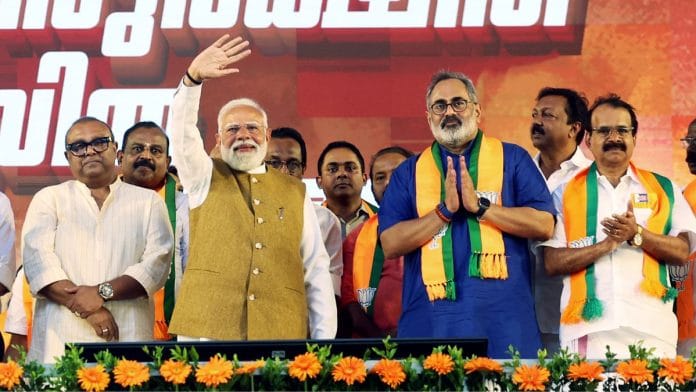



The Bharatiya Janata Party in Kerala is basking in the glory of its historical win in the Thiruvananthapuram Municipal Corporation. The giant strides in the state capital, however, masked the middling returns overall for the party—after the NDA touched a high of 20 per cent vote share in the preceding Lok Sabha elections.
A particularly jarring note was its poor performance in the Christian belt and the abysmal strike rate of the candidates fielded from the community. This also came up when Union home minister Amit Shah flew down to Thiruvananthapuram on 12 January to take stock and firm up plans for the Assembly elections.
Of the record 1,926 Christian candidates the BJP fielded across the state, only 25 went on to win. It was a policy decision by the party at the state level, set in motion after Rajeev Chandrasekhar took charge as state BJP chief. A circular by the party’s Kannur North district committee on fielding a certain percentage of Christians was leaked to the media ahead of the polls.
A conciliatory note
Although the BJP’s central leadership had long green-signalled this approach, the state unit, under Hindutva poster boy K Surendran, had been reluctant to go all out to woo the Christian community. On the other hand, Chandrasekhar is fully onboard with the central leadership on this count. In a first for a Kerala BJP president, he nominated two Christian faces into the core committee of the state unit: state vice-president Shone George and general secretary Anoop Antony.
Nevertheless, the BJP cut a sorry figure in George’s base of Pala municipality, where the party got blanked despite fielding seven Christian candidates. In the Mutholy panchayat in the Pala Assembly constituency, which was previously ruled by the BJP, the party lost power after returning just two of its six representatives. Similarly, in Thiruvalla, the home turf of Antony, the party’s two Christian candidates ended up on the losing side.
The Nilambur by-poll was Chandrasekhar’s first election assignment as state president. Despite fielding a Christian Kerala Congress turncoat on the BJP ticket with fanfare, the party couldn’t improve on its performance, ending up a distant fourth behind independent candidate PV Anvar.
Also read: What Indira Gandhi said in her first speech as PM, 60 years ago
Hindu backlash
Apart from the fact that the Christian outreach hasn’t led to a breakthrough, what perturbs the BJP hardliners backed by the V Muraleedharan faction is the prospect of a Hindu backlash. From their perspective, the results of the local body polls vindicate them, as the Left managed to wrest back sections of the Hindu vote polled by the BJP in 2024. This shift was most evident in districts such as Thrissur, Alappuzha, and Thiruvananthapuram, where the BJP made huge gains in the Lok Sabha polls.
Even the Rashtriya Swayamsevak Sangh (RSS) isn’t too impressed with Chandrasekhar’s rhetoric on carrying everyone along. In fact, the state chief’s olive branch to the Muslim community, going beyond the memo, caught the mothership by surprise. It wasn’t clear whether his comment linking the lack of Muslim representation in the Union cabinet was a result of such internal discord.
The silver lining
The only silver lining was the party’s stunning win in the Kadappuram ward of Munambam, epicentre of the anti-Waqf protests, which hogged the national headlines. According to BJP Minority Morcha’s Philip Joseph, the win was accomplished despite the Latin Church—represented by the Vicar of the Velankanni Matha Church—campaigning against the party.
“Except for Fr Joshy Mayyattil, we got no backing from the clergy, but we managed to impress upon the voters to stand with the BJP for a permanent solution to the restoration of their revenue rights,” Joseph told me.
In the past, the BJP hadn’t even fielded a candidate in the Congress bastion.
However, the attacks against Christians reported from across the country seemed to negate any progress made by the Kerala unit on Christian outreach beyond Munambam. The likes of Thrissur Archbishop Andrews Thazhath, who also serves as president of the Catholic Bishops Conference of India; Archbishop Joseph Pamplany; and Baselios Marthoma Mathews III, who heads the Malankara Orthodox Church—all of them previously seen as soft on the BJP, came out with scathing statements in its wake.
Chandrasekhar was quick to initiate damage control. After the highly publicised arrest of Kerala nuns in Chhattisgarh last year, Chandrasekhar also initiated a meeting between Syro-Malabar Church representatives and Prime Minister Narendra Modi in Delhi, ahead of the local body polls. But it may not have been enough.
Christmas attacks
Notwithstanding the prime minister’s televised visit to the Cathedral Church of the Redemption in New Delhi on Christmas, attacks against the community were reported from across the country the same week. This included Hindu groups singing Hanuman Chalisa outside a church in Bareilly.
The attacks against Christmas revellers seemed to spill over to Kerala when an attack on a children’s carol was reported from Palakkad. The alleged perpetrator was an RSS-BJP worker. But what shocked Malayalis more was the justification of the act by state BJP vice-president C Krishnakumar. He dubbed the carolling children “intoxicated”, drawing a sharp response from their parents.
Krishnakumar had earlier taken pains to travel all the way to Munambam in Kochi in the middle of his campaign, when he stood as the party candidate for the Palakkad by-poll. However, Krishnakumar’s words betrayed his true colours and laid bare the transactional nature of the BJP’s engagement with the church.
Beyond paying lip service on occasion, the party doesn’t seem to care when it comes to core issues of the Christian community. The fact that the prime minister and the home minister did not publicly condemn these attacks became too conspicuous to be missed by prelates Thazhath, Pamplany, and Marthoma Mathews III—prompting them to vent their frustration.
“The government says fringe groups are responsible. If so, why the silence? Why no public condemnation? Silence is not neutrality — it is complicity,” Thazhath said, not mincing his words.
Also read: Mark Tully was a colossus on the Indian subcontinent. He had sources at all levels
National Commission for Minorities
There has been no Christian representation in the ‘headless’ National Minority Commission for over five years. The same goes for Christian representation in the National Commission for Minority Education. George Kallivayalil, former Associate Editor of Deepika, Kerala’s oldest daily promoted by the Syro-Malabar Church, wrote that the central government snubbed Pope Francis under the cover of technicalities—despite the pontiff expressing his eagerness to visit the country.
TJ Joseph, victim of cross-amputation for ‘blasphemy’ perpetrated by the Popular Front of India in 2010, was reportedly approached by the BJP, soliciting his interest on being nominated to the National Minority Commission. Professor Joseph told me that after parading him around at a Modi event in Kochi, there was no further contact even after he had acquiesced to the proposal.
The Syro-Malabar Church has lately been getting worked up over issues such as migration, dwindling numbers, and poor representation in government. Its decision to declare 2026 as the Year of Community Empowerment and exhortation to Catholic youth to enter politics needs to be seen in this context.
Local body polls aftermath
Lately, the Syro-Malabar Church has also been disappointed with the Pinarayi Vijayan government for various omissions and commissions. This includes the decision to not release a report submitted by retired justice JB Koshy, which delved into the ‘backwardness’ among Christians including representation in government service.
“Christians are sliding backwards on every measurable index of power,” Thazhath had lamented.
The results in the local body polls saw the Congress-led United Democratic Front (UDF) sweeping in Christian-dominated Central Travancore, indicating a shift from 2021. The Church also had several issues with Congress in the recent past, but seems to have put those behind it, anticipating a slice of the political pie in the event of the UDF coming back to power. Such a scenario prompted the Church to even persuade the community-backed Kerala Congress (Mani) to belatedly shift to the UDF—even if it didn’t materialise once Vijayan got a whiff of it.
The UDF is the natural voting choice for Christians. Even if sections of the community may have voted for the Left in 2021, incidents such as the firing on the Angamaly Church during the 1959 Vimochana Samaram (liberation struggle) are so deeply ingrained within the community that it can’t be sustained.
BJP’s conundrum
PM Modi visited the state capital on 23 January. Chandrasekhar and the state unit are in a quandary on the way forward in Kerala, where the party has both short-term and long-term goals. When the party decided to field so many Christian faces on the BJP symbol for local body polls, an unanticipated issue was finding suitable candidates. Eventually, it had to rely on the pro-BJP outfit Christian Association & Alliance For Social Action (CASA) to source its candidates.
That situation persists. The party’s warm welcome for turncoat spokesperson Reji Lukose (from the Left ranks) reeks of desperation. With the Left aggressively chipping away at the Hindu votes, it might be in the BJP’s short-term interest to consolidate its base before casting its net wide to cater to the Christian community. Doing otherwise would risk frittering away the gains made in 2024.
A bird in the hand is always worth more than two in the bush.
Anand Kochukudy is a Kerala-based journalist and columnist. He tweets @AnandKochukudy. Views are personal.
(Edited by Prasanna Bachchhav)
An average malayali reads 2 news papers, consume more tv channel debates than other states . Christains in kerala see the rising attack againist christians in north India, and realised that their turn has now come after muslims. And, they clearly see that, except for Goa, all sang dominated states treat them as second class citizens.