






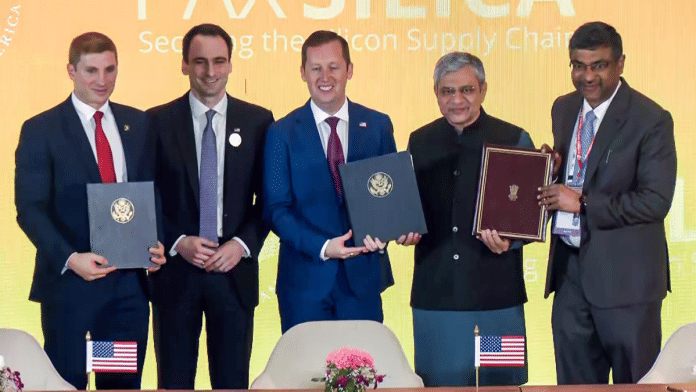



If Pax Americana was defined by a world stabilised by US military and financial dominance, Pax Silica is then a world order structured around the control of semiconductor, advanced compute, AI hardware and the infrastructure that powers the digital age. To that end, India signed the United States-led Pax Silica initiative on the sidelines of the AI Impact Summit 2026 in New Delhi. The framework, initially launched in December 2025, was aimed at a secure global supply chain primarily for semiconductors, AI and critical minerals in order to reduce reliance on China, which dominates the space.
Last year, the geopolitics of critical earth minerals had surfaced with renewed intensity amid escalating US–China trade tensions. Following a round of tariff measures introduced by the Trump administration, Beijing responded with export control mechanisms framed as necessary to safeguard “national security and industrial interests.” Given China’s overwhelming dominance in global rare earth production and processing, these controls carried strategic weight far beyond routine trade policy. Rare earths are indispensable to advanced electronics, electric vehicles, wind energy systems and high-end defence technologies—sectors central to both economic competitiveness and military capability.
Both the US and the European Union are dependent on China for their critical earth supply chain. The European Commission even expressed “deep concern” and cautioned that China’s critical earth export controls could risk intensifying trade fragmentation.
With the US and EU firms embedded in clean energy transitions and defence modernisation, constrained access to rare earth elements could translate into higher costs, production delays, and strategic vulnerability. Subsequently, what unfolded was not merely a tariff dispute but a recalibration of leverage within critical mineral supply chains, a reminder that in the emerging industrial order, control over upstream resources increasingly functions as geopolitical power.
Pax Silica is a framework which includes allies such as Japan, Korea, Israel, Australia UK and now India, among others. Though the framework is still evolving, it presently includes critical minerals and refining, semiconductor design, fabrication and packaging, energy grids and power generation.
In this emerging new order, these collaborations are no longer merely commercial arrangements but also security arrangements. Export controls increasingly function as instruments of diplomacy. Chip subsidies are framed as extensions of national security doctrine. Fabrication plants are treated as strategic assets akin to ports or airbases, and AI compute clusters are projected as markers of sovereign ambition and technological prestige.
Also read: India must build its own AI stack. It is now a strategic necessity
Advantages of joining
For India, joining Pax Silica has an upside. It does not currently sit at the centre of the semiconductor ecosystem, it does not manufacture cutting-edge chips at scale, and neither does it control high-end fabrication plants. Chips now sit at the foundation of economic growth, military capability and political influence. They power everything from missile guidance systems and satellites to banking networks, 5G infrastructure, and artificial intelligence models. In such an environment, control over semiconductor supply chains is no longer industrial policy but a national necessity. The emerging geopolitical logic is clear—whoever controls advanced compute controls the future of AI, and whoever controls AI influences defence, productivity and information ecosystems, and whoever influences these domains shapes global hierarchy.
India does not have first mover advantage. China dominates the silicon and semiconductor industry. The US dominates chip design and high-end AI architecture. Taiwan leads in cutting-edge fabrication. The Netherlands supplies the lithography machines, without which advanced chips cannot be produced. South Korea commands memory manufacturing. And Japan retains critical material and equipment advantages.
But India is still not marginal. It possesses a deep software talent pool, a thriving digital services industry, a burgeoning downstream sector and one of the world’s most sophisticated digital public infrastructure models. These assets position India not just as a bystander but also as a potential balancing actor in the Silicon Age.
India also contributes scale to Pax Silica as no other country does. And India has one of the fastest-growing electronics markets, defence modernisation programmes and 5G infrastructure ambitions, making India a long-term market justifying capital-intensive fabs. Additionally, India’s geostrategic position in the Indo-Pacific adds to the logistics component And most importantly, as the largest democracy, it offers legitimacy to the alliance. With credibility and trust among the so-called Global South countries, India’s participation in Pax Silica is integral to preventing the alliance from looking like an elite group.
Also read: India must govern AI with confidence. Use guardrails, not handcuffs
Preserve flexibility
While India is an important ally and there are advantages to joining the alliance, it does not necessarily mean that it will be insulated from challenges. India has to weigh whether participation means technological advancement. India still has a long way to go in advanced lithography capabilities, semiconductor manufacturing and sophisticated fabrication. Without committed long-term investment, exploration initiatives and ease of business that is subsidy-driven with regulatory consistency, India may stagnate and remain confined to lower-end segments such as packaging and assembly. Moreover, India could also face limitations to its strategic autonomy. The coalition could impose export and technology controls, which might hamper diplomatic ties with non-member countries.
Therefore, India’s focus has to be on maximising its role in the alliance by increasing its capability, while preserving its diplomatic flexibility.
Finally, even though Jacob Helberg, US undersecretary of State for economic affairs, has said that “Pax Silica is really not about China, it is about America. We want to secure our supply chains”, the fact remains that China’s domination of rare earths is central to this initiative. India, as a partner that will help de-risk supply chains, must also retain its strategic autonomy while being a part of shaping Pax Silica, not merely adapting to it.
Rami Niranjan Desai is a scholar of Northeast region of India and the neighbourhood. She is a columnist and author and presently Distinguished Fellow at India Foundation, New Delhi. Views are personal.
(Edited by Theres Sudeep)