






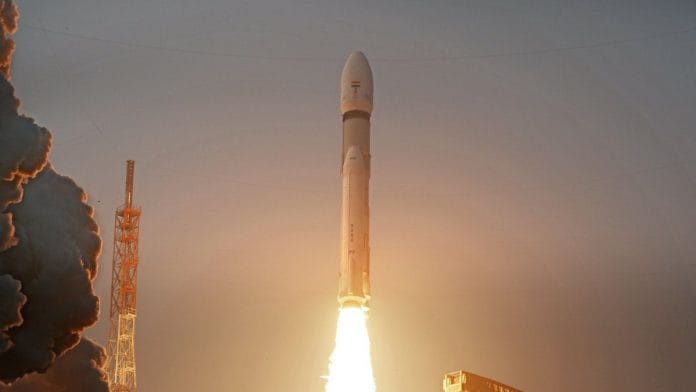



On 24 December 2025, the Indian Space Research Organisation launched the LVM3-M6 / BlueBird Block-2 mission for its US-based commercial customer, AST SpaceMobile. This was the ninth flight of the LVM3 rocket, which has maintained a perfect track record so far. Beyond the operational success, it is important to assess the mission’s broader importance across the technological, commercial, and geopolitical arenas.
From an Indian perspective, this launch highlights ISRO’s ability to handle complex, high-stakes missions for global clients. In two earlier launches in October 2022 and March 2023, ISRO successfully placed 72 satellites into orbit for the UK-based agency OneWeb as part of its global Low Earth Orbit (LEO) constellation for internet connectivity.
With the launch of the BlueBird-6 communications satellite (for mobile telephony), ISRO further demonstrates to satellite manufacturers and operators that it offers a proven, reliable, and time-tested launch services capability. It’s also another significant chapter in the evolving India-US space partnership.
Also Read: From Sharma to Shukla, India’s spaceflight goes from Russia’s goodwill to NASA’s partnership
A breakthrough for ISRO
Technologically, the mission establishes ISRO’s heavy-lift credentials and the viability of direct-to-device satellite connectivity.
Developed by the Indian space agency, LVM3 is a three-stage launch vehicle comprising two solid strap-on motors (S200), a liquid core stage (L110), and a cryogenic upper stage (C25). It has a lift-off mass of 640 tonnes, a height of 43.5 m, and a payload capability of 4,200 kg to geosynchronous transfer orbit (GTO).
In its earlier missions, LVM3 successfully launched Chandrayaan-2, Chandrayaan-3, and two OneWeb missions carrying a total of 72 satellites. The previous LVM3 launch was the LVM3-M5/CMS-03 mission, which was successfully completed on 2 November 2025.

With this mission, ISRO has put the BlueBird Block-2 satellite into Low Earth Orbit. At 6,100 kg, it is the largest commercial communications satellite deployed in LEO so far and the heaviest payload launched by LVM3 from Indian soil. For ISRO, this is a major achievement and opens the door for undertaking heavy satellite launches in future for scientific, strategic, and commercial purposes.
The LVM3’s configuration, with two S200 solid boosters, a liquid core stage, and a high-thrust cryogenic upper stage, is central to this capability.
For long, cryogenic propulsion posed a technological challenge for ISRO. But with the success of this mission, it has demonstrated growing confidence in designing and operating high-thrust cryogenic systems. The precise orbital injection of the BlueBird Block-2 satellite further demonstrates the technical maturity of the LVM3 vehicle and ISRO’s integration of propulsion, guidance, and satellite systems, enabling a smooth mission execution.
After ISRO put the satellite in a perfect location, the owner company, AST SpaceMobile, took control of the system and confirmed nominal telemetry. The platform is an answer to dead zones, one of the most persevering problems in mobile telephony. Unlike conventional systems, it does not rely on ground towers or specialised satellite phones, but connects directly with mobile handsets.
For this purpose, there is a massive phased-array antenna connected to the satellite, covering approximately 223 square metres of area. This will allow the satellite to pick up faint signals from a smartphone and beam back high-speed 4G and 5G broadband. In short, the satellite itself functions as a powerful cell tower, without the obstructions that cell towers on Earth confront.
Also Read: Three Hyderabad start-ups are conquering the new frontier in space race — Low Earth Orbit
From denial to cooperation
In recent years, cooperation between the United States and India has expanded to areas such as human spaceflight and Earth observation. Notably, NASA supported India’s plan to send an astronaut to the International Space Station during the Axiom-4 mission. Earlier this year, ISRO also successfully launched the NASA-ISRO Synthetic Aperture Radar (NISAR) Earth observation satellite, a major joint mission that reflects growing trust and technical collaboration between the two agencies.
At the same time, there is some historical irony in the backdrop of this cooperation.
In the early 1990s, the US actively worked to block India’s access to cryogenic engine technology, significantly limiting ISRO’s ability to launch heavy satellites. Decades later, the situation has reversed.
Today, a US private company has approached ISRO to launch its satellite, underlining how far India’s launch capabilities have matured. It’s a statement not just on ISRO’s technological self-reliance and credibility, but on how India-US relations have transitioned from technology denial to cooperation in space.
Ajey Lele is deputy director general at the Manohar Parrikar Institute for Defence Studies and Analyses (MP-IDSA). Views are personal.
(Edited by Asavari Singh)