






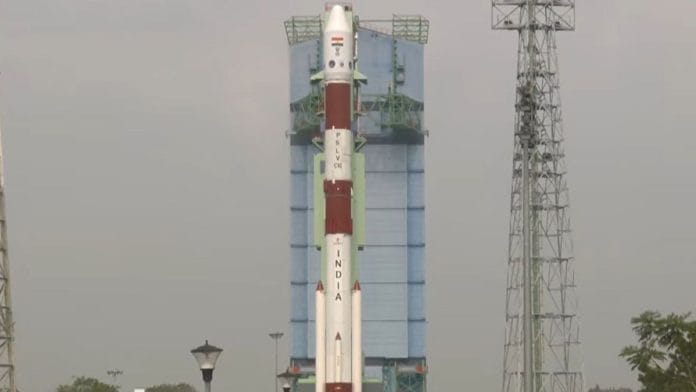



ISRO’s Polar Satellite Launch Vehicle, PSLV, has suffered two consecutive failures within eight months. These are anomalies for a rocket revered as the Indian Space Research Organisation’s most reliable workhorse. They are fuelling deep concerns about the ripple effects on India’s space sector and its broader ambitions.
But for us to try and understand what this moment means, it helps to hold two ideas at once: The weight of PSLV’s long record of performance, and the fragility of the transition currently underway in India’s space programme.
The proven workhorse
Discounting the recent failures of flights C61 and C62, the PSLV held a success rate of approximately 95 per cent. For decades, it maintained an unbroken streak of successes. It earned a global reputation as one of the most reliable launch vehicles. It carried the weight of India’s most visible scientific missions like the first lunar probe (Chandrayaan-1), the first Mars orbiter (Mangalyaan), and the first solar observatory (Aditya-L1). Few rockets have demonstrated this level of mission flexibility.
The point here is this: The PSLV is a mature piece of technology. It is a platform designed, optimised, and perfected over three decades. But even mature technology is not immune to entropy. Systems can drift when suppliers change, components age, and processes evolve. However, ISRO has proven it knows how to build a reliable launch system, how to run missions repeatedly, and how to recover from setbacks. It is reasonable to believe ISRO can fix PSLV again.
Also read: Industry experts call for quality control and accountability with ISRO’s repeat launch failures
Why this moment feels bigger
Space has a lot many more participants and stakeholders. Back-to-back failures hurt more today than they might have a decade ago because of this. It is now tied to commerce, national security, universities, startups, and international partnerships.
With the recent failed launches, multiple satellites were lost. The consequences of failure spread across many stakeholders.
Until PSLV returns to service cleanly, global customers and insurers may hesitate to book rides on a launcher under scrutiny. This hesitation comes at a critical time, when India is trying to grab a larger slice of the global launch economy.
A routine rocket in a new era
This crisis also arrives at an awkward institutional moment. ISRO’s ambition set has expanded. Human spaceflight (Gaganyaan), the Next Generation Launch Vehicle (NGLV), and the Bharatiya Antariksh Station demand deep attention from the agency’s best engineers and scientists.
The Indian Space Policy 2023 reflects this new direction. It outlines ISRO’s role being reoriented to dedicate more time doing what only ISRO can do, which is frontier R&D, while routine services move outward to industry.
This is where the PSLV confusion lies. It is vital, yet it belongs in the “routine operations” bucket. The ideal scenario was a smooth handover of a perfected PSLV to industry partners like the HAL-L&T consortium. These failures complicate that handover. ISRO is forced to stall to fix a legacy platform, creating friction across the national roadmap.
Also read: PSLV-C62 failure: What Indian start-ups say about trusting ISRO as a launch partner
What ISRO should do now
ISRO has to clear this bottleneck and restore momentum. To achieve this, it must prioritise three decisive actions.
First, be transparent. After consecutive failures, transparency becomes crucial for all stakeholders and the public. Even if ISRO cannot release every technical detail immediately, it should commit to a clear cadence of communication: What is known, what is still being tested, what hypotheses have been ruled out, and when the next update will come. Silence creates a vacuum that gets filled with speculation. It is bad for commercial confidence.
Second, publish a return-to-flight plan with timelines. This is the most practical way to rebuild confidence through process. The industry needs to see a checklist. By when will the failure investigation be closed? By when will corrective actions be completed? What additional verification tests will be done on the ground before flight? What are the “go/no-go” criteria for declaring PSLV ready again? This restarts the rest of the ecosystem and commercial planning.
Third, keep the long game in sight. As ISRO moves toward higher-risk missions, failures become more likely because the frontier is harder. That is exactly why a culture of openness and process discipline must begin now.
Space has moved to the centre of global geopolitics and economics. Reliable access to orbit is the entry ticket to space. India has secured its seat at the table through decades of perseverance and brilliance. It should protect that position now with openness and clarity.
The author is a research analyst at the Takshashila Institution. Views are personal.
(Edited by Theres Sudeep)