






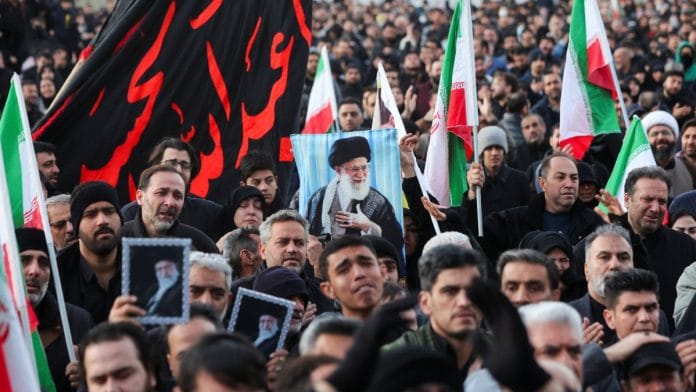



The war in the Middle East has today entered its seventh day. In his first video address, Donald Trump spoke openly about regime change in Iran. Yet by the time the second official communication arrived from the US Central Command, or CENTCOM, that objective was dropped.
Even so, the absence of explicit mention does not seem to mean the objective has vanished. Increasingly, evidence suggests that Washington may be war-gaming a parallel path to destabilising the Iranian regime — one from within.
This approach seems to be designed to operate alongside the ongoing US-Israeli strikes to degrade Iran’s conventional military capabilities: ballistic missiles, drone networks, and naval assets. Despite limitations — particularly in magazine depth and interceptor stocks — both the Americans and Israelis have achieved full air superiority in Iranian skies and severely degraded its military capabilities.
Meanwhile, Iran, pushed to the corner, has sought to widen the war. Its strategy has predictably been aimed at threatening the energy infrastructure of the Gulf. In its own way, this is a calculated and effective move. The wealthy Gulf monarchies rest on a delicate political contract: stability and prosperity in exchange for political acquiescence. Any sustained threat to their economic lifelines — oil terminals, shipping lanes or refining capacity — could shake the order-seeking business models of these states and provoke public anxiety within.
This strategy, however, carries risks for Tehran. Rogue attacks could convince Gulf states that stopping midway would be more dangerous. Reportedly, some Gulf governments are urging Trump to continue degrading Iranian military capabilities and push the war toward a decisive culmination.
In this context, revisiting the discussion on internal destabilisation in Iran becomes relevant. So far, there have been no major defections within the Islamic Revolutionary Guard Corps (IRGC) or the regular military, the Artesh. Yet, the fog of war shields accurate information from the region and many developments discussed today will require clearer corroboration in the weeks ahead.
Evolving statehood
To understand whether Iran can be destabilised internally, one must first understand the historical and ethnic experience of the Iranian state.
Iran is a civilisational crossroads where diverse peoples, languages, and identities intersect. Any attempt to weaponise these differences must be assessed through an analytical framework that considers historical experience, ethnic diversity, and the transnational nature of minority communities.
Not all minorities can be mobilised in the same way because their relationship with the Iranian state varies widely. Before I turn to the ethnic groups and their varying hostilities toward the regime, the state-society dynamic of Iran merits attention.
Before the Islamic Revolution of 1979, Iran was far less opaque than it is today. For centuries, it had been a society where local leaders, tribal authorities, and clerical figures wielded significant influence. Foreign powers — particularly Britain and Russia — exploited this decentralised political landscape during the late imperial period and into the early 20th century.
As historian Mehran Kamrava has long argued, Iran’s political evolution can be understood through the shifting balance between state power and societal power. Historically, Iran resembled a strong society with a weak state, creating an imbalance manipulated by foreign actors leading to internal fragmentation.
It was precisely this vacuum that enabled Reza Shah Pahlavi to seize power in 1925 and begin consolidating the Iranian state. His rule marked the first serious attempt in modern times to build a centralised national authority capable of resisting foreign interference.
His son and successor, Mohammad Reza Shah, continued that project after 1941, though his methods were deeply controversial. The second Shah’s regime, backed by the West and enforced through an extensive secret police trained with British and CIA assistance, cracked down on democratic activists and religious leaders alike. Instead of strengthening legitimacy, repression deepened popular resentment.
Ironically, these decades of centralisation weakened local power structures and prepared the ground for an even stronger state. When the Shah was overthrown in 1979 and Ayatollah Ruhollah Khomeini returned from exile in Paris on 1 February, Iran entered a new phase: the emergence of a highly centralised Islamic theocracy.
The rise of the security state
The Islamic Republic rapidly constructed one of the most sophisticated security systems in the region. At its core perched the IRGC, tasked not only with defending the state but also the ideological legacy of the revolution.
The IRGC took shape during the eight-year Iran-Iraq War, when Saddam Hussein’s invasion threatened the survival of the revolutionary regime. By the time Ayatollah Ali Khamenei succeeded Khomeini in 1989, the IRGC gained the central position of the regime’s watchdog.
Over the decades that followed, IRGC developed a network of regional proxies to extend the regime’s influence and build strategic depth. These included Hezbollah in Lebanon, the Houthis in Yemen, Hamas in Gaza, and several Shia militias across Iraq and Syria. A 2019 mapping project by The Washington Institute identified more than a hundred Shia groups and sub-groups across the Middle East connected, directly or indirectly, to Iran.
Domestically, the IRGC’s power expanded beyond the military sphere. It gained vast economic influence, controlling major sectors of infrastructure, energy, and construction. Yet even this formidable apparatus could not fully resolve one persistent issue — it could only suppress, not resolve, the question of Iran’s ethnic tensions.
Iran’s ethnic conundrum
Iran shares land borders with seven countries: Iraq, Turkmenistan, Afghanistan, Pakistan, Azerbaijan, Turkey, and Armenia. This geography alone hints at the ethnic complexity within its borders.
Ethnic Persians make up roughly 60 per cent of Iran’s 90-million population, concentrated in the western and central regions, while the remaining 40 per cent comprises various minorities. Azeris (16 per cent) live mainly along the Azerbaijan border and relatively integrated into the system — indeed, the slain Ali Khamenei was of Azeri descent. Kurds are 10 per cent and Lurs are 6 per cent while Baloch, Arabs, and Turkic groups each constitute about 2 per cent.
Among these, the Sunni Kurds and Baloch have historically harboured the deepest grievances against the Shia IRGC. Azeris, while more integrated, present a more complex case due to Israel’s energy and military ties with Azerbaijan.
Despite such fault lines, the IRGC’s security apparatus has largely suppressed separatism, even as millions have fled over decades.
Also read: Iran conflict has reached India. Muslims are again asked to prove their patriotism
The Kurdish factor
If Washington and Tel Aviv are indeed weighing internal destabilisation, the Kurds appear the most plausible vector. Recent reports suggest that the CIA may be coordinating with Kurdish groups to move armed fighters into Iran. Kurdish organisations already maintain thousands of combatants along the Iraq-Iran border, mainly in Iraq’s Kurdistan region.
Since 28 February, several Kurdish groups have issued statements hinting at imminent action and urging Iranian military personnel to defect. Representatives of the Kurdish Regional Government have indicated that US support for these networks may have begun months before Operation Epic Fury was launched.
Beyond Iraqi Kurdistan, Washington can also draw on longstanding ties with Syrian Kurdish forces, many of whom are US-trained during the fight against ISIS and are battle-hardened in irregular warfare.
But even if Kurdish mobilisation occurs, success is far from certain. Timing, coordination, and alignment with other minority groups would be critical — and not all minorities share the same interests.
Baloch and the limits of insurgency
Any discussion of Iranian internal instability must also consider the Baloch in southeastern Iran. Their territory borders Pakistan’s Balochistan province along a porous frontier stretching nearly 900 kilometres.
Like the Kurds, the Baloch are a transnational people. But their political dynamics differ significantly. In Pakistan, Baloch insurgents are largely separatist. In Iran, they are radical Sunni organisations.
The region has also evolved into a hub of shadow economies and smuggling Iranian and Russian crude, weapons, and narcotics. These networks exist in a complex relationship alternating between co-optation and conflict with the IRGC itself.
This complexity at times gets overlooked in policy debates where in calls for supporting Baloch insurgencies in Pakistan rarely consider the broader implications. A “Greater Balochistan” would destabilise not only Pakistan but also Iran and Afghanistan, potentially triggering a far wider regional instability.
For Washington and Israel, then, the option of destabilising Iran internally carries profound risks.
Arming Kurdish groups would unsettle Turkey and Syria, both of which view Kurds as a major security threat. Encouraging Azeri hostility could destabilise the Caucasus. Supporting Baloch insurgents would further inflame the already volatile Af-Pak region.
In other words, destabilising Iran through ethnic fault lines may solve one problem only to create several others.
Also read: Regime change is a pipe dream. A stress test on Iran is what we’ve got so far
Does that ring a bell?
The unfolding situation evokes uncomfortable historical memories of Yugoslavia’s bloody disintegration in the 1990s. This ethnically diverse state, held together for 37 years by a powerful leader, unravelled after his death in wars that scarred Europe for more than a decade.
Yugoslavia’s president, Josip Broz Tito, was not from the dominant Serb ethnicity, but of Slovenian-Croat descent, and his passing triggered a cascade of conflicts along religious and ethnic lines.
Of course, Iran’s context and historical experiences are different. However, it is not difficult to imagine the spectre of prolonged fragmentation and human tragedy if attempts at internal destabilisation go awry.
Swasti Rao is a Consulting Editor (International and Strategic Affairs) at ThePrint. She tweets @swasrao. Views are personal.
(Edited by Aamaan Alam Khan)
What this shows is a desire to harm the State of Iran, any which way. No concern for the well being of its people. USA has been here before, and never left a good taste in the mouth.