






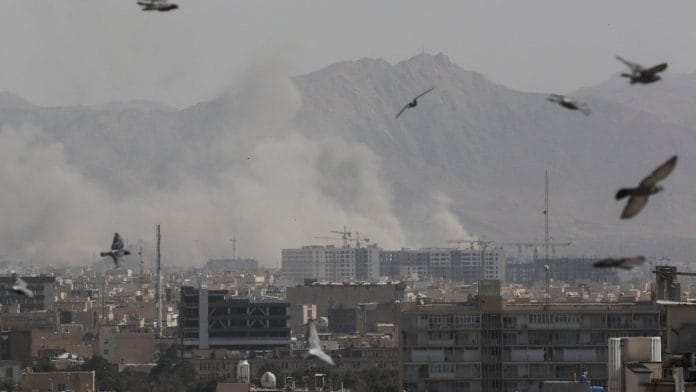



In a video on his social media platform, ‘Truth Social’, announcing the start of combat operations against Iran launched on February 28, US President Donald Trump exhorted the people of Iran to “take over your government.” The words were telling. The American president was effectively dictating to a sovereign people–the people of Iran—what political outcomes they should produce.
The leader of one country—the US President– was publicly prescribing the political future of another.
Yes, the Iranian regime is oppressive and dictatorial. Its repression of women and attacks on civil liberties are deeply reprehensible and have no place in 21st century norms of civil life.
But can you bomb a country from the air and simultaneously claim to midwife its democracy? This is the very definition of Great Power paternalism and imperialism.
The US and Israel’s military strikes on Iran—launched with an explicit objective of crippling Tehran’s military capacity and ultimately effecting a change of government—are not merely another chapter in West Asian turmoil. They represent a shockingly dangerous retreat from the carefully constructed post-World War II international architecture that has tried to curb aggressive conflict and uphold the sovereignty of all nations. This architecture was the United Nations-anchored world order, created in 1945 with the deliberate purpose of preventing another world war.
Trump’s Iran campaign, dubbed “Operation Epic Fury,” has already killed Iran’s Supreme Leader Ali Hosseini Khamenei—in a targeted assassination of an incumbent head of state—and its former President Mahmoud Ahmadinejad. The operation—which has triggered widespread Iranian retaliation in the region—was justified in part by rhetoric urging Iranians to “take over” their government.
Trump’s statement lays bare the oldest and most perilous temptation in foreign policy: the belief that force can remake societies according to the preferences of distant Western capitals, or can ‘change regime from the air’. Dictatorships are intolerable indeed. But war waged by foreign powers is not a reliable cure.
US-Israel strikes illegal
This doctrine—“regime change” through external military action—is not just immoral, it is illegal under international law. It is, to put it plainly, an abhorrent doctrine. The UN Charter, a foundational instrument born from the horrors of two world wars, limits the use of force to self-defence or Security Council-authorised action. It does not permit a powerful state like the US to simply declare war on another’s political system merely because it finds that system odious or despicable.
Yet, powerful states have repeatedly rationalised military intervention on moral grounds. And the results are almost always catastrophic.
The US and its allies invaded Iraq in 2003 on the pretext of weapons of mass destruction, none of which were ever found. The regime of Saddam Hussein fell rapidly, but what followed was prolonged chaos. Sectarian violence boiled over, governance withered and became weak, there was a fracturing of the state, and there was a civilian death toll in the hundreds of thousands.
In 2011, North Atlantic air power backed the civil war in Libya to topple its military ruler, Muammar Gaddafi, under a UN humanitarian mandate. Yet, without a viable plan for political transition or security, Libya splintered. Militias filled the power void. Civil wars erupted. Slavery markets appeared. Regime removal did not yield stability. It produced fragmentation, refugees and tremors of volatility rippling outwards from the country whose “regime” was “changed.”
And now, again in West Asia, the same argument is being recycled. The notion that declaring a regime illegitimate is justification enough for military force. This is not law; it is imperialism wrapped in humanitarian language.
Nor is the destructive pattern hypothetical. Even US officials have been acknowledging domestic scepticism in TV debates and voicing doubts about whether the US-Israeli strikes will lead to regime collapse in Tehran. Iran is an ancient, complex, sophisticated nation, and its institutions are powerful as well as resilient. Denuding a state of its leaders does not necessarily dismantle the forces that sustain its authority—instead, such interference often empowers even harder, more violent elements.
Also read: Khamenei is dead. What is the next political objective for US and Israel in Iran?
Worrying consequences for India
If this doctrine of “regime change” is normalised, it will weaken the pillar that protects all states from external coercion. Once “regime change” is accepted as legitimate, the permissive discourse expands. Rival powers, jealous of influence and suspicious of the West, will invoke the same logic elsewhere. Intervention begets counter-intervention. Global disorder becomes the new normal.
And for India, “regime change” could have extremely worrying consequences. If might is right, is an expansionist military superpower like China justified in making further claims to Indian territory? Will a China-supported Pakistan test its military might by claiming parts of India it regards as its own?
India is a large but vulnerable post-colonial democracy navigating a fraught neighbourhood. Our sovereignty is hard-won after decades of a torturous freedom struggle. Our borders are contested by less-than-friendly neighbours. Narratives of “disputed regions” and external interference are used repeatedly by various actors to justify pressure and intervention. If powerful states acquire the license to overthrow governments they dislike, the norm protecting Indian sovereignty weakens. What was once prohibited becomes discretionary.
India’s foreign policy—from Jawaharlal Nehru’s dignified Non-Alignment to the pursuit of strategic autonomy under other governments—has consistently defended sovereignty and territorial integrity as core principles.
Even in India’s only major intervention under the doughty former Prime Minister Indira Gandhi—East Pakistan in 1971 and the creation of Bangladesh—the context was a massive refugee crisis and direct security threat to India itself, not the imposition of political change for its own sake.
But sadly, the Narendra Modi government is retreating from India’s long-held courageous foreign policy principles and showing terrible moral cowardice in not condemning this “regime change” doctrine that violates the sovereignty of nations. Every Indian government since Nehru has stood firm for the UN-mandated international charter.
It is only the Modi dispensation that has, with PM Modi’s recent hopelessly mistimed visit to Israel, and refusal to challenge Trump on his repeated ownership of the Operation Sindoor ceasefire or on the trade deal imposed on India by the US, shown a pathetic proclivity to throw out India’s proudly independent foreign policy legacy, and become an open camp follower of America.
Dictatorships such as the Iranian regime do deserve universal condemnation. Iranians have suffered terribly for decades. Dictatorships suffocate dissent, imprison opponents and rob citizens of human rights. They deserve international isolation, scrutiny, sanctions, diplomatic pressure and human rights advocacy. But war is not a reliable remedy. War does not build institutions; it destroys them.
The Modi government is seen by many across the globe as an autocracy stifling civil rights. Does this mean the sovereign government of India should be destabilised by outside force? No, it most certainly does not. “Regime change” contains the highly troubling question: who decides which regimes should continue and which should not? Who is the arbiter? Who decides which regime stays and which has to go? Does violent intervention not beget more violent intervention based on the might-is-right normlessness?
Also read: How Pakistan lost the plot in the Middle East—from security provider to security seeker
India must choose wisely
Consider Iran’s internal debate over its own political order. Thousands protested against repression in 2025 and early 2026; the deaths of protesters were tragic and condemnable. But external military action is not the appropriate channel for supporting domestic dissent. When external powers call for Iranians to overthrow their own institutions, they fuel a narrative that violent upheaval is inevitable—and in doing so, they abdicate the long and difficult work of diplomacy and legal constraints.
The moral paradox runs deeper: interventions purportedly meant to protect lives often cost more lives. Bombs do not discriminate. Precision strikes leave ruins. Homes are destroyed. Schools are flattened, and children are killed. In Minab, Iran, more than 100 schoolgirls died in the US’s military campaign, apparently designed to protect the emancipation of women. In the pursuit of “regime change,” the human cost far outweighs abstract policy goals.
Some governments have already recognised this danger. Some European leaders have distanced themselves from these strikes, expressing concern about escalation and the absence of clear post-conflict planning. Russia has condemned the US-Israel action as aggression against a sovereign state, but an expansionist Moscow itself invokes the “regime change” doctrine in its relentless campaign to conquer Ukraine.
A war begun by external aggression should make one thing clear: democracy cannot be imposed from abroad, democracy cannot be airdropped from 30,000 feet. It cannot be engineered with bombs and missiles. Robust political orders arise from internal legitimacy, not external imperialist diktats. Gandhi’s template of non-violence is not weakness; it is strategic restraint and a route towards durable long-term legitimacy.
India, as the world’s largest democracy, must uphold — not abandon — the rule of law and sovereignty. We must reject the notion that powerful states are arbiters of who should govern whom. We must insist on diplomacy, legal restraint, and multilateralism. Regime change by force is not liberation. It is a license for chaos. India must unequivocally and publicly reject the doctrine of “regime change.” A “Vishwaguru” cannot stay silent.
Sagarika Ghose is a Rajya Sabha MP, All India Trinamool Congress. She tweets @sagarikaghose. Views are personal.
(Edited by Saptak Datta)
I will dispense with the caveat in the heading. Iran’s dictatorship, by no means the only one in West Asia, is not the rest of the world’s business. It is not any major power’s task or responsibility to bring democracy to the dark lands. US democracy itself has never looked as frayed as it is today. 2. So please let us focus on the joint US – Israeli strikes. How well they accord with international law. The UN Charter. Even more narrowly, how they advance India’s national interest. All our substantial economic equities in West Asia. The task of our diplomacy to protect them at a time when a tepid global economy is weathering the storm created by President Trump’s trade and tariff policies.
Modi is a coward indeed. Sagarika and Mamata are the only two brave hearts in India. Death to Ayatollahs. Iranians await to be liberated by Sagarika and Mamata.