






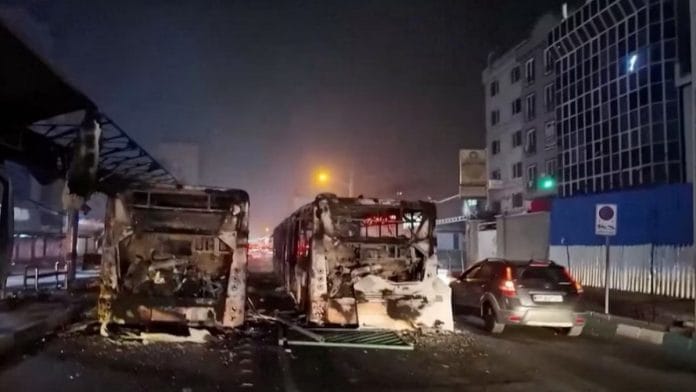



Iran has been witnessing a grassroots revolt for quite some time now. The present turmoil is the culmination of a simmering discontent. To dismiss it as an anti-government protest prompted merely by economic distress, or as agitation by power-hungry mobs instigated by foreign agencies, would be a serious error of judgement and an insult to the freedom warriors on the streets of Tehran and other Iranian cities. Several mosques that blared the Ayatollah’s teachings and enforced moral policing have been burned down by protesters, who have also made bonfires of the mandatory hijab and other imposed Islamic symbols. There is hardly any news of shops and malls being looted. The protests are clearly against the repressive Islamic regime.
The three-weeks-old protests have turned violent, with the Ayatollah’s Islamic Revolutionary Guard Corps (IRGC) cracking down with force. While Iran’s foreign minister, Abbas Araghchi, claims that “the situation has come under total control”, the regime seems to be on its last leg. Though protests are not new in Iran, this time the uprising has spread all over the country. The reprisal too has been disproportionate and severe, with unconfirmed reports of thousands of unarmed protesters killed, and large numbers of security personnel dead or injured. The fact that internet connections have been down for more than a week signals the seriousness of the situation.
The unrest has also drawn strong reactions from outside powers, especially America.
US President Donald Trump has warned Iran of serious consequences and urged protesters to keep fighting, promising that “help is on the way”. But for unarmed protesters fighting a repressive government armed to the teeth for three weeks, it’s no guarantee. Tehran’s warning that protesters will be handed the death penalty is not an empty threat; such punishments have been carried out in the past. The Iranian regime has also warned of attacks on American and Israeli bases in the region, along with other retaliatory measures, if American forces strike Iran.
In this ambiguous situation, the only certainty is the continuation of protests and a massive reprisal by the regime in Tehran, leading to a prolonged period of instability and disruption in the Indian Ocean. Nearly one-fourth of the global oil trade passes through the Strait of Hormuz.
In a closely interconnected world and a contiguous Asia, developments in Iran cannot remain confined to its geography, especially when its economy, oil trade, military capabilities, and nuclear ambitions are deeply interlinked with regional powers and emerging economies, including China, Russia, and India. New Delhi, therefore, cannot look the other way. It must act even if its options are limited.
Also Read: What the US did in Venezuela shows the world is still at the mercy of brute power
US regime change calculus, India’s opening
As of now, the US seems to be recalibrating its military options, which might, if they materialise at all, be limited to air strikes rather than putting American boots on Iranian soil. After its failure in Afghanistan, the Pentagon is unlikely to risk a direct military operation, thus leaving open two other covert possibilities for intervention.
One is to engineer a regime change, like in Syria. The other is to negotiate for accommodating Reza Pahlavi, the exiled crown prince and son of the deposed Shah of Iran. Neither of these options is easy.
The change of regime in Syria was not through a popular uprising but an orchestrated process in which the Bashar al-Assad regime was brought down and Hayat Tahrir al-Sham (HTS), an offshoot of Al Qaeda, seized power. HTS is now enforcing Sharia law, targeting minorities, and silencing dissent. Assad’s refusal to allow a US-backed Qatar-Turkey pipeline through Syria, while favouring a rival Iran-Russia proposal, was also a factor in the strategic calculus. Unlike Syria, however, Iran has no armed groups that can be easily mobilised as proxies for American forces. Negotiations to accommodate Reza Pahlavi, too, appear a near-impossible proposition.
Regime change in Iran would not be an end in itself. Through it, both the US and Israel would also be looking to weaken Palestinian outfits such as Hamas and Palestinian Islamic Jihad (PIJ), the Yemen-based Houthis, and Lebanon’s Hezbollah, which are part of Iran’s so-called ‘Axis of Resistance’, supported by the Quds Force of the IRGC. Of course, going by the revival of the Taliban in Afghanistan and Al Qaeda-linked groups in Syria, it is doubtful whether such organisations can ever be fully defanged.
However, should a regime change be effected, Washington and Tel Aviv would ask the new establishment to shelve Iran’s nuclear programme. In such a scenario, India should demand a similar shelving of nuclear projects by another rogue state—Pakistan.
Reactions from other powers would vary. While China has invested heavily in Iran, it would likely prefer to wait for the outcome of the protests and resist regime change, especially if a pro-American Reza Pahlavi is air-dropped into Tehran. Russia, too, would not welcome regime change in Iran, especially after setbacks in Afghanistan and Syria. But the possibility of a Moscow-Tehran camaraderie under a Pahlavi-led dispensation cannot be ruled out.
Also Read: A quarter century in revolt: Iran’s wave of uprisings, from Bloody November to Mahsa Amini
What India should do now
New Delhi should realise that an unstable Iran, or a pro-American regime in Tehran, coupled with Islamabad tilting totally toward the US, is not in India’s interest, especially at a time when bridges are being built with Kabul. The India-Middle East Economic Corridor (IMEC) could be delayed further. Operations at the Chabahar port may be stalled, while the International North-South Transport Corridor (INSTC) and the proposed Chabahar-Central Asia rail link, which would give landlocked Central Asian countries access to the Indian Ocean, could also face delays or be temporarily shelved.
While American, Chinese, and Russian involvement would pull Iran in different directions, India can intervene and help diffuse the situation as a first step to reconciliation and a return to normalcy.
Iran is a member of the 23-country Indian Ocean Rim Association (IORA), which became an observer to the UN General Assembly and the African Union in 2015, mainly focusing on trade and maritime cooperation. India, as the present chair, can call an urgent meeting and initiate dialogue between the Iranian regime and the protesters, with both sides urged to refrain from violence.
India can also call for the immediate deployment of a UN peacekeeping force in Iran, as Tehran risks turning into a killing field under a repressive theocratic regime. While this is a complex mechanism in the present geopolitical climate, there cannot be a repeat of the lethargy and political indecision that led to UN inaction during the 1994 Rwanda genocide. In any case, neither the world nor India can keep twiddling thumbs any longer.
Seshadri Chari is the former editor of ‘Organiser’. He tweets @seshadrichari. Views are personal.
(Edited by Asavari Singh)
In which world you live.Assadist committed war crimes and even state terrorism against syrian sunni populations.Also, supported terrorist groups like houthis,hezbollah,fathimiyoun and zainabiyyoun brigade.And syria revolution was a populist one,and started by free syrian army.But what can one expect from raafidi terrorist sympathising sanghi extremist.