









Imagine if India were to regulate capital raising for its businesses like this. An entrepreneur raises overseas funding after months of effort. The government gives them a licence to receive that capital—for five years. At the end of that period, the entrepreneur wishes to bootstrap their business, and not raise capital. At this point, the State may step in, take control of their assets, run their business, eventually sell those assets and transfer the proceeds to the Consolidated Fund of India. Absurd? This is precisely how India will regulate its civil society organisations if the amendments to the Foreign Contribution Regulation Act 2010 tabled last month in the Lok Sabha are passed as is.
The FCRA is a law governing foreign grants, donations and endowments—all called “contribution”—to Indian non-profits. Since 2014, the FCRA has been amended three times—twice through Finance Acts and once through a comprehensive amendment in 2020—each progressively tightening the regulatory grip on civil society organisations. Late last month, the Home Minister tabled yet more amendments to the FCRA. The latest FCRA Amendment Bill marks a shift from regulating capital to controlling assets.
More stringent than an emergency-era law
To understand how we got here, it is worth revisiting the FCRA’s origins in 2010. The FCRA’s predecessor law—the Foreign Contribution (Regulation) Act 1976, enacted during the Emergency—was primarily a political control statute. Its focus was narrow: To prevent foreign influence over elections, the press, and organisations deemed political in nature.
By the late 2000s, the number of non-profits had grown significantly, and foreign flows had increased. The FCRA was introduced in this backdrop, also shaped by heightened security concerns following the Mumbai attacks. But the 2010 law effectively converted a one-time registration requirement into a license-cum-surveillance regime. Registration became time-bound—valid for five years—introducing a recurring point of State discretion. Compliance became continuous rather than episodic: Annual filings, strict reporting, tighter eligibility conditions, and expanded grounds for suspension and cancellation. The 2010 law made its Emergency-era predecessor look almost permissive.
Three sets of amendments introduced since 2014 have steadily tightened the screws. Under these amendments, the end-use restrictions were tightened, limiting how organisations could deploy funds. The ability to transfer foreign contributions to other organisations was severely restricted, disrupting collaborative models within civil society. Banking requirements were centralised, mandating a designated account structure that increased friction in fund flows. Identification and disclosure norms for office bearers became more stringent. It was clear that the government wanted to vet every single dollar that came to a FCRA-registered non-profit.
Also read: Govt control has weakened Indian consumers by taking away their right to sue
From regulation to asset expropriation
As per MHA data, as of February 2024, 20,721 FCRA registrations have been cancelled since 2012. Half of these were in 2015 alone, and the remaining half scattered across the last decade. Now, under the original 2010 framework, the cancellation of an FCRA-registration had consequences for foreign funds, and, to an extent, for assets created out of them. Non-renewal of a license had none.
The 2026 amendment changes this fundamentally. It introduces a new concept—“cessation”—where a licence that is not renewed is deemed to have lapsed in law. The amendments propose a detailed framework under which the assets of such non-renewed organisations automatically vest in a government-designated authority. Thus, assets of not only those organisations whose registration is cancelled, but also those who choose not to renew their registration, will automatically vest in the government. This puts the non-profit organisation in a Catch-22: if it chooses to renew its license, it subjects itself to continuous State surveillance, and if it chooses not to renew its license, it loses its assets. The State may then manage the assets, transfer them to public bodies, or sell them and credit the proceeds to the Consolidated Fund of India.
Also read: India’s love-hate relationship with foreign capital holds it back. What Budget 2026 hints at
The enforcement chronology
When this is juxtaposed with recent FCRA enforcement trends, the design becomes clear. Data on this is not officially published, but is scattered across sporadic government press releases and replies to questions in the Parliament (Table). Pulling these together, over the last decade, the system has already shifted toward non-renewals as the primary regulatory tool. This is because non-renewal is administratively simpler, and less adversarial.
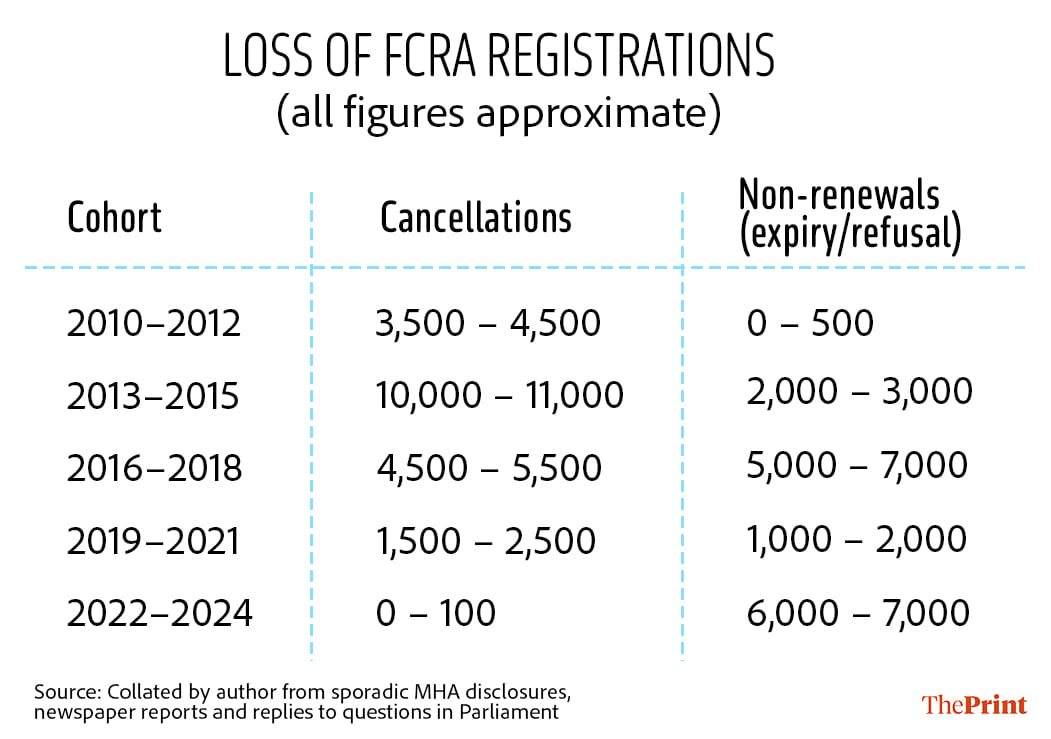
The 2026 FCRA Amendment Bill effectively weaponises that trend. What was once a passive administrative outcome—failure to renew—now triggers active State control over assets.
The problem becomes sharper when one considers the nature of assets. Money is fungible. An organisation may build a school, a hospital, or a research institution using a mix of foreign and domestic funds. The amendment permits the State to vest the entire asset—even if only partly funded by foreign contributions. There is no minimum threshold for this vesting to take place. Indeed, while “vesting” is the language used in the statute, in substance, this is expropriation. This raises a serious property rights concern. Article 300A of the Indian constitution permits deprivation of property only by authority of law—but the question here is proportionality. When money is fungible, can the State legitimately appropriate an entire asset just because a portion of its funding was foreign?
Also read: India must allow citizens to invest beyond its borders. It’s risk management, not luxury
Clipped a sector’s wings
The 2010 Act was enacted in the shadow of India’s most serious security challenges, including the Mumbai attacks. A tighter regulatory framework for foreign funding was perhaps politically inevitable. But over time, successive amendments have gone well beyond addressing security concerns. They have constrained civil society organisations’ ability to access capital, operate flexibly, and scale their activities. In financial terms, they have clipped the sector’s wings.
There is a broader economic question that is often ignored in this debate. India remains a lower middle-income country with significant gaps in State capacity. Public delivery systems—whether in health, education, or social protection—are uneven and often overstretched. In such a context, foreign philanthropic capital supplements scarce public resources. Concerns around law and order or anxieties over religious conversion must be weighed against the developmental reality that the State cannot, on its own, meet the scale of India’s needs. A regulatory framework that systematically deters such capital weakens precisely those institutions that fill these gaps.
The 2026 amendment to the FCRA is the straw that will break the camel’s back. It does not just regulate inflows or usage of funds—it creates a credible risk that non-profits’ assets themselves may be taken over. That changes incentives in a fundamental way. Foreign capital will be deterred. That is the stated goal. But so, increasingly, will domestic philanthropic capital. At that point, the question is no longer about regulation. It is about whether the system still permits a meaningful, independent civil society to exist. We would not tolerate our entrepreneurs being treated this way. Why would we tolerate our civil society organisations being treated as such?
Bhargavi Zaveri-Shah is the co-founder and CEO of The Professeer. She tweets @bhargavizaveri. Views are personal.
(Edited by Theres Sudeep)