






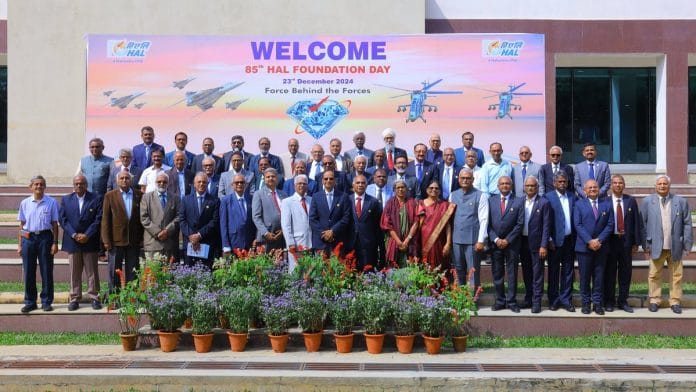



India’s defence preparedness today rests heavily on the shoulders of Hindustan Aeronautics Limited. With an order book running into lakhs of crores and the Armed Forces pressing for timely deliveries, the government’s decision to restructure HAL is not just welcome, it has now become imperative.
I have followed HAL’s journey from close quarters, and I know how deeply the organisation’s fortunes are tied to the nation’s ability to secure its skies. Having observed earlier reform efforts, including the Chaturvedi Committee, I witnessed how good intentions were diluted into cosmetic changes. This time, the restructuring must go beyond appearances. HAL now stands at a decisive moment, either embracing reform with seriousness or risk being left behind in the race for modernisation.
Lessons from the Chaturvedi Committee
This is not HAL’s first brush with reform. In October 2011, the government set up an Expert Group under BK Chaturvedi, then Member of the Planning Commission, to review HAL’s organisational structure.
The committee submitted its report in September 2012, offering 38 recommendations, of which 34 were accepted.
I had the opportunity to observe the committee’s work closely and even accompany team members during some of their visits. That experience offered me rare insight into how the committee functioned and the kind of changes it sought to introduce. While the intent was to strengthen HAL, many of the recommendations proved cosmetic.
The most debated was board restructuring. Managing Directors of HAL complexes were redesignated as Chief Executive Officers but excluded from the Board, weakening decision-making.
The CEOs were, however, assured of perks equivalent to those of Directors in order to placate them. These perks, revised from time to time “as deemed fit” included entitlements for vehicles, accommodation, and other benefits during and after service, much to the chagrin of other executives.
The newly created Director (Operations) role had limited authority, largely confined to marketing and corporate planning. As one Director joked to me, he had “nothing concrete to operate.” In fact, earlier the same functions were handled under the Director (Corporate Planning and Marketing). The title was rechristened.
Another proposal, the creation of an Aerospace University, was ambitious but impractical. HAL lacked the mandate and expertise to run a university. The idea fizzled, although HAL has its own management academy in Bengaluru, which is underutilised despite significant investment.
I have visited this academy a number of times and seen its impressive infrastructure, but its achievements remain modest. Reforming this academy should be a priority for the new consultants. They must review how this academy can be restructured to deliver genuine value whether through partnerships with universities, specialised aerospace courses, or leadership training tailored to HAL’s needs.
The current programmes designed for HALites have not produced significant results. On the other hand, the Post Graduate Diploma in Management (PGDM) offered to external candidates has attracted very few takers, largely because HAL cannot guarantee placements and prospective students do not find the course worthwhile.
Also read: Critics aren’t HAL’s enemy—hubris is. And it’s hurting India’s defence readiness
Outsourcing: A rare success
One genuine success of the Chaturvedi Committee was its push for outsourcing. HAL now collaborates extensively with private industry, from large firms to MSMEs.
Take the case of Tejas. In the Tejas Mk1A programme, fuselage sections, wings, and assemblies are outsourced, enabling faster production. With over 180 Tejas Mk1A aircraft to be delivered to the Indian Air Force, outsourcing has become critical to meeting timelines.
I noticed during my interactions within HAL that outsourcing has not only accelerated production but also created a healthier ecosystem of suppliers. This is one area where the committee deserves credit. Yet, the deeper cultural shift envisioned such as moving HAL away from rigid PSU practices never fully materialised. The company remains bound by public sector guidelines, limiting flexibility. This cannot change unless some new clauses are brought in.
The current restructuring drive
The new restructuring exercise, led by reputed consultants, is expected to address HAL’s most pressing challenges—clearing its massive backlog and accelerating deliveries.
Proposals being discussed include splitting HAL into separate entities for fixed-wing aircraft, helicopters, and MRO services, integrating R&D centres more closely with DRDO and ADA to strengthen indigenous design. The formation of strategic business units (SBUs) is important though this may be cumbersome in a PSU framework.
Equally critical is the shift from labour-intensive operations to automation-driven production. This transition, though necessary, will be contentious given HAL’s large workforce and entrenched culture.
Financial complexities, shareholding patterns, market capitalisation, and PSU governance adds further challenges. Unlike the Ordnance Factory Boards, HAL’s divisions work in close cohesion, making structural separation difficult without disrupting synergy.
Also read: India’s AMCA is a chance to break HAL’s monopoly and finally build an aerospace ecosystem
Human resources: The weak link
Among HAL’s non-technical departments, Human Resources remains the most inconsistent. I have seen promotion policies tweaked frequently, leading to anomalies—executives promoted just months before retirement, or uneven residual service requirements.
The result is a bloated pool of Executive Directors, a relatively new development since promotions now occur every six months instead of annually. Deciding where to place them with complete independent responsibility remains a challenge, especially as General Managers too must be accommodated as heads of departments. Eyebrows were raised when one ED was moved out of his core area and relegated to a small department at the Corporate Office.
A few years ago, I had come across a situation where HR had two General Managers, one Executive Director, and the Director (HR) all sitting in the Corporate Office at the same time! Many other senior HR officers were reporting to them in turn.
The departmental matrix in several HAL offices—for example, the Company Secretariat—shows a skewed ratio of officers to non‑officers. The argument of organisational prerogative, rights, and necessities fails to carry conviction in such scenarios. Consultants will need to address this imbalance as part of the restructuring exercise.
The Department of Public Enterprises has largely stayed silent, but uniform HR policies across Maharatna companies with some variables are overdue. Without fairness and transparency, morale inevitably suffers and talented executives risk being side-lined. I have personally witnessed how some of the best-qualified officers remain demoralised, while others benefit from policy manipulations.
This is just one aspect of HR. There are many other areas like yearly transfers, integration of departments, consolidation of manpower to avoid duplication of the work etc. In the case of HAL, the proposed restructuring exercise offers a fresh opportunity to iron out these troubling issues.
Underutilised talent and worker dynamics
HAL invests heavily in training engineers abroad and at premier institutions like IITs and IIMs but they are underutilised. I have met bright engineers who returned from Cranfield in the UK or from courses in France, only to be placed in administrative roles or in areas which had nothing much to do with their training.
They are sometimes forcefully transferred but generally have no qualms in taking such roles as these roles in high offices come with extra perks like travel, power and assured promotions.
Let the new consultancy suggest that such brilliant officers spend time on shop floors, research areas and work toward technology-driven solutions, which HAL platforms badly need.
The permanent workers on the other hand wield significant bargaining power over overtime, transfers, and entitlements. Meeting year-end targets ultimately vindicates their claims calling for customary celebrations. However, the success is not only because of permanent employees, the credit must go to outsourcing and contract workers. I noticed that contract staff, paid far less, often fill critical gaps efficiently, while permanent employees could contribute much more. HR needs to figure out how to balance the demands of all employees against their work.
Also read: New HAL CMD doesn’t have to be an ‘insider’. Let merit decide
Collaborative fabric between divisions
The restructuring exercise will also have to balance efficiency with continuity. HAL’s divisions work in close cohesion, and splitting them into separate entities risks disrupting synergy. Consultants must ensure that reforms strengthen HAL without eroding the collaborative fabric that binds its complexes and divisions.
The road ahead
HAL’s future hinges on whether restructuring delivers genuine agility, sharper technological focus, and a complete HR overhaul. HAL’s marketing and customer services departments long used to dealing with captive customers like the Indian Armed Forces need a revolutionary approach to bring in new customers and realise much talked about export potential of HAL products. The consultancy firm’s recommendations will be closely scrutinised, as India’s defence preparedness depends on HAL evolving into a technology‑driven aerospace powerhouse. The hope is that this exercise avoids the shortcomings of the Chaturvedi Committee Report of 2012, which promised much but achieved little
Ultimately, what is at stake is not just HAL’s future, but India’s ability to secure its skies. Having observed HAL’s journey from close quarters, I believe the company has the talent, infrastructure, and legacy to succeed. But success will depend on whether the restructuring is pursued with seriousness, transparency, and a willingness to break free from outdated practices. I have seen how reforms can falter when they are cosmetic; I now hope to see HAL rise to the challenge with genuine transformation.
Gopal Sutar is ex-spokesperson HAL and media analyst, SABIC/ARAMCO. Views are personal.
(Edited by Theres Sudeep)
‘Cheap and best’ mentality of socialist India is hurting our defence industry. Our goods are of no match to Western goods.